You wake from it uncertain which wedding you attended. Sometimes you were the bride, radiant and terrified in the same instant; sometimes you only watched from the pews, unable to say whose day it was. And often, just before waking, the scene tilts — the flowers still there, the music still playing, but something funereal moves under the surface, as if the ceremony were also a burial no one has named aloud. That doubleness is the truest report the dream gives: not a happy announcement but a joining, two things that were apart being forced into one. The dictionary reflex — new beginning, commitment, a part of yourself finally embraced — answers the word and misses the image. The only useful questions are what is being married to what, and what the union costs.
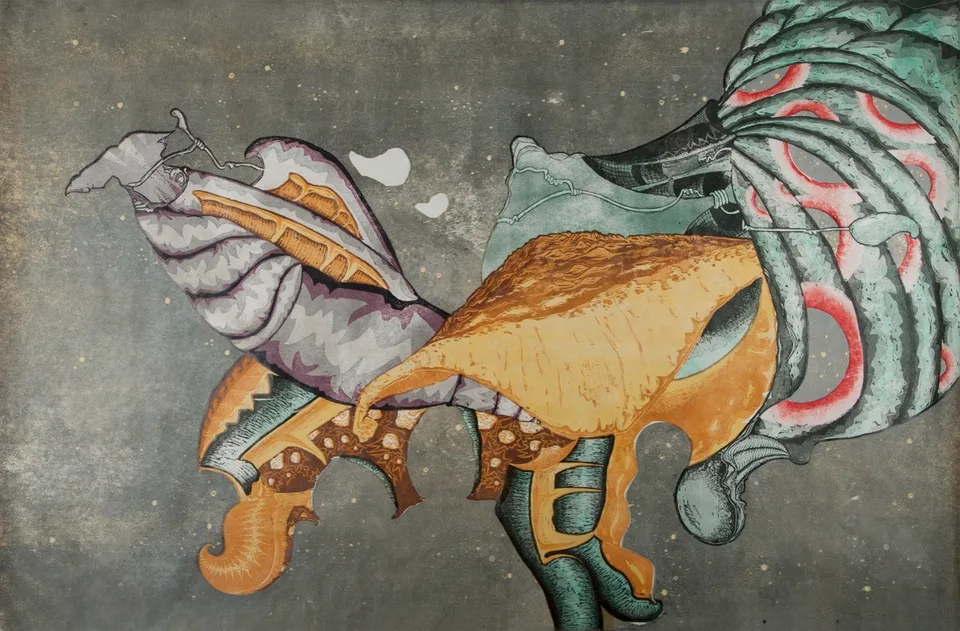
Depth psychology has a precise name for this image: the coniunctio, the conjunction of opposites. Jung found it at the very center of the alchemists’ work and insisted it could not be reduced to wish or sentiment. “If symbols mean anything at all,” he wrote, “they are tendencies which pursue a definite but not yet recognizable goal” (Jung, Mysterium Coniunctionis, 1955). The wedding is not arrival but tendency — the psyche reaching toward a wholeness it cannot yet see. Andrew Samuels notes that Jung took the coniunctio so seriously he made it the model for transformation itself, the alchemical marriage standing as “a precursor of his own analytical psychology and particularly his concept of the individuation process” (Samuels, The Plural Psyche, 1989).
What makes the image hard is that the marriage is not painless. Edward Edinger, reading a woman’s dream of two chemists laboring over a vessel while she and her lover lie together to “supply the energy” for the work, draws out the cost: “To hold opposites simultaneously is to experience paralysis amounting to a veritable crucifixion” (Edinger, Anatomy of the Psyche, 1985). He reaches, as the alchemists did, for Augustine’s startling image of Christ as bridegroom — who “came to the marriage bed of the cross, and there, in mounting it,” consummated his union with the world. The wedding and the wound are the same gesture. To be joined to what you have kept separate is to be undone by it.
The Greeks knew the wedding as a meeting of powers larger than the couple. Émile Benveniste finds the prototype in the gods themselves — Zeus and Hera “united by the hieròs gámos, the sacred marriage” — and notes that beneath the official version lies an older memory in which “the great goddess is the wife of the great god,” the woman’s role primary, not secondary (Benveniste, Indo-European Language and Society, 1973). Walter Burkert traces how this sacred marriage hovers at “the secret climax of a festival,” the union of Sky Father and Earth Mother enacted when “Zeus and Hera unite at the summit of Mount Ida, veiled in a golden cloud from which glistening drops fall to the earth” (Burkert, Greek Religion, 1977). A wedding in this register is fertility and danger at once — the meeting of heaven and earth in a single charged moment.
And here the image turns its darker face. The wedding in dream so often carries a chill because the rite of marriage and the rite of death were, in the oldest tradition, nearly the same ceremony. Margaret Alexiou documents how the laments sung for a bride leaving her father’s house were “closest to the laments for the dead in structure and form,” sharing “the solemn ablutions of bride and bridegroom, the anointing with nuptial oils and perfumes, the elaborate dressing, the wearing of the marriage garland and the use of torches” — so close that the young dead were dressed in wedding attire, “death and marriage” held to be “fundamentally similar occasions, signalling the transition from one state to another” (Alexiou, The Ritual Lament in Greek Tradition, 1974). To be married is to leave one life entirely. Something has to die for the union to take place.
Marie-Louise von Franz finds the same equation written into the mystical tradition. “In the Cabala,” she observes, “death is described as a mystic marriage”; at the burial of Rabbi Simeon ben Yochai a voice cried, “Up and come to the marriage of Rabbi Simeon.” She reads the recurring motif plainly: “the unconscious psyche often represents death as a union of opposites, as the achievement of an inner wholeness” (von Franz, Aurora Consurgens, 1966). The dream-wedding that frightens you may not be foretelling loss so much as naming the price of completion — the old, partial self that must be relinquished so that something whole can be born.
So the wedding dream is not the announcement of happiness, and it is not the warning the dictionaries make of a “fear of commitment.” It is the psyche staging a conjunction: an inner marriage of what has been split — masculine and feminine, conscious and unconscious, the part of you that lives in the world and the part kept hidden in the vessel. Burkert noticed that in myth the wedding festival itself often followed the sacrifice, the union arriving only after something had been given up. The question the image asks is not whether you will find love. It is whether you are willing to let two things you have held apart become one — knowing the joining is a death and a birth in the same breath, and that the figure waiting at the altar, veiled, is some lost half of yourself.