The dream dictionaries answer before you have finished asking: a kiss means love, means desire, means a relationship on your mind. It flatters the obvious and stops there. But a kiss is not one gesture. There is the kiss you give and the kiss you receive; the kiss longed for across a distance and the kiss that betrays; the kiss of a stranger, of someone forbidden, of someone already dead. The older traditions do not read the kiss as a verdict about romance. They read it as an exchange at the threshold of the mouth — a passage where breath, soul, and desire cross from one being into another — and the only useful questions are what is passing, in which direction, and whether you are giving life or taking it.
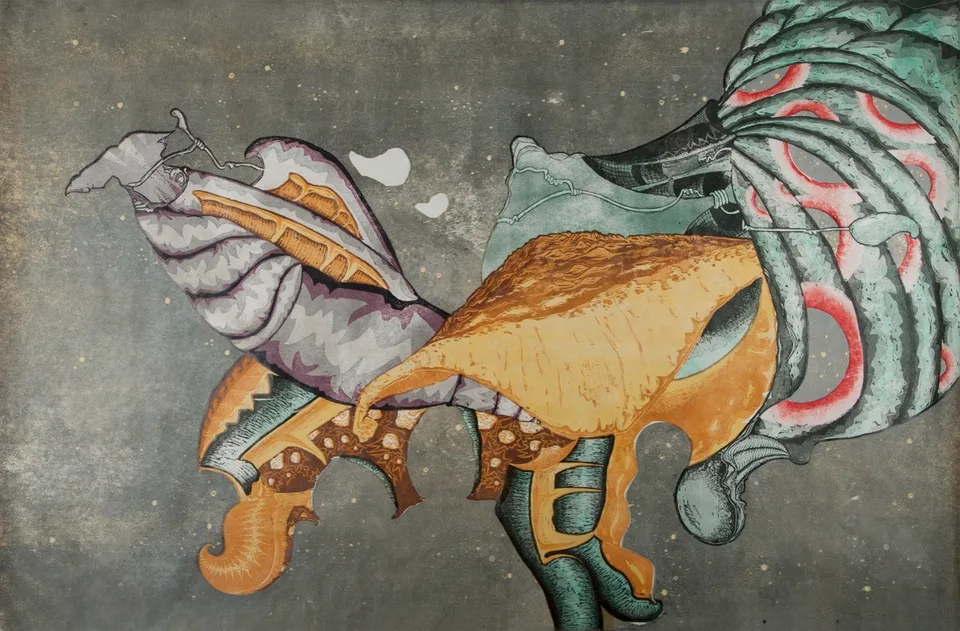
Begin with what the mouth was for. For the Greeks the soul itself moved through it. Bruno Snell finds that in Homer “psyche is the force which keeps the human being alive,” the thing that “forsakes man at the moment of death” and “flutters about in Hades” (Snell, The Discovery of the Mind, 1953). The soul is breath, and breath leaves by the mouth. This is why the kiss could be more than affection. R. B. Onians documents the ancient deathbed rite of catching the last breath lip to lip: “the ‘last kiss’ is virtually inspiration,” the next of kin pressing his mouth to the dying man’s “to inhale the parting soul at the moment of quitting the body” (Onians, The Origins of European Thought, 1988). A kiss, at the limit, is a transfer of soul.
The lovers’ kiss carried the same charge. Onians records Bion’s dirge for Adonis, where Aphrodite begs a kiss from her dying beloved that lasts “until from your soul your breath flow into my mouth” (Onians, The Origins of European Thought, 1988). To kiss is to breathe the other in — and to risk being breathed out. So if the dream kiss feels less like pleasure than like something being drawn from you, or poured into you, the tradition would say you have read it rightly. That is what a kiss does.
The alchemists made this literal exchange the heart of their work. Marie-Louise von Franz, reading the Aurora Consurgens, finds Wisdom’s love-song to the soul rising to its climax in exactly this image: “from whose kiss I receive the breath of life, in whose loving embrace my whole body is lost” (von Franz, Aurora Consurgens, 1966). Here the kiss is the coniunctio — the union of opposites in which the self is both undone and renewed. Edward Edinger describes that union as “both releasing and burdensome,” the moment when one stops being “thrown back and forth between the opposites” and learns at last to hold them “side-by-side” (Edinger, Anatomy of the Psyche, 1985). A kiss in a dream may be picturing not a person but a reconciliation: two halves of you, long at war, finally touching mouths.
But not every kiss unites, and the tradition is honest about the kiss that wounds. The governing myth is Eros and Psyche, and its turning point is a kiss withdrawn. Donald Kalsched retells the moment the lamp’s oil betrays the sleeping god: “Leaping from the couch, his secret now betrayed, Eros tore himself from Psyche’s kisses and flew away with never a word” (Kalsched, The Inner World of Trauma, 1996). The kiss here is the thing lost — interrupted at the instant of intimacy, punished for the wish to see clearly. A dream of a kiss that breaks off, or a beloved who vanishes mid-embrace, belongs to this lineage. It is not failure; it is the wound that begins the soul’s long search.
That wounding is built into desire itself. Anne Carson, anatomizing the Greek word for love as “sweetbitter,” shows that eros names “’want,’ ‘lack,’ ‘desire for that which is missing’”: “the lover wants what he does not have,” and “it is by definition impossible for him to have what he wants if, as soon as it is had, it is no longer wanting” (Carson, Eros the Bittersweet, 1986). The kiss is the perfect emblem of this paradox — the closing of a distance that, once closed, dissolves the very longing that reached for it. Carson finds the same doubleness wherever the Greeks looked: on the wall of Troy, love and hate “converge within erotic desire,” an irresistible enemy made of both at once. The dream kiss that arrives charged with dread as much as wanting is not confused. It is telling the truth about eros.
And the soul that risks the kiss is not safe. James Hillman, reading the same Eros-and-Psyche tale, insists that “love that leads to psyche is not bound by human concerns”; it “comes into life as a grace,” but the iconographic record shows “the psyche is tortured by love” — Psyche weeping, bound, her wings burned (Hillman, A Blue Fire, 1989). The kiss that opens the soul also exposes it. To be kissed in a dream is to be made permeable, and permeability cuts both ways.
So the question the kiss asks is never simply who. It is what is crossing the threshold of your mouth, and whether you are ready for the crossing. Is this the deathbed kiss that gathers a soul before it scatters, or the lovers’ kiss that breathes one self into another? Is it the coniunctio in which the warring opposites are at last reconciled, or Psyche’s kiss torn away at the moment of seeing? The image holds its mouth open between communion and loss. Either way the dream is not congratulating you on a crush. It is asking whether you will let something pass — soul, breath, the thing you most lack — and become, by that exchange, someone slightly other than you were.