The dream dictionaries reach for the obvious: you are avoiding something, you feel guilty, you are afraid to be seen. The image is read as evasion and closed in a sentence. But hiding is not one act. There is the child who crawls under the bed, and the fugitive who flees; the thing you conceal and the self that hides from you; the cupboard you are crammed into and the secret you guard so well you have forgotten its contents. The tradition does not treat hiding as a synonym for shame. It treats it as a structure — something kept out of sight precisely because it matters — and the only useful questions are who is hiding, what is being concealed, and whether what is hidden is being protected or being kept alive.
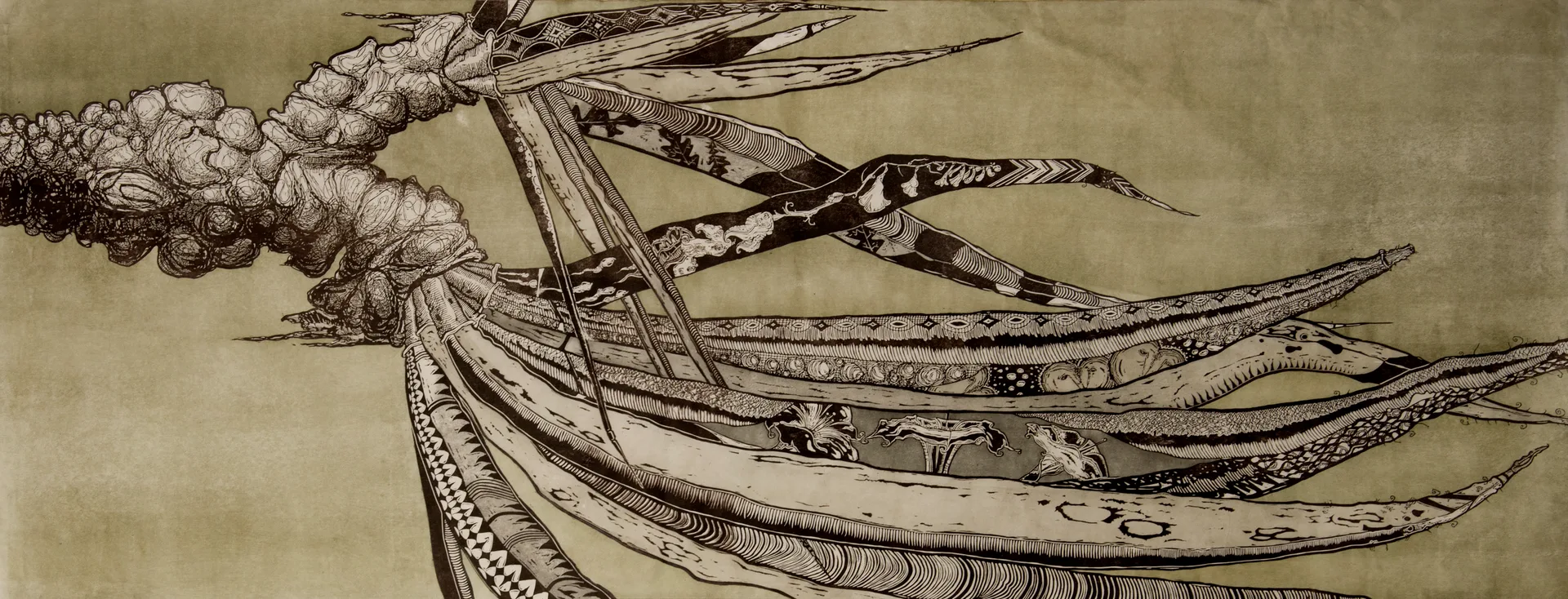
Begin with the figure who hides. Murray Stein, mapping Jung’s psyche, describes the shadow as the one who lives out of the light: persona and shadow are “like two brothers (for a man) or sisters (for a woman); one is out in public, and the other is hidden away and reclusive” (Stein, Jung’s Map of the Soul, 1998). What the dreaming ego rejects does not vanish; it withdraws and waits. The persona itself, Stein notes, is a mask whose job is “both to conceal and to reveal” — so that to hide in a dream may be to glimpse the one you have spent waking life concealing.
But why hide at all? Jung, brooding on the alchemical mysteries, located something deeper than the content beneath the secrecy. The thing concealed, he writes, “is always more or less irrelevant”; what matters is the gesture. “The essential thing is the hiding, an expressive gesture which symbolizes something unconscious and ‘not to be named’ lying behind it” (Jung, Mysterium Coniunctionis, 1955). Hiding, on this reading, is not the absence of meaning but its index. The dream conceals a thing to point at a thing — to mark a content that “exacts from consciousness a tribute of constant regard.”
The Greeks built a whole cosmos on this intuition. Their underworld was, etymologically, the realm of the unseen. Ruth Padel records that the Greeks related Hades to “a-idein (‘to not-see’), a-ides (‘unseen’)” — the dead go not to torment but to invisibility, to the place that cannot be looked at (Padel, In and Out of the Mind, 1994). And there was a technology for it. R. B. Onians traces the “Helmet of Hades,” the dogskin bonnet that “rendered him upon whom it was placed invisible,” explaining the very name of the god as “the Unseen One” (Onians, The Origins of European Thought, 1988). To put on the cap of Hades is to step out of the visible world entirely — a god’s privilege, and a fearsome one. To hide, in the old imagination, is to draw near death’s own darkness, to be wrapped in the cloud that “cannot be seen by the ordinary person outside.”
Depth psychology inherits both the terror and the necessity. Donald Kalsched, reading Winnicott, finds the most consequential hiding of all in the wounded child. Where early care fails, a “false self” forms over the wound, “hiding the still omnipotent, but now traumatized true self as its shameful secret” (Kalsched, The Inner World of Trauma, 1996). At the extreme, Kalsched continues, “the true self is completely hidden, even from the false self” — concealed so thoroughly the person no longer knows what they are protecting. This is hiding as survival, not cowardice. The self goes underground so that something can live.
And the dream gives this hiding a landscape. Kalsched notes, after Steiner, that such inner retreats appear in dreams as literal “places” — “caves, fortresses, or islands” — sanctuaries within which a fugitive part of the personality “can hide, avoiding anxiety and pain” (Kalsched, Trauma and the Soul, 2013). The hiding place is double-edged: it saves and it isolates. Steiner watched patients “emerge with great caution like a snail coming out of its shell and retreat once more if contact leads to pain.” The cave keeps the child alive and keeps the child captive. Both are true at once.
So which is your dream? That depends on what waits to be found. The mystical traditions insist that concealment is never the last word, only the first move of a revelation. Henry Corbin, reading Ibn ‘Arabi, describes a divine Imagination that “can reveal the Hidden only by continuing to veil it.” The veil is not the enemy of seeing; it is the condition of it. The veil “can become so opaque as to imprison us,” Corbin writes, or “increasingly transparent” — until what was hidden shows itself as it is (Corbin, Alone with the Alone, 1969). The hidden thing was never meant to stay hidden. It was waiting to be approached with the right kind of attention.
This is the turn the image works toward. The dream of hiding is not a verdict on your timidity, and it is not telling you to come out with your hands up. It is asking what you have buried, and why, and whether the time has come to go down and look. The one crouched in the dark may be a guilty thing avoiding the light — or it may be the truest part of you, sealed in its cave precisely because it was too precious to risk. The cap of Hades comes off. The veil thins. The dream is not asking whether you have something to hide. It is asking whether you are finally ready to find it.