The dream dictionaries reach for helplessness first: you feel controlled, someone in your waking life has power over you, you are a victim of circumstance. It is a reading that hears only the terror and none of the grammar. But the dream of being seized and carried off is one of the oldest images the Western imagination possesses, and the tradition does not file it under helplessness. It files it under abduction — a word with a precise and terrible shape. Something breaks in from below, takes hold of you against your will, and carries you down. The dictionaries treat this as a problem to be solved. The tradition treats it as a threshold, and it is remarkably specific about where the threshold leads.
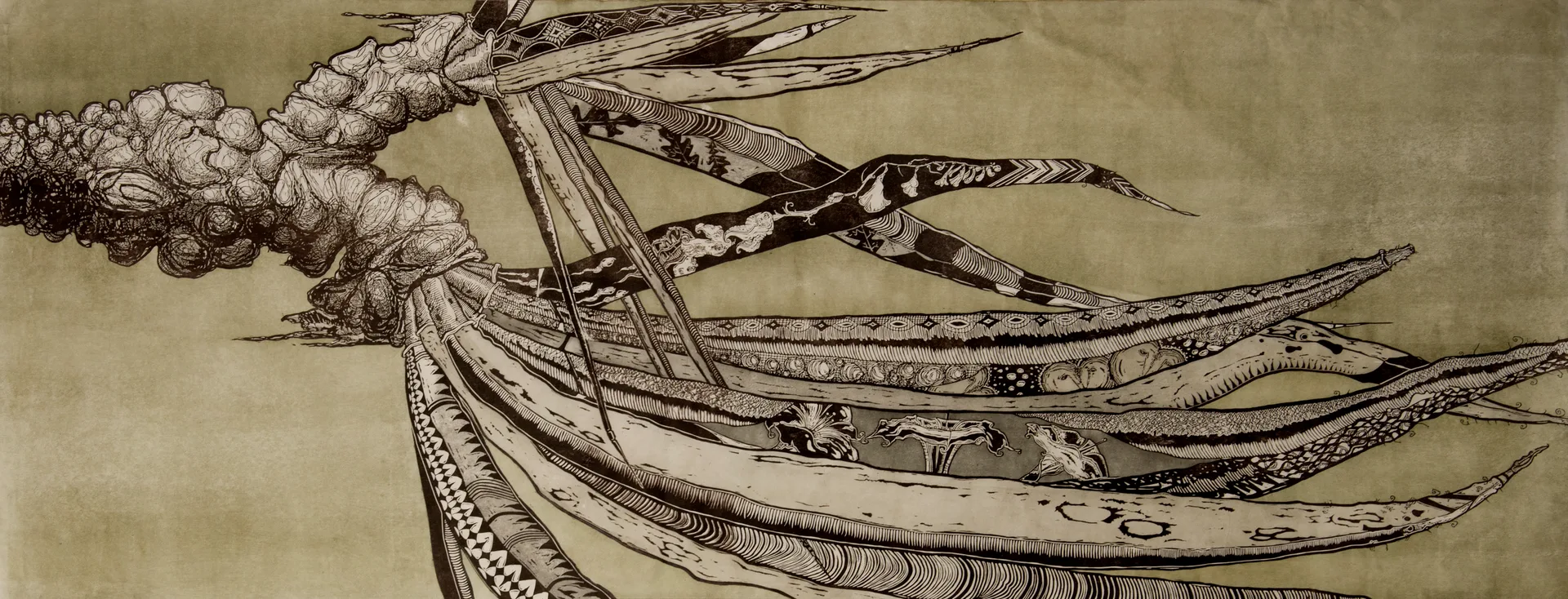
Begin with what the image is actually doing. It is not merely being frightened; it is being taken. The founding version is Persephone’s, and Joseph Campbell tells it in its bare, unsentimental sequence: the maiden was playing in a meadow, culling flowers, when she spied a glorious plant “which had been sent up expressly to seduce her by the goddess Earth (Gaia), at the behest of Hades, the lord of the underworld. So that when she hurried to pluck its flowers the earth gaped and a great god appeared in a chariot of gold, who carried her down into his abyss despite her cries” (Campbell, Primitive Mythology (The Masks of God, Volume I), 1959). Every element of the kidnapping dream is already here: the ordinary moment, the flower that is a lure, the ground that opens without warning, the cries that go unheard, the carrying-down. The abducted one did nothing wrong. Agency is not lost in the dream; it was already overridden before the dream began.
What matters is that the tradition refuses to read this seizure as simple catastrophe. The Greeks, who lived nearest the image, understood divine abduction as a compound event — not only violence but transport, not only death but a strange preservation. Gregory Nagy, surveying the Homeric and Hesiodic language of being snatched away, finds that “the divine abduction of mortals by gusts of wind (thuellai or harpuiai) entails not only preservation but also sex and death” (Nagy, The Best of the Achaeans: Concepts of the Hero in Archaic Greek Poetry, 1979). To be carried off is to be plunged into “the earth-encircling river Okeanos,” which Nagy names as “one of the prime mythical boundaries that serve to delimit light from darkness, life from death, wakefulness from sleep, consciousness from unconsciousness.” The kidnapping dream sets you on that boundary. You are taken across the line that separates the waking mind from what lies underneath it, and the crossing does not ask your permission because permission is not what the image is about.
This is why the abduction is inseparable, in the myth, from the making of the maiden. C. G. Jung and Carl Kerényi read Persephone as a figure who “embodies these connexions as two forms of being each carried to extremes and balanced against one another,” where “one of the forms (mother and daughter) is life; the other (young girl and husband) is death” (Jung and Kerényi, Essays on a Science of Mythology: The Myth of the Divine Child and the Mysteries of Eleusis, 1949). They use the brutal mythic language without softening it, even saying the violation is “in her nature to happen.” That sentence has to stay in its symbolic register: it is not permission, not consolation, and not a denial of harm. It names a pattern in which the protected maiden-world breaks apart because it already carried “the seeds of its own destruction.” The dream of being seized is the psyche staging exactly this — the safe, enclosed, protected self broken open so that something the enclosure could never contain can enter.
Erich Neumann pushes this further, into the paradox at the center of the whole motif. Reading the Eleusinian mysteries, which re-enacted precisely this abduction, he insists that the violence is only half of what is happening. “Rape, victimization, downfall as a girl, death, and sacrifice stand at the center of these events,” he writes — and yet “Kore is not merely overcome by the male; her adventure is in the profoundest sense a self-sacrifice, a being-given-to-womanhood, to the Great Goddess as the female self” (Neumann, The Great Mother: An Analysis of the Archetype, 1955). This is the hinge the dictionaries miss entirely. The image carries two truths at once: real overpowering, and a transformation the ego could not have arranged. The dream does not make the violence good. It shows the soul trying to think an experience of being overrun by something larger than choice.
The mysteries built an entire initiation on this reversal. Anne Baring describes how the Eleusinian initiates “suffered the terrors of death as a condition of initiation,” passing through darkness where “Eleusis celebrates with torches the abduction of the daughter and the sorrowful wanderings of the mother” (Baring, The Myth of the Goddess: Evolution of an Image, 1991). The word for the goal, she notes, is telos, “from which the word teleo, ‘to initiate’, was derived.” To be initiated is to be brought to an end — one’s own end — and out the other side. The abduction dream rehearses this: it is the seizure that begins a passage, the being-taken that is also a being-brought.
And the tradition is honest that this passage is not gentle. There is a kinder descent, the one led by a guide rather than a captor. Chiara Tozzi records a therapeutic approach that offers “a different and more benevolent kind of descent into that nether realm, unlike the myth of Persephone and her abduction by Hades into the underworld,” where the guide “takes more of Hermes’ role as that of psychopomp” so that one is “being guided to rather than abducted to the underworld” (Tozzi, Active Imagination in Theory, Practice and Training, 2017). The distinction is exact. Some descents are walked into with a companion. The kidnapping dream is the other kind — the descent that comes for you, that you do not walk into but are carried down into, before you understand what is happening. Liz Greene and Howard Sasportas find the same seizure inside every threshold of the life-cycle, reading Persephone’s abduction “as an analogy for what happens during adolescence,” where “you die as a child and are reborn a young adult” (Greene and Sasportas, The Development of Personality: Seminars in Psychological Astrology, Volume 1, 1987). The little girl “under the protective embrace of her mother” is taken, and cannot go back.
So when the dream seizes you and carries you off, do not ask only who is controlling you. Ask what enclosure has just been broken open, and what could only appear once that enclosure failed. Ask whether the ground opened under a life that had grown too sealed, too much the maiden in the meadow, to change by persuasion alone. The image withholds the reassurance that you will be returned whole; Persephone rose again, but as queen of the dead, marked and doubled, never only a daughter again. It offers instead the oldest knowledge the motif carries: some descents arrive by force in the image, and the work after such a dream is not to excuse the seizure but to ask what threshold it has exposed.