Hector stands “rooted to the spot” before the Skaian gates. Alkathoos can “neither flee nor escape”: he stands “like a pillar or a tall tree” and is struck through the chest. R. B. Onians, tracing the archaic vocabulary, shows that Homer’s word for this fixing is one of fettering and shackling — a literal cord of fate thrown over a man, fastened from outside the victim and against his will (Onians, The Origins of European Thought, 1988).
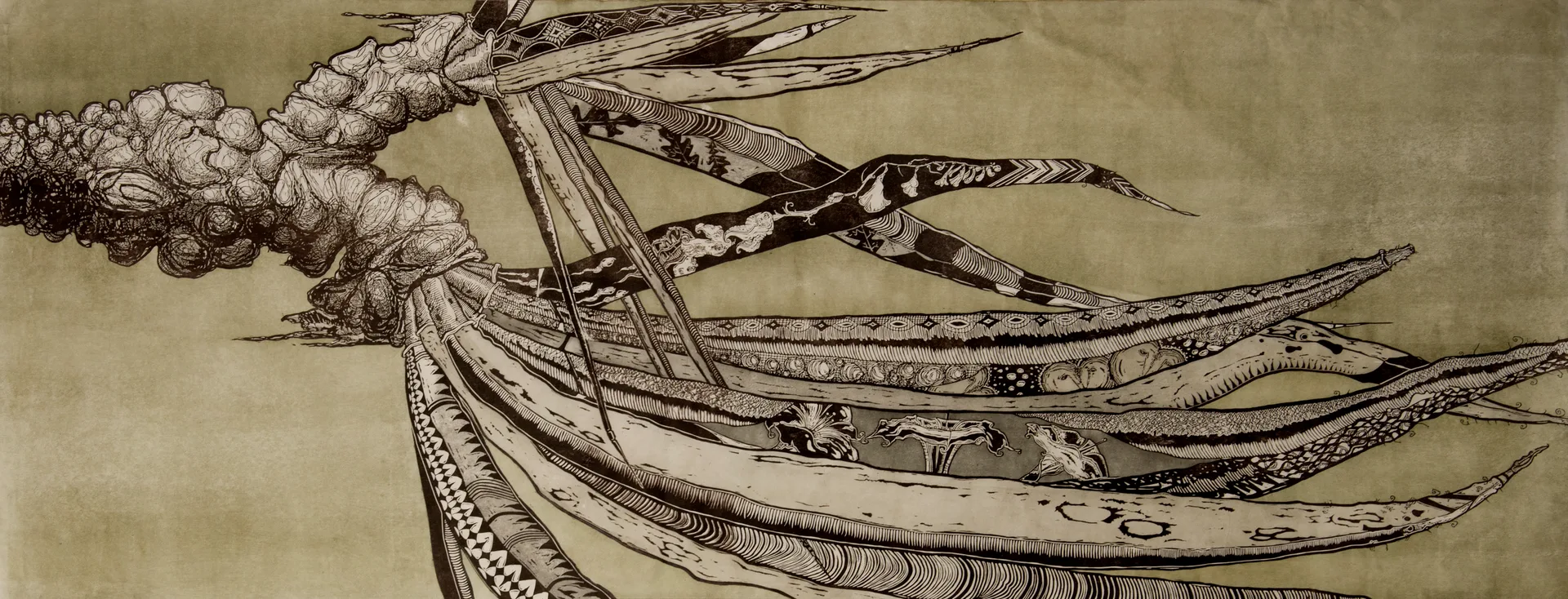
This is the oldest picture of the dream in which the legs will not answer, and a stranger one than the dream dictionaries print: stuck, trapped in waking life, the dream repeating it back. That reading is not wrong so much as incurious — it treats the paralysis as a message to be decoded and set aside, when the paralysis is the event itself. Very different bodies of thought keep returning the harder verdict: this is not a failure of nerve but something done to you. The body is bound, because something with more authority than your intention has decided you will stay. The question is not why you froze but what has thrown the cord, and what the binding is trying to accomplish.
E. R. Dodds names the power behind that binding. In the world that produced Greek tragedy, the irrational seizure that overtakes a person was felt as the work of a daemon — an agent of ate, of ruin — and what is striking is how external it felt. These impulses, Dodds writes, are “not truly part of the self, since they are not within man’s conscious control; they are endowed with a life and energy of their own, and so can force a man, as it were from the outside, into conduct foreign to him” (Dodds, The Greeks and the Irrational, 1951). He describes “powerful forces in whose grip mankind is helpless.” The frozen dreamer stands inside precisely that grip. Ruth Padel sharpens the grammar of it: in tragedy the verbs of madness are passive, and the language “comes down more heavily in favour of madness caused from outside” — you are “hit and struck,” skewed “aside,” held by “daemonic persecution” (Padel, Whom Gods Destroy, 1995). To be unable to move is to have been seized by something that does not come willingly to terms with you.
Carry that intuition into the modern interior and it does not dissolve; it acquires a mechanism. Jung’s earliest experimental work found the same foreign hand operating inside ordinary people. In the association experiment he watched a stimulus word touch a buried complex and saw the subject become “altogether unable to produce a reaction, although he may be unaware that the complex is independent of his intentions” (Jung, Experimental Researches, 1904). The complex, he concluded, possesses “autonomy” — it is “relatively independent of the central control of consciousness, and at any moment liable to bend or cross the intentions of the individual,” like “revolting vassals in an empire.” Marion Woodman gives the everyday form of this: a complex “behaves like an animated foreign body in the sphere of consciousness,” and “puts us momentarily under a spell of compulsive thinking and acting” (Woodman, The Owl Was a Baker’s Daughter, 1980). The dream in which you cannot run is the spell made visible. The will gives its command and a vassal countermands it. You meet, in your own legs, a sovereignty that is not yours.
Where this image becomes most literal — and most merciful — is in the body itself. Peter Levine takes the freeze out of the realm of cowardice entirely. When an organism faces “overwhelming mortal danger, with little or no chance for escape,” he writes, “the biological response is a global one of paralysis and shutdown” — the ethologists’ tonic immobility — and “humans experience this frozen state as helpless terror and panic” (Levine, In an Unspoken Voice, 2010). It is not a perception or a trick of the imagination. As he puts it elsewhere, “The body cannot move. This is abject helplessness — a sense of paralysis so profound that the person cannot scream, move, or feel” (Levine, Waking the Tiger, 1997). Crucially, the immobility is the nervous system’s emergency brake: confronted with energy it cannot discharge, “it applies a brake so powerful that the entire organism shuts down on the spot.” His patient Nancy’s body, pinned by masked figures, “wanted to run away and escape, but it could not.” That is the dream verbatim — the body that wanted to run and was held down — surfacing in sleep because the freeze was never finished, never discharged. Pat Ogden adds the further floor beneath the freeze: a collapsed “feigned death,” where “muscles go limp, eyes look glazed,” the senses dull, and pain itself recedes — “a complex pattern of surrender” the whole animal kingdom carries (Ogden, Trauma and the Body, 2006). The dreamer who cannot even feel the danger pressing in has dropped through freeze into that older surrender.
Donald Kalsched is the one who joins the Greek seizure and the bodily brake back into a single figure. What looks like helpless paralysis, he argues, is the work of an inner self-care system — an “archaic and typical dyadic structure” that, “in an ironical twist of psychical life,” generates the very images meant to defend the self and turns them malevolent and imprisoning (Kalsched, The Inner World of Trauma, 1996). The traumatized child is split, and “the regressed part of the personality” is locked away in what he calls an “imprisoning sanctuary,” guarded by a daimonic figure that protects by paralyzing — keeping a vital seed alive precisely by “cutting it off from life in this world” (Kalsched, Trauma and the Soul, 2013). This is why the dream of not-running can feel almost guarded, as if the freeze itself were a sentry. The immobility is not only the trap; it is the jailer that once saved you, still standing watch over a part of you it has not yet been told it can release.
So the image refuses to resolve into “you feel stuck.” It says, rather, that you are gripped — by a fate-cord, by a daemon, by an autonomous complex, by a survival brake that locked and never let go — and every one of these traditions reads the grip not as a verdict but as an unfinished act. Onians’ bond is meant to be loosed. Levine’s brake is meant to release into trembling and movement. Kalsched’s jailer is a guardian who has outlived the danger and does not yet know it. The frozen dream is the held energy of an escape that was interrupted, knocking to be allowed, at last, to complete itself. The legs are not asking why they failed. They are waiting, in the dark, for the hand to lift — for permission to finally run.