The dream dictionaries hear the word and reach for stress: you are “at war” with a coworker, a deadline, your own bad habits; the battlefield is just your overloaded life. It is a reading that registers the noise and never asks who the combatants are. A dream of war is not a busy week in costume. It is the psyche staging an actual battle — a front, two sides, a conflict that cannot end in a shrug — and the tradition is old and unusually specific about who is really fighting, and why the fight so rarely looks like what it is.
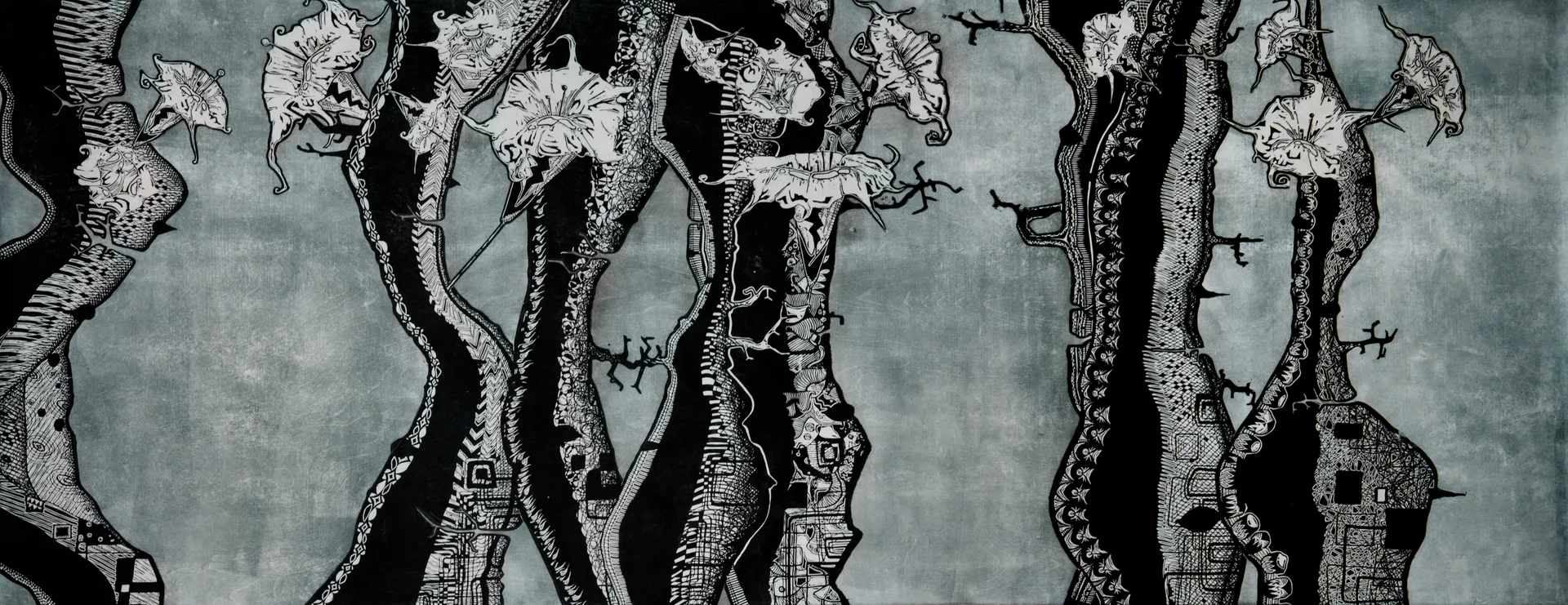
Begin with the first correction the tradition makes, because it overturns the obvious reading. The enemy is almost never foreign. Llewellyn Vaughan-Lee, writing where Sufism meets Jungian psychology, states it plainly: “When myths describe physical battles, these are only images of an inner struggle. The greatest battle is to do battle with oneself” (Vaughan-Lee, Catching the Thread: Sufism, Dreamwork, and Jungian Psychology, 1992). The seeker who follows the war inward, he writes, “finds that his enemy is in his own heart.” The dream musters armies and draws a line across a field, but the line runs through the dreamer.
What makes the enemy look foreign is a single mechanism, and the depth tradition names it exactly: projection. “The power of projection,” Vaughan-Lee continues, “is that we do not need to acknowledge our own faults, to look our darkness in the face.” The disowned part does not vanish when it is refused; it puts on a uniform and appears across the valley, armed and hostile and — crucially — not-me. Jung watched this happen in the politics of his own century. “The problem of the shadow plays a great role in all political conflicts,” he wrote, describing a dreamer who, had he not reckoned with his own darkness, “could easily have identified” his inner adversaries with the “dangerous Communists” or the “grasping capitalists” of the outer world — and so “avoided seeing that he had within him such warring elements” (Jung, Man and His Symbols, 1964). The war-dream is the theatre where the ego’s refused material marches back as an army.
The Christian ascetics knew this inner war centuries before it had a psychology, and they described its most unnerving feature — that it comes without warning. The desert anthology The Philokalia calls it noetic warfare, the war of the mind, and marks how it differs from the visible kind: “noetic warfare lacks one feature possessed by visible warfare: declaration of hostilities. Suddenly, with no warning, the enemy attacks the inmost heart, sets an ambush there” (The Philokalia, Volume 4, 1995). This is the phenomenology of the war-dream precisely — no diplomacy, no build-up, the front simply there, the ambush already sprung. What the monks called the passions and the analysts call the shadow attack from inside the walls.
And the tradition is honest that the battle, once joined, is punishing. To turn and face the disowned self is not to win cleanly; it is to be torn. Vaughan-Lee describes the confrontation with the shadow as something that “at first brings conflict between the ego and the shadow, and the individual is thrown, often violently, between the two,” so that one “experiences an inner battlefield as opposing aspects of oneself fight it out” (Vaughan-Lee, 1992). The dream of war can be the felt image of exactly this — a self that has lost its single command and become a contested country, each side demanding the ground.
There is a collective layer too, and it is the darkest. Erich Neumann argued that whole cultures do to the world what the individual does to a rival: they load their unowned aggression onto an enemy and go to war to be rid of it. When the old scapegoat rituals — the ones that once served, in his phrase, “to redeem the collective from its shadow problem” — have lost their force, there remains “an urgent and redoubled need for the collective to liberate itself from the aggressive drives which have accumulated within” it (Neumann, Depth Psychology and a New Ethic, 1949). The nation, like the dreamer, finds a face to hang its darkness on. A war-dream can carry this weight — the sense of being conscripted into a conflict larger than any personal quarrel, the private psyche caught in the machinery of a collective projection.
None of this counsels surrender, and none of it counsels victory. Edward Whitmont, working out the ethics of the shadow, insists that the disowned side cannot simply be defeated and buried; it “has to have its place of legitimate expression somehow, sometime, somewhere,” and the real task is to choose “when, how and where” (Whitmont, The Symbolic Quest: Basic Concepts of Analytical Psychology, 1969). A war won by annihilation only drives the enemy underground to rearm. What the dream is working toward is harder than a rout: a negotiated peace that gives the adversary a country to live in.
So when the dream sounds the war, do not ask only how to win it. Ask who the enemy is — what it wears, what it wants, what it accuses you of — and then ask the question the tradition keeps returning to: what does it carry that is yours, that you have refused to carry yourself? The battle ends not when one side is destroyed but when the field is finally recognized as a single country, and the two armies as one divided people. The dream does not tell you the war is over. It shows you the front, and waits to see whether you will cross it.