No older tradition ever mistook a staircase for a career. Before the stair became a measure of success, it was the one structure that joins two worlds, and the traditions that honored it cared less about the fate of the climb than about whether the joining would hold. The dreamer who wakes from a crumbling staircase and goes looking for its meaning is handed a much smaller inheritance: the stair as career ladder, the collapse as goals slipping, progress destabilized, fear that the climb will fail. But a staircase is not a metaphor for ambition, and its crumbling is not one feeling. There is the step that gives way beneath the foot and the whole flight that dissolves below you; the stair that fails as you climb and the one that fails as you try to descend; the slow erosion and the sudden drop into nothing. Each is a different dream, and every one of them puts the older question first: what happens when the structure joining your worlds can no longer be trusted to hold?
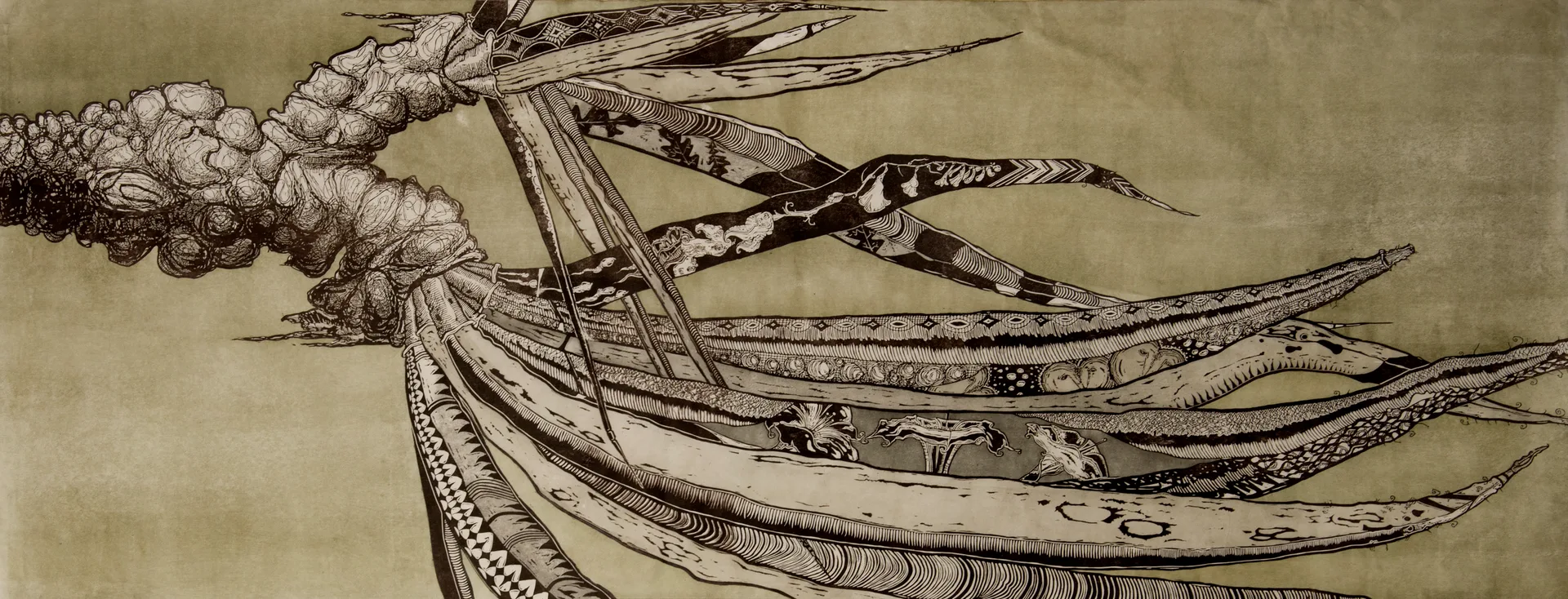
Begin with what a stair is for. Mircea Eliade, surveying the religions of the world, found the ladder and the staircase everywhere doing a single work: they are the body’s oldest image of the bridge between the levels of being. “Communication between heaven and earth,” he writes, “can be brought about … by some physical means (rainbow, bridge, stairs, ladder, vine, cord …)” — every one of them “merely variants of the World Tree or the axis mundi” (Eliade, Shamanism: Archaic Techniques of Ecstasy, 1951). The stair is the axis. To dream it crumbling is to dream the axis itself in question.
That axis runs in two directions, and this is where the dream divides. Edward Edinger, reading the alchemists, recovers the Hasidic saying that “Man is a ladder placed on the earth and the top of it touches heaven” — the soul itself stretched as a stair, every rung a stage of ascent toward what the alchemists called the sublimatio, the rising and refining of spirit (Edinger, Anatomy of the Psyche, 1985). When the climbing stair crumbles, this is the image undone: the upward refinement loses its footing, the elevation it promised cannot bear weight. But Eliade is careful to note that the same ladder “facilitates the gods’ descent to earth” as readily as the soul’s rise. The stair that fails as you go down is a different wound entirely — the path back into the body, into ordinary ground, into incarnation, that will not hold you.
And the descent is the older, harder direction. Walter Burkert traces the Greek imagination of katabasis, the going-down: Kore is carried beneath the earth, and though she is fetched back in the anodos, the return, the myth refuses to call it a cycle. “Things will never be the same as they were before,” he writes; what the descent founds is a permanent doubleness, so that “a dimension of death is introduced into life, and a dimension of life is introduced into death” (Burkert, Greek Religion, 1977). The crumbling stair belongs to this knowledge. It is the moment in the descent where you cannot go back up the way you came. The structure that brought you down is gone behind you, and you are changed by the going.
Why should the psyche build the failing structure as stairs and not simply as falling? Because the stair is architecture, and architecture is the self’s own masonry. Gaston Bachelard, building his poetics of the house on Jung, quotes the image directly: the mind is a building whose “upper story … was erected in the nineteenth century; the ground floor dates from the sixteenth century,” and beneath it “Roman foundation walls, and under the cellar a filled-in cave” — story stacked on buried story, a vertical history of the self (Bachelard, The Poetics of Space, 1958). The staircase is what lets you move between those floors. When it crumbles, the levels of the psyche lose their connective tissue; the conscious upper rooms are severed from the old foundations below. Bachelard even names the dread that follows, in Nerval’s line about beings whose “towers have been destroyed.” The crumbling stair is that ruin caught at the instant of breaking — not the tower already fallen, but the structure dissolving while you still stand on it.
There is also the body, which does not theorize the collapse but simply suffers it. Pat Ogden, working with trauma in the flesh, describes how shock makes us “lose our ground,” disrupting “the foundational base of security from which we draw support.” We say, she notes, that such moments have “knocked us off our feet” (Ogden, Sensorimotor Psychotherapy, 2015). The crumbling staircase is exactly this in dream-form: the literal floor of the self giving way, the foundational base failing underfoot, the grounded support that should hold a body upright suddenly absent. The dream is not abstract. It is the nervous system rendering, in stone and gravity, the felt loss of solid ground.
So the questions the image actually asks are not will I fail. They are: which way were you traveling on the stair — climbing toward something refined, or descending toward something buried — and what is it that can no longer carry you in that direction? The crumbling staircase is the axis mundi under strain, the connective structure between your levels giving way, the old route between upper and lower self breaking precisely where you stood on it. That is frightening, and it is not only loss. Burkert’s descent does not restore the world to what it was; it founds a deeper one. The dream is not telling you to rebuild the stair and climb again as before. It is telling you the old structure between your levels has reached the end of what it can bear — and asking whether you are willing to find the ground a different way down.