One moment the box is doing exactly what it was built to do — steel and counterweights carrying you safely between floors — and the next the cable is gone, the stomach lifts, and you are awake before you land. Waiting there, already, is the dictionary’s verdict: control lost, career collapsing, support giving way. It is a strange fate for the most modern image the dreaming mind has taken up, the one machine engineered so that no one need fall, to be flattened back into a single word, anxiety. But the falling elevator is not one image, and it is not really about the machine. There is the drop that comes all at once and the sinking that goes floor by floor; the descent you ride alone in a lit box and the one where the floor simply dissolves. The tradition never asks whether you fear losing control. It asks what is giving way beneath you, which direction the fall is taking, and what is waiting at the bottom of the shaft.
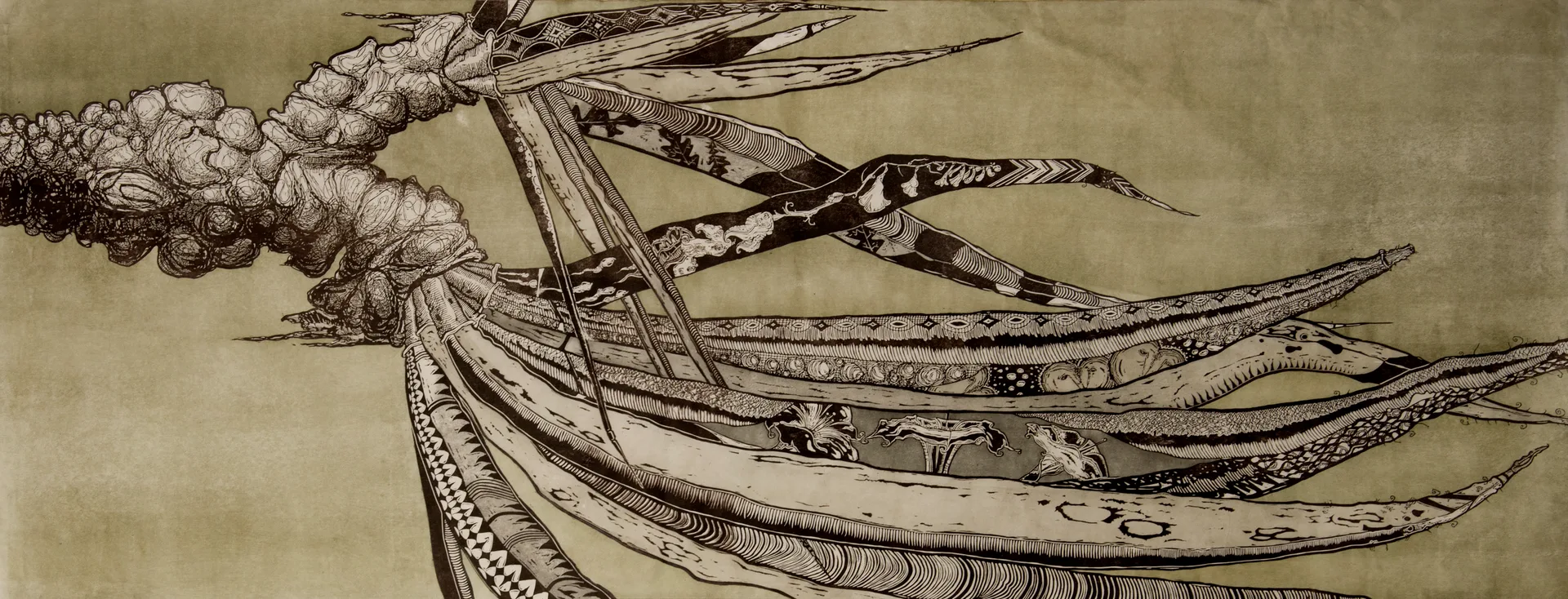
Begin with the floor itself. Robert Bosnak describes the moment a fixed structure in the psyche begins to come apart and notes that such change “makes one feel as if solid ground were being pulled out from under one’s feet” (Bosnak, A Little Course in Dreams, 1986). The elements that had “appeared in the foreground as fixed structures of the soul’s life” rot away to make room for new ones, and the process is frightening precisely because “something is dying off.” That is the elevator exactly: the platform you stood on without thinking, the engineered certainty that you would arrive, suddenly in free fall. The dream is not reporting your fear. It is showing you a structure dissolving.
Marie-Louise von Franz watched this in a dreamer who was “slowly falling into the big split within the earth,” past stars seen below him and fields seen as if from an airplane (von Franz, Puer Aeternus, 1970). What she fixes on is the strangeness of the speed: the man “continues to fall slowly in the same place” — “that means that he is falling and not falling; it is a dream paradox.” The slow elevator-drop is this paradox made mechanical. And the slowness matters. In a parallel case she compares the descending psyche to an aircraft “too high up” that “has to land slowly to avoid a crash,” and insists the dreamer “cannot be pushed too much” toward the ground (von Franz, The Problem of the Puer Aeternus, 1970). A controlled descent is not the same as a crash. The elevator that lowers you, even in terror, may be doing the gentler work of bringing you down.
The Greeks heard descent as something that falls on a person from outside. Ruth Padel traces the word at the root of ruin, atē, to exactly this motion — a disastrous folly that “falls huge, difficult” upon the mind, sent by the Erinyes onto a person’s phrenes (Padel, Whom Gods Destroy, 1995). For Homer’s Agamemnon it is not a metaphor for poor judgment; atē is dispatched into him and he drops. The falling elevator carries this older grammar. It is the dream of being taken down, of a descent arriving rather than chosen — and the Greeks did not read such a fall as mere accident but as something fated, weighted, addressed to you in particular.
Depth psychology inherits this and gives the descent a purpose. The alchemists called the going-down into blackness the mortificatio, and Edward Edinger reads it as the necessary death of an over-sure ego: the ego “is eventually eclipsed — falls into the blackness of mortificatio — but from its death the ‘child of the philosophers’ — the Philosophers’ Stone — is born” (Edinger, Anatomy of the Psyche, 1985). The whole logic of the work depends on it. As Lyndy Abraham records of the blackening, the adepts held “that there could be no regeneration without corruption,” that “nature could only be renewed after first dying away” (Abraham, A Dictionary of Alchemical Imagery, 1998). Mircea Eliade traces this same pattern back through the ancient mysteries, where the whole point was “the transmutation of man”: by an experience of “initiatory death and resurrection, the initiate changed his mode of being,” and the blackest phase of the work, the nigredo, simply “symbolizes death” — the death that any rebirth must pass through (Eliade, The Forge and the Crucible, 1956). The elevator that plunges into the dark of the lowest level is, in this reading, not destroying you. It is the descent of an initiation, taking the part of you that thought it could not fall down to where it can finally be remade.
And then the body, which knows none of this and only drops. Peter Levine names the reflex precisely: when we sense danger “we duck, we dodge, we retract and stiffen,” and “when escape seems impossible, we freeze or fold into helpless collapse” (Levine, In an Unspoken Voice, 2010). The lurch awake, the stomach left behind, the limbs that will not catch you — this is the oldest defense rehearsing itself in sleep, the organism dropped into a fall it cannot fight or flee. The falling elevator can be the body’s own helplessness, dreamed.
So the question the dream presses is not whether you fear the loss of control — you do, and the dictionary already told you so. It is what is dissolving beneath you, and whether the fall is a crash or a descent. The same image holds the body’s collapse and the alchemist’s necessary blackening, the ruin that atē drops on a person and the slow landing that spares the aircraft. The elevator was built to spare you the descent. The dream has cut the cable on purpose. The only thing it asks is whether you are ready, this time, to go all the way down.