The foot goes down and nothing answers. Sometimes it is the slow grade where the car simply refuses to shed speed; sometimes the hill where it gathers more; sometimes the intersection rushing up while the pedal sinks all the way to the floor. The dream dictionaries answer before you have finished describing any of these: you feel out of control, you are afraid of losing your grip on your life, you cannot stop something you set in motion. The reading is not wrong so much as lazy — it restates the panic you already woke with and calls that an interpretation, and it flattens three different ways of not stopping into a single stock verdict. The dream itself is more precise. The will is still issuing its command; the body of the machine no longer obeys. The only useful questions are what, exactly, has stopped answering to you, and what is doing the driving in its place.
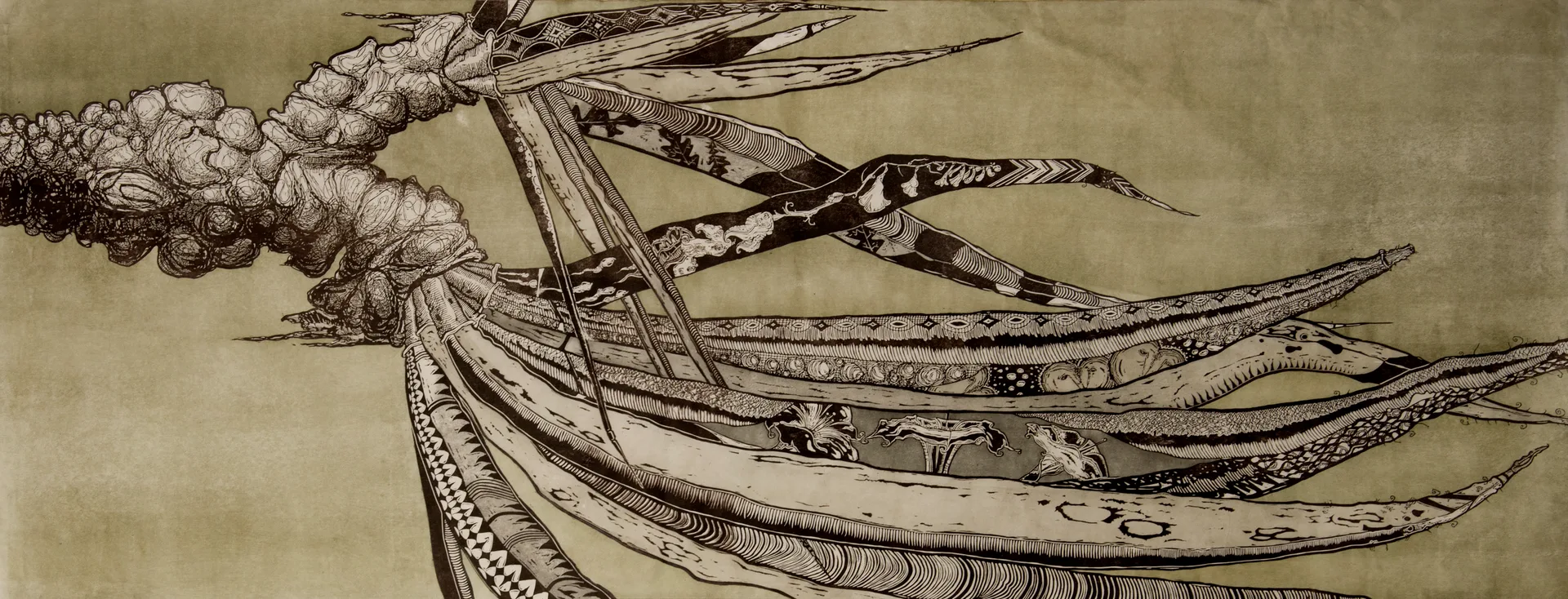
The oldest version of this image is not a car but a chariot, and it is already about the failure of control. Plato gives the soul as “a pair of winged horses and a charioteer,” and warns that for the human driver the two horses are mismatched — one noble, one base — so that “the driving of them of necessity gives a great deal of trouble to him” (Plato, Phaedrus, c. 370 BCE). The trouble is structural, not occasional. To be a soul at all, in this picture, is to hold reins over animals that do not finally belong to you. The brakes-failing dream is the moment the reins go slack.
The ancients did not treat that slackening as mere weakness of nerve; they built a whole psychology around it. Richard Sorabji traces how the Stoic inheritors read Plato’s figure: reason “has to master two horses,” one “concerned with victory and anger, one with the baser appetites,” and the emotional element of the soul is what is “controlling the animal’s impulse” until reason can take it back (Sorabji, Emotion and Peace of Mind, 2000). Notice what this makes of the failed brake. It is not that nothing is steering. It is that the steering has passed to the horses — to anger, to appetite, to the part of you that wants speed. The dream stages a coup inside the chariot.
Depth psychology renames the horses but keeps the structure exactly. Jung describes the state in which “the unconscious overtakes or ‘takes over’ the conscious mind”; the ego “has somehow got stuck, with the result that the unconscious takes over the forward-striving function, the process of transformation in time, and breaks the deadlock” (Jung, Symbols of Transformation, 1952). Read that against the dream and it inverts the panic. The terror is that you cannot stop. But Jung’s patient is someone who had stopped — who “wants to stop the turning wheel that rolls the years along,” who wants to hang on to childhood rather than move and change and die. Sometimes the failing brake is not the catastrophe. Sometimes the brake is the thing that was killing you, and the dream is what overrides it.
What takes the wheel has a name in this tradition. Edward Whitmont calls it the complex, and his clinical portrait reads like a transcript of the dream: a man “driving and taunting” himself toward the very situations that wreck him, who “did not know he was being driven” (Whitmont, The Symbolic Quest, 1969). Marie-Louise von Franz pushes the diagnosis to its root. When a person is possessed by a drive — by craving, by an idea, by anything that has captured the whole engine — “there is no freedom, but rather a certain automatism,” and “reactions become automatic and compulsive” (von Franz, Psyche and Matter, 2014). That is the dream’s mechanics translated into the language of the psyche: the pedal is the will, and the will has been disconnected from a motor now running on its own. Donald Kalsched lets Jung name the force behind it directly — “compulsion is the great mystery of human life,” an involuntary motive force ranging “all the way from mild interest to possession by a diabolical spirit” (Kalsched, The Inner World of Trauma, 1996). The brakes do not fail at random. Something in you wanted the speed, and it has stopped asking permission.
And then there is the body, which knows this image in its own tissue. Peter Levine, describing the physiology of overwhelm, reaches for precisely this dream without knowing it is one: “If hyperarousal is the nervous system’s accelerator, a sense of overwhelming helplessness is its brake.” In ordinary driving the two never fire at once. In a traumatic reaction “both brake and accelerator operate together,” the engine racing while the body locks (Levine, Waking the Tiger, 1997). This is the cruelest version of the dream and the most literal — not a brake that fails but a brake jammed down hard against a floored throttle, the whole organism roaring and frozen at once. If that is the dream you are having, it is not a parable about your discipline. It is your nervous system showing you, in the only language it has, the bind it is actually caught in.
So the failing brake is not one meaning but a hinge between several. It can be the spirited horse seizing the reins, the complex that drives you while you sleep, the will gone slack against a drive that no longer answers to it — or the body itself caught flooring two pedals at once. The image refuses to tell you which until you ask what is at the bottom of the hill. The dream is not, finally, an instruction to grip harder. It is asking a harder question: what have you been steering that was never yours to steer, and what would happen if you stopped pretending the wheel was in your hands.