Seba.Health
Key Takeaways
- Schore's 1994 work does not merely apply neuroscience to psychoanalysis; it provides the biological mechanism for the ego-Self axis that Neumann theorized and Edinger formalized, grounding the most speculative claim in analytical psychology — that the mother functions as the infant's Self — in measurable right-hemisphere orbitofrontal development.
- The book reframes affect regulation not as a clinical skill but as the foundational act of psychic structure-building, dissolving the boundary between Fairbairn's object relations, Winnicott's transitional space, and Jung's archetypal Self by locating them all in the same corticolimbic circuit.
- Schore's demonstration that the brain is a socially dependent organ eliminates the false dichotomy between intrapsychic and interpersonal models of the psyche, giving Kalsched's archetypal defense system a neurobiological substrate and Wiener's transference matrix a physiological reality.
The Mother Is Not a Metaphor for the Self — She Is the Neurobiological Mechanism Through Which the Self Incarnates
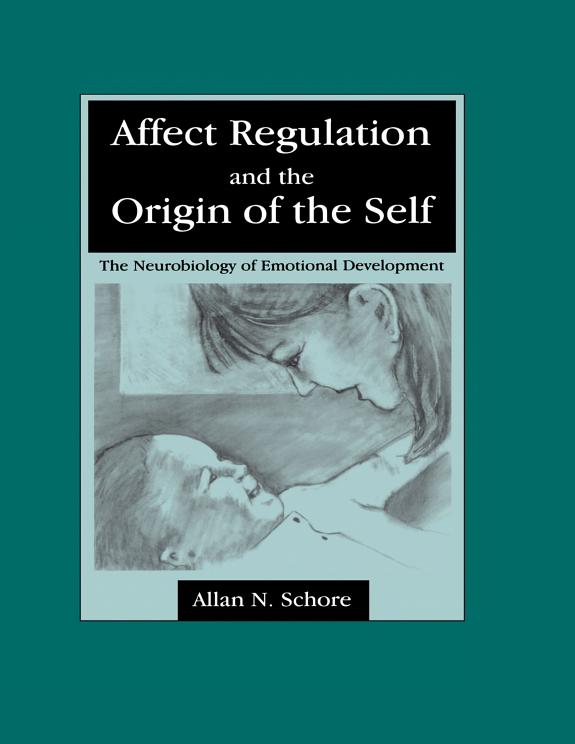
Allan Schore’s Affect Regulation and the Origin of the Self accomplishes something no prior work in depth psychology or psychoanalysis had done: it demonstrates, through an exhaustive synthesis of developmental neuroscience, that the infant’s right orbitofrontal cortex — the brain region responsible for affect regulation, attachment, and the emerging sense of self — is literally sculpted by the mother’s regulatory functions during the first two years of life. This is not analogy. The mother’s face, voice, and timing regulate the infant’s autonomic nervous system, and in doing so lay down the neural architecture that becomes the child’s capacity for self-regulation. Erich Neumann’s proposition that the mother serves as “carrier” of the child’s Self, and that “the development of the later ego-Self axis of the psyche and the communication and opposition between ego and Self are initiated by the relationship between mother as Self and the child as ego,” is here given a precise physiological address. Fordham objected that if the mother is the baby’s Self, there is no baby; Schore resolves this by showing that there is indeed a baby — an organism with a genetically primed but experience-dependent brain — whose selfhood emerges through, not despite, the mother’s regulatory mediation. The Self does not preexist in some completed archetypal form awaiting deintegration; it is assembled, synapse by synapse, in the dyadic regulatory field. Andrew Samuels recognized this convergence when he noted that “the centre of the personality, archetypal to its core, depends for its individual incarnation on the feeling experiences of infancy.” Schore provides the hardware for that statement.
Affect Regulation Is Not a Therapeutic Technique — It Is the Origin of Psychic Structure Itself
The radical implication of Schore’s synthesis is that what clinicians call “ego strength” is not an abstract capacity but a specific neurobiological achievement: the development of orbitofrontal circuits capable of modulating subcortical arousal. When Donald Kalsched describes how the traumatized child’s “mediational capacities that later become the ego are, at the beginning of life, totally vested in the maternal self-object who serves as a kind of external metabolizing organ for the infant’s experience,” he is narrating exactly the process Schore maps in neural terms. The mother’s empathic attunement to the infant’s arousal states — her capacity to sense agitation, comfort, and help name feeling-states — is the process by which subcortical affect finds cortical representation. Schore demonstrates that this is not a metaphor for containment but the actual mechanism of containment: the right hemisphere’s maturation depends on dyadic regulation in a critical period. When this regulation fails — through neglect, misattunement, or trauma — the orbitofrontal cortex does not develop adequate inhibitory connections to the amygdala and brainstem. The result is precisely what Kalsched describes as the continuation of archaic, unsymbolized affect: “volcanic storms, quickly dissipating or giving way to their opposite.” Neumann’s evolutionary language of the “medullary man” being superseded by the “cortical man” acquires startling specificity here. The movement from undifferentiated affect to regulated emotion is not an allegory of consciousness development — it is the same process viewed from within the skull.
The Socially Dependent Brain Dissolves the War Between Intrapsychic and Interpersonal Models
One of the longest-running fractures in depth psychology — between those who privilege the intrapsychic world of archetypal fantasy and those who insist on the primacy of actual relationships — is rendered obsolete by Schore’s central finding. Jan Wiener captures this when she describes Schore’s demonstration that “the brain always organizes itself in the context of another person with another brain” and that “affect regulation underlies and maintains the functioning of the individual.” The brain is not a self-contained processor onto which relational experience is overlaid; it is a socially dependent organ whose very structure reflects the quality of its earliest interpersonal environment. This means that Fairbairn’s “reactive matrix” and Jung’s “initiatory agency” are not competing descriptions but two moments of the same developmental process: the Self initiates archetypal potentials that can only be realized through the reactive, relational field. Wiener’s concept of the “transference matrix” — drawing on Siegel’s extension of Schore — gains its deepest justification here. When she writes that “not only do two people — mother and baby or patient and analyst — have the capacity to influence one another’s psyches and emotions, but interpersonal experience may continue to influence neurobiological processes throughout the lifespan,” she is articulating the clinical corollary of Schore’s developmental neuroscience. The transference is not merely a psychological repetition; it is a neurobiological event in which right-hemisphere-to-right-hemisphere communication between patient and analyst can, under optimal conditions, rewire regulatory circuits that were malformed in infancy. This is why Kalsched’s archetypal defenses — the “diabolical” inner figures that attack affect and connection — are so tenacious: they are not merely fantasies but expressions of neural pathways consolidated under conditions of terror, pathways that fire automatically and preconsciously, before any ego can intervene.
Why Schore’s Book Remains the Missing Foundation
The depth psychological tradition has always intuited that the earliest mother-infant relationship shapes the architecture of the soul. What it lacked was a mechanism — and mechanism matters, because without it the field remained vulnerable to the charge that its claims about archetype, Self, and ego were unfalsifiable metaphors. Schore’s 1994 work changes the epistemological status of these claims. The ego-Self axis, the self-care system, the archetypal defense, the transference matrix: all acquire testable neurobiological correlates in the maturation of right-hemisphere regulatory circuits. For anyone working within the traditions of Jung, Neumann, Fordham, Winnicott, or Fairbairn, this book does not merely add neuroscience as a garnish. It reveals that these thinkers were, in their different idioms, describing the same developmental process — the experience-dependent maturation of the social brain — and it shows exactly where each of them was right, where each was incomplete, and how they cohere. No other single work in the depth psychological library accomplishes this integration with comparable rigor or scope.
Sources Cited
- Schore, A. N. (1994). Affect Regulation and the Origin of the Self: The Neurobiology of Emotional Development. Lawrence Erlbaum.
- Bowlby, J. (1969). Attachment (Attachment and Loss, Vol. I). Basic Books.
- Damasio, A. (1994). Descartes' Error: Emotion, Reason, and the Human Brain. G. P. Putnam's Sons.