Seba.Health
Key Takeaways
- Van der Kolk's central achievement is not proving that trauma lives in the body — clinicians already knew this — but demonstrating that the body's dysregulation constitutes its own form of memory, one that operates independently of narrative cognition and therefore cannot be reached by talk therapy alone.
- The book's most radical clinical implication is that the psyche-soma split Kalsched and Woodman theorize as an archetypal defense is empirically observable in brain imaging, creating a bridge between depth psychology's inner world and neuroscience's measurable substrates that neither tradition has fully reckoned with.
- Van der Kolk inadvertently exposes the poverty of mainstream psychiatry's symptom-based model by showing that PTSD, dissociation, addiction, and developmental delay are not discrete disorders but surface expressions of a single underlying failure: the body's inability to register safety.
The Body Is Not a Container for Trauma but the Trauma Itself
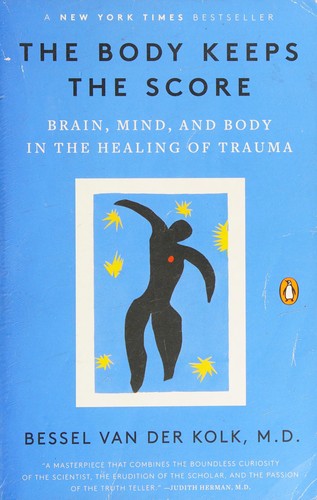
Bessel van der Kolk’s The Body Keeps the Score stakes a claim that sounds simple but dismantles the operational logic of both psychopharmacology and cognitive-behavioral therapy: traumatic experience is not stored as a memory to be retrieved and reprocessed but is inscribed in the body’s physiology — in muscle tension, autonomic dysregulation, immune response, and the frozen sensorimotor patterns that persist decades after the threatening event has passed. The title is not a metaphor. Van der Kolk marshals fMRI data, heart-rate variability studies, and decades of clinical observation to argue that the traumatized brain literally reorganizes itself around threat detection, shutting down the medial prefrontal cortex (the area responsible for self-awareness and time sense) while hyper-activating the amygdala and insula. The consequence is that traumatized individuals do not remember their trauma — they relive it somatically, caught in an eternal present tense the body cannot exit. This resonates directly with Donald Kalsched’s account of the self-care system in The Inner World of Trauma, where he describes how “affect and sensation aspects of experience stay with the body and the mental representation aspect is split off into the ‘mind,’” leaving the person with “no words for feelings.” Kalsched names this condition dis-affected and dis-spirited; van der Kolk gives it neurological coordinates. Together, the two works form a devastating double portrait: what depth psychology grasps through dream, myth, and transference, neuroscience confirms through scanner and electrode.
Dissociation Is the Psyche’s Sacrifice of Presence for Survival
Van der Kolk’s treatment of dissociation is where the book becomes genuinely dangerous to psychiatric orthodoxy. He reframes dissociation not as a pathological aberration but as an intelligent, adaptive response — the organism’s emergency protocol when neither fight nor flight is possible. The body “leaves” because the self cannot afford to stay. This insight parallels Kalsched’s description of archetypal defenses that “allow for survival at the expense of individuation” — they “keep the personal spirit ‘safe’ but disembodied, encapsulated, or otherwise driven out of the body/mind unity.” Van der Kolk extends this by showing that dissociation is not merely psychological but physiological: the dorsal vagal complex mediates a shutdown response that drops heart rate, numbs sensation, and collapses muscular tone. The clinical stakes are enormous. If dissociation is the body’s sacrifice of presence for survival, then therapeutic approaches that demand cognitive engagement — narrating the trauma, challenging distorted beliefs — are asking the patient to use precisely the capacities that trauma has disabled. Van der Kolk’s advocacy for EMDR, neurofeedback, yoga, and theater is not eclecticism; it is the logical conclusion of his central thesis. You must address the body’s frozen emergency response before the mind can participate in its own healing. Marion Woodman arrived at an identical conclusion from a completely different direction: “releasing the body into spontaneous movement or play constellates the unconscious in precisely the same way as does a dream.” For Woodman, “the body is the unconscious in its most immediate and continuous form.” Van der Kolk would agree entirely, though he would add: and here is the fMRI to prove it.
The Failure of Diagnosis Is a Failure of Imagination
One of the book’s most consequential interventions is van der Kolk’s sustained polemic against the DSM’s categorical model of mental illness. He traces his own failed campaign to include “Developmental Trauma Disorder” in the DSM-5, a diagnosis that would recognize the pervasive impact of chronic childhood adversity on personality formation, affect regulation, and relational capacity — rather than scattering these effects across a dozen discrete diagnoses (PTSD, ADHD, borderline personality disorder, oppositional defiant disorder, and so on). The psychiatric establishment’s refusal to adopt this category reveals something James Hillman diagnosed decades earlier: the literalism of the therapeutic imagination. In Healing Fiction, Hillman argued that case history is itself “a genuine psychic event, an authentic expression of the soul” — not a set of diagnostic checkboxes but a narrative demanding interpretation. Van der Kolk’s developmental trauma framework is, in effect, a demand that psychiatry start reading the patient’s life as a coherent story rather than a cluster of symptoms. The DSM fragments the person into billable codes; van der Kolk insists on reintegration. His clinical descriptions — of children who cannot play, veterans whose bodies brace against dangers that ended years ago, women who cannot feel their own skin — are precisely the kind of “soul stories” Hillman believed depth psychology existed to tell. The difference is that van der Kolk tells them with the authority of a Harvard-affiliated psychiatrist wielding neuroimaging data, which gives them a political force that purely archetypal language cannot achieve within institutional medicine.
Healing Requires the Restoration of Agency, Not the Recovery of Memory
The book’s therapeutic vision converges on a single principle: recovery from trauma is not primarily about uncovering what happened but about restoring the body’s capacity for self-regulation, pleasure, and intentional action. Van der Kolk’s emphasis on rhythm — in breathing, in communal movement, in theatrical performance — echoes Woodman’s insistence that “to relax is to allow the breath to go into the depth of the body” and that authentic bodily responses can only emerge when chronic muscular armoring is released. What van der Kolk adds is the concept of interoception — the capacity to sense one’s own internal states — as the foundation of both selfhood and recovery. Traumatized people, he demonstrates, are estranged from their own viscera. They cannot feel hunger, satiety, heartbeat, or breath without these sensations triggering alarm. Agency begins not with insight but with the simple, radical experience of inhabiting one’s own body without terror.
This book matters now not because it popularized trauma awareness — that has already happened, with mixed results — but because it provides the empirical architecture for a truth that depth psychology has carried for a century without mainstream credibility: the psyche is embodied, and healing that bypasses the body is not healing at all. For clinicians trained in the Jungian, Hillmanian, or Woodmanian traditions, van der Kolk’s work is both vindication and challenge. Vindication, because the somatic unconscious they have long honored is now neurologically mapped. Challenge, because the mapping demands that imaginal and archetypal approaches demonstrate — not just assert — their capacity to shift the body’s autonomic baseline. The Body Keeps the Score is the book that forces depth psychology and neuroscience to stop pretending they are studying different things.
Sources Cited
- van der Kolk, B. (2014). The Body Keeps the Score: Brain, Mind, and Body in the Healing of Trauma. Viking. ISBN 978-0-670-78593-3.
- Porges, S.W. (2011). The Polyvagal Theory. W.W. Norton.
- Levine, P. (1997). Waking the Tiger: Healing Trauma. North Atlantic Books.