On a Mycenaean coffin a dead woman’s image rises “on batlike wings” toward “its new home” — Emily Vermeule’s “first psyche in Greek art, an impressive rendition of the invisible” (Vermeule, Aspects of Death in Early Greek Art and Poetry, 1979). The flight in the dream may be the oldest motion the psyche knows, yet the dictionary’s verdicts — freedom craved, problems fled — hand the lift in the chest back as a slogan. It is not one image: the soaring that thrills and the soaring that will not stop; the bird let out of its cage and the soul torn loose from the body; the escape toward something and the escape from. The tradition reads flight not as freedom but as an upward direction, and asks what rises, what it flees, and whether the ground it left could ever hold it.
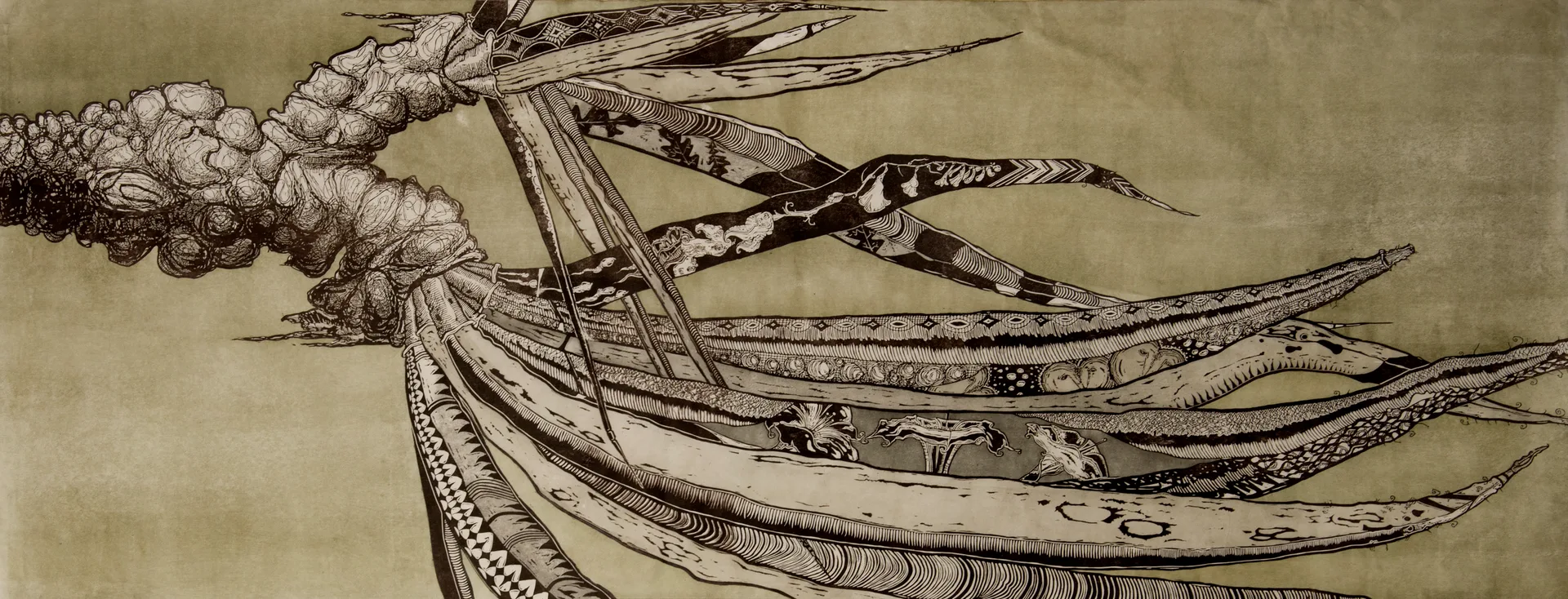
The Greeks built that motion into the soul itself: mad, afraid, drunk, angry, or in love, Ruth Padel finds, “their soul, thumos or nous, ‘flies’” (Padel, In and Out of the Mind, 1994). Air, breath, wind are its element; at death it goes “winged” down to Hades. To fly away, in this lineage, is what the soul does when it leaves.
So the first question is whether the dream is flying up — and who, in you, is doing the rising. James Hillman names that figure the puer aeternus, “the winged godlike imago in us each,” and gives him his whole doomed flock: “Icarus on the way to the sun, then plummeting with waxen wings; Phaethon driving the sun’s chariot out of control… Bellerophon, ascending on his white winged horse, then falling onto the plains of wandering” (Hillman, Senex & Puer, 2015). This is the flight of aspiration — “transcendence to everything given” hardening into “ascendance over everything given.” Hillman will not reduce it to neurosis; he insists on “the puer’s legitimate ambition and art of flying,” because “he who cannot fly cannot imagine.” The dream of soaring may be the imagination itself, refusing the valley.
But the same wings carry a warning. Marie-Louise von Franz describes the man who is identified with the puer as one who “never quite touches the earth. He never quite commits himself to any mundane situation but just hovers over the earth, touching it from time to time, alighting here and there” (von Franz, The Problem of the Puer Aeternus, 1970). That is the recurring flying dream of someone whose waking life has not landed — the lift that feels like freedom and functions as avoidance. The alchemists had a precise word for the danger: sublimatio, the ascent that, in Edward Edinger’s reading, “raises us above the confining entanglements of immediate, earthy existence.” It buys a wider view at a steep price: “the higher we go the grander and more comprehensive is our perspective, but also the more remote we become from actual life… We become magnificent but impotent spectators” (Edinger, Anatomy of the Psyche, 1985). Edinger notes that this very movement can show up “in dreams by the escape or release of caged birds” — an auspicious sign, sometimes, and sometimes a soul that has simply left the room.
This is where the body enters, and the verb changes from fly to flee. Stanton Marlan draws the line that matters: there is “an important difference between a grounded bodily imagination and a defensive or naive Gnostic flight that leaves the body and the darkness behind” (Marlan, The Black Sun, 2005). The dream of escape can be the second kind — not aspiration but evacuation. Janina Fisher places it among the oldest survival equipment we own: when there is “nowhere to turn, nowhere to hide,” the organism falls back on “the animal defense survival responses of fight, flight, freeze, submit, and attach for survival” (Fisher, Healing the Fragmented Selves of Trauma Survivors, 2017). Flight here is not a wish; it is a mechanism. And the dreamer who keeps escaping in the night may be rehearsing what the body once needed: “a sense that there is relief in sight; an exit plan, a parachute… ‘There is something I can do.’” The flight that looks like freedom can be the memory of a moment when leaving was the only safety on offer.
So before the dictionary tells you that you long to be free, ask what your flight is made of. Is it the puer’s upward fire, the imagination refusing to be grounded — and is that drive carrying you toward your destiny or hovering you safely above a life you have not agreed to enter? Is it the soul-bird of the Greeks, doing in sleep what it has always done, taking wing at the threshold of something ending? Or is it the old defense, the body lifting you out of a room that once was not safe, still running long after the danger has passed? Vermeule’s winged soul left the coffin because it had somewhere new to go. The puer hovers because he will not land. The two look identical from inside the dream. The image is not telling you to escape. It is asking what you are flying from — and whether the ground you keep refusing is the one that could finally hold you.