The dream dictionaries have their verdict ready: flying means freedom, it means escape, it means you have risen above your problems. They hand you the exhilaration and stop there, as if lift were a single sensation with a single meaning. But flying is not one image. There is the effortless glide and the panicked thrash to stay aloft; the soar that lifts you toward the sun and the hover that keeps you circling, unwilling to come down; the flight on borrowed wings and the flight that is simply, suddenly, your own. The tradition does not read flying as a synonym for liberation. It reads it as a direction — upward, away from the earth — and the only useful questions are what is doing the rising, how high it means to go, and what it is leaving behind on the ground.
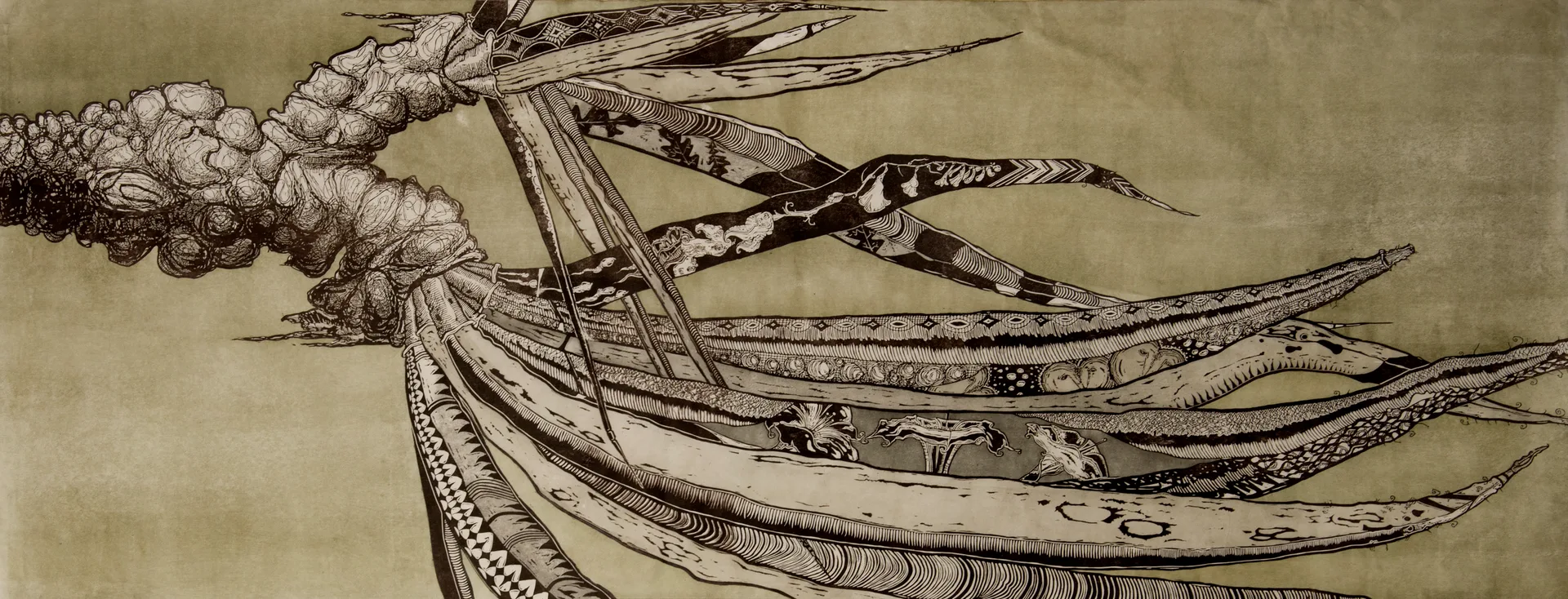
The Greeks did not locate flight in the body alone but in the mind. Ruth Padel finds the very faculties of soul taking wing: “When people are mad, very afraid, drunk, angry, youthfully reckless, or much in love, their soul, thumos or nous, ‘flies’” (Padel, In and Out of the Mind, 1994). To fly, in this older grammar, is to be carried off — by emotion, by a god, by something that enters from outside. In the Bacchae the warning is exact: “Now you are flying, and though you are sane you are not thinking sanely.” Flight here is not mastery but a kind of beautiful unsoundness, the mind lifted clean off its footing. And at the end, Padel notes, “the soul returns at death to the air, the element of which it is made, and flies down ‘winged’ to Hades.” Flying is the soul’s native motion, and not all of it goes upward.
Depth psychology gives this rising a name and a danger: the puer aeternus, the eternal youth, the winged boy of the spirit. James Hillman gathers the whole soaring lineage — “Icarus on the way to the sun, then plummeting with waxen wings; Phaethon driving the sun’s chariot out of control, burning up the world; Bellerophon, ascending on his white winged horse, then falling onto the plains of wandering, limping ever after” (Hillman, Senex & Puer, 2015). These are the heaven-stormers, and Hillman refuses to shame them. Without this drive upward “there would be no spiritual drive, no new sparks, no going beyond the given.” He insists on “the puer’s legitimate ambition and art of flying,” because “he who cannot fly cannot imagine.” The flying dream may be the imagination itself testing its wingspan.
But the wing has a gravity of its own. Stanton Marlan recovers the ancient charter for ascent: “The function of the wing, Plato tells us, is to take what is heavy and raise it up into the regions above… where the gods dwell. Of all things connected with the body, the wing has the greatest affinity with the divine” (Marlan, The Black Sun, 2005). The wing exists to lift the heavy toward the heavenly. That is its glory and its peril, because the higher one rises the more one leaves below. Edward Edinger draws the cost precisely. The alchemical sublimatio “is an ascent that raises us above the confining entanglements of immediate, earthy existence,” and dreams sometimes announce it through “the escape or release of caged birds or some other auspicious upward movement.” Yet there is a price for altitude: “The higher we go the grander and more comprehensive is our perspective, but also the more remote we become from actual life… We become magnificent but impotent spectators” (Edinger, Anatomy of the Psyche, 1985). Flying can be the soul opening its cage. It can also be the soul abandoning the ground where anything actually happens.
That abandonment has a face. Thomas Moore recounts a man who dreamed he was flying a biplane over his childhood farm: “He could see his family down on the ground in front of the house. They were signaling to him to land and be with them, but he kept flying in circles around them” (Moore, Care of the Soul, 1992). The puer spirit, Moore writes, “often maintains its distance from the labyrinth of the family… a choice of pure spirit — air — over descent into the family soul.” Here flight is not transcendence but evasion, the refusal of the heavy and intimate and unglamorous below.
And so the tradition keeps returning to the one figure who flew too well. Edinger states it without hedging: “I think that all dreams of flying have some allusion to the myth of Icarus; this is particularly true of the dreams of flight without any means of mechanical support” (Edinger, Ego and Archetype, 1972). When you are aloft on nothing — no plane, no rope, no wings you built yourself — the dream is staging the necessary crime of inflation, the rising that overreaches. “When one is off the ground the danger is that he may fall.” The wax warms. The question the dream presses is not whether you feel free. It is what is carrying you up, and whether those wings are yours or borrowed, and what you are circling above rather than landing in.
So before you accept the dictionary’s bright little word — freedom — notice the kind of flight you were having. Were you released like a caged bird, or were you fleeing the labyrinth? Were you flying toward the sun, or merely refusing to come down? The image holds open between aspiration and inflation, between the soul taking its native air and the boy who could not bear the ground. Either way the dream is not congratulating you on your escape. It is asking how high you mean to go, and reminding you, in the old way, that everything with wings eventually has to answer to the earth.