Seba.Health
Key Takeaways
- Shapiro's Adaptive Information Processing model is, beneath its clinical packaging, a theory of psychic dissociation that converges with Jung's complex theory and Kalsched's self-care system—making EMDR less a technique than a contemporary rediscovery of the psyche's autonomous capacity to metabolize traumatic images.
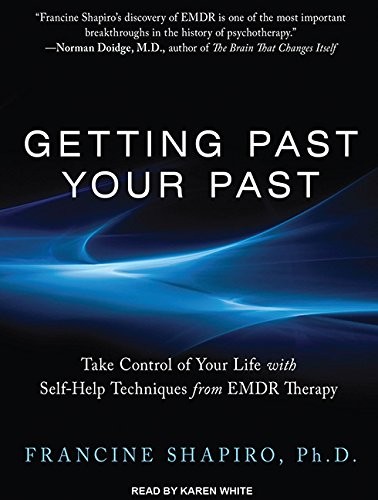
- *Getting Past Your Past* translates the depth-psychological insight that the past lives in the present body into a self-help protocol, accomplishing what Hollis describes as the obligation to "re-imagine ourselves in order to live in the present"—but by bypassing narrative meaning-making entirely in favor of somatic and imaginal reprocessing.
- The book's most radical move is democratizing access to the memory network model, revealing that what depth psychology calls complexes and what neuroscience calls maladaptively stored memories are the same phenomenon viewed through different lenses—a convergence that neither tradition has fully reckoned with.
EMDR’s Adaptive Information Processing Model Is a Neuroscientific Restatement of Jung’s Complex Theory
Francine Shapiro built EMDR on a deceptively simple premise: disturbing experiences, when inadequately processed, become stored in state-specific form—retaining the original emotions, body sensations, and beliefs intact, as though frozen in neurological amber. Her Adaptive Information Processing (AIP) model holds that the brain possesses an innate information-processing system that, under ordinary conditions, moves experience toward adaptive resolution, integrating it into broader memory networks. Trauma disrupts this system. The unprocessed memory then operates autonomously, hijacking perception and behavior whenever triggered. This is not merely a clinical hypothesis; it is a structural account of how the past colonizes the present. Read through a depth-psychological lens, the AIP model describes precisely what Jung meant by a complex: an affectively charged cluster of associations that operates with quasi-autonomous agency, splitting off from ego-consciousness and activating reflexively. Kalsched’s daimonic self-care system—that dissociative defense personified in dreams as both protector and persecutor—maps onto Shapiro’s description of how unprocessed trauma simultaneously shields the psyche from overwhelm and imprisons it in repetitive suffering. The convergence is not metaphorical. Both frameworks identify the same structural reality: that psychic material excluded from integrative processing develops its own gravitational field, distorting everything that enters its orbit. Where Jung used amplification and active imagination to engage the complex’s imaginal content, Shapiro deploys bilateral stimulation to unlock the frozen memory network and allow associative processing to resume. The mechanism differs; the target is identical.
The Body as Archive Challenges Narrative Supremacy in Depth Work
Shapiro’s most consequential contribution for the depth-psychology reader is her insistence that the body is not a metaphor for psychological suffering but its primary repository. Getting Past Your Past is saturated with case examples in which physical sensations—tightness in the chest, nausea, a clenched jaw—serve as the royal road to the unprocessed memory, displacing the Freudian dream and the Jungian image from their privileged positions. This is not anti-imaginal; Shapiro’s protocols explicitly use imagery, cognition, emotion, and somatic sensation as simultaneous access points. But the hierarchy is inverted: the body leads. Hollis writes that “the activated complexes shrink our vision to the narrow range determined by our regressive reflexes”—a formulation that Shapiro would endorse entirely, except that she would locate those reflexes not in metaphorical swampland but in specific neural pathways and muscular patterns. The tension is productive. Hillman’s insistence that “case history is not the place of hang-ups to be left behind” but “a waking dream giving as many marvels as any descent into the cavern of the dragon” preserves the imaginal dignity of personal history. Shapiro, by contrast, treats the traumatic memory not as a narrative to be elaborated but as a neurological knot to be untangled. The self-help techniques she offers—the Safe Place exercise, the Lightstream Technique, the Butterfly Hug—are somatic and imaginal simultaneously, asking the reader to visualize while attending to bodily states. This dual-channel approach implicitly bridges the gap between Hillman’s imaginal psychology and contemporary somatic trauma therapies informed by Porges’s polyvagal theory. Marta Tibaldi’s published explorations of the rapprochement between Jungian analysis and EMDR confirm that this bridge is not accidental but structurally necessary: the psyche processes through images and through the body, and any therapy that privileges one channel exclusively leaves the other unmetabolized.
Survivorship as Identity Trap: Shapiro and Estés Converge on the Danger of Frozen Self-Narratives
One of the book’s most clinically potent insights is that the negative cognitions attached to unprocessed memories—“I am worthless,” “I am unsafe,” “I am powerless”—function not as beliefs about the self but as the self, structuring identity from the inside. Shapiro demonstrates that these cognitions are not rational conclusions but the emotional residue of experiences stored in their original, undigested form. When processing occurs—whether through EMDR or the self-help techniques adapted from it—the cognition shifts spontaneously, not through persuasion but through the memory network’s reorganization. This maps directly onto Estés’s warning about the survivor identity. Estés writes that “there is a potential trap in calling ourselves by names taken on during the most terrible time of our lives,” that survivorship “creates a mind-set that is potentially limiting.” Shapiro provides the neurological mechanism for this trap: the unprocessed memory network is the identity structure. The person does not merely believe they are damaged; the memory system presents damage as current reality because it has never been integrated into the broader network of adaptive experience. Estés prescribes ritual, ofrenda, and the deliberate naming of new identities; Shapiro prescribes reprocessing. Both understand that thriving requires the past to be metabolized rather than merely narrated. Neumann’s account of ego-consciousness evolving through successive encounters with archetypal images provides the developmental frame: the ego must absorb and integrate each stage’s content or remain arrested. Shapiro’s AIP model is, in this light, a clinical technology for facilitating precisely that evolutionary movement—unfreezing the ego from its traumatic fixation so that the next stage of development becomes possible.
Why This Book Matters for the Depth-Psychological Reader
Getting Past Your Past occupies an unusual position in the literature: it is a self-help book written by a clinical researcher that, without ever using depth-psychological language, delivers a theory of psychic functioning more compatible with Jung’s complex theory than most explicitly Jungian clinical texts. Its limitation is also its strength. By stripping away mythological amplification and archetypal narrative, Shapiro isolates the processing mechanism itself—the psyche’s innate drive toward integration—and makes it accessible to anyone willing to do the exercises. What is lost is the soul-making dimension that Hillman insisted upon: the recognition that suffering carries imaginal significance, that the symptom is not merely a malfunction but a communication from the depths. What is gained is immediacy and democratic access. For the reader steeped in depth psychology, this book does not replace the imaginal tradition; it reveals the somatic infrastructure upon which that tradition operates. It shows that the psyche’s self-healing capacity, which Beebe calls “quintessentially Jungian,” is not a philosophical posture but a neurobiological fact that can be engaged through specific, repeatable interventions. No other book in the library makes that particular claim with this degree of clinical specificity.
Sources Cited
- Shapiro, F. (2012). Getting Past Your Past: Take Control of Your Life with Self-Help Techniques from EMDR Therapy. Rodale.
- Shapiro, F. (2001). Eye Movement Desensitization and Reprocessing (EMDR) (2nd ed.). Guilford Press.
- Siegel, D. J. (2010). Mindsight: The New Science of Personal Transformation. Bantam.