Seba.Health
Key Takeaways
- Herman's three-stage model of recovery (safety, remembrance, reconnection) is not a clinical protocol but a political ontology of selfhood: it asserts that the precondition for psychological integration is the restoration of power to the person whose agency was annihilated—making trauma recovery inseparable from justice.
- By demonstrating that the same psychological syndrome emerges from domestic battery, incest, combat, and political imprisonment, Herman collapses the artificial distinction between private pathology and public atrocity, revealing that the diagnostic category of PTSD is itself a political achievement won through feminist and veteran advocacy.
- Herman's concept of "complex PTSD" names a condition that Kalsched's archetypal self-care system and Fairbairn's internal saboteur describe from the inside—the characterological deformation that results not from a single overwhelming event but from prolonged captivity, where dissociation becomes not a momentary defense but an entire way of being.
Trauma Is a Political Diagnosis Before It Is a Clinical One
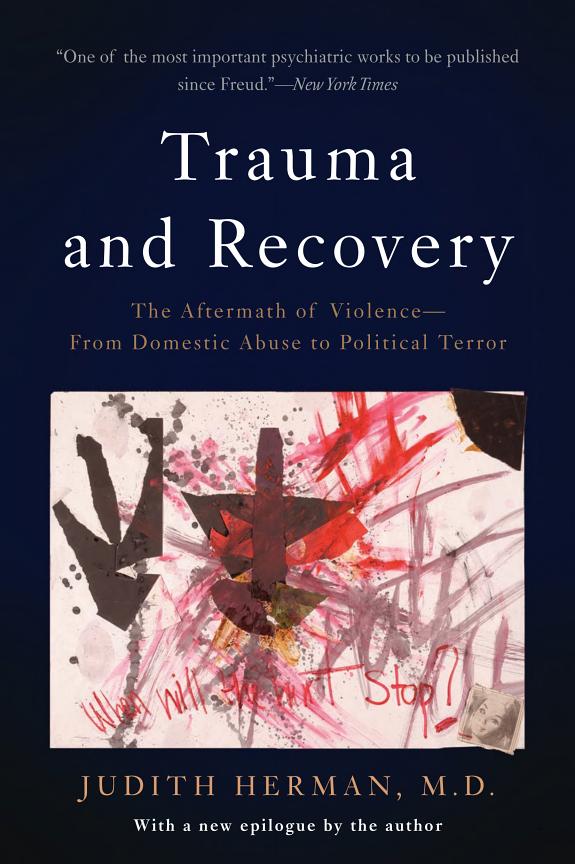
Judith Herman opens Trauma and Recovery not with symptom checklists but with a historiography of forgetting. The study of psychological trauma, she demonstrates, has surfaced and been suppressed three times: in Charcot and Janet’s hysteria research, in the shell shock investigations of the First World War, and in the feminist rediscovery of sexual and domestic violence in the 1970s. Each wave required a political movement—republicanism, veterans’ advocacy, feminism—to force the profession to see what it preferred to deny. This is Herman’s foundational move: trauma is not merely a wound that the individual psyche sustains; it is a wound that society inflicts and then conspires to render invisible. The “forgetting” is not personal repression but collective dissociation, and recovery therefore demands not only intrapsychic work but the reconstitution of social witness. Donald Kalsched, writing four years later in The Inner World of Trauma, would note that psychoanalysis itself “suffered a kind of professional amnesia on the subject” of trauma before its recent rediscovery. Herman explains why that amnesia recurs: studying trauma means confronting perpetrators, and perpetrators are protected by institutional power. The diagnostic category of PTSD, ratified in 1980, was not a scientific discovery in any straightforward sense—it was a political victory. Herman’s insistence on this point is what separates her from every purely clinical account.
The Dialectic of Trauma Is the Dialectic of Dissociation
Herman’s central clinical insight is that trauma produces a “dialectic” between intrusion and constriction—between the relentless return of the event (flashbacks, nightmares, hyperarousal) and the psyche’s equally relentless efforts to wall it off (numbing, amnesia, depersonalization). This oscillation is not a failure of coping; it is the post-traumatic condition. Here Herman converges with Kalsched’s account of the “self-care system” that simultaneously preserves and imprisons the personal spirit. Where Kalsched locates this dialectic in archetypal dream imagery—the Protector/Persecutor dyad, the daimonic figure who guards by annihilating—Herman locates it in the phenomenology of daily life: the battered woman who cannot leave, the veteran who cannot sleep, the incest survivor who cannot feel. Both authors describe the same structural paradox: the defense that saves the self from annihilation becomes the agent of continued suffering. But Herman’s contribution is to show that this paradox is not merely an interior drama; it is reproduced in every social institution that encounters the trauma survivor. Courts disbelieve victims, families demand silence, therapists collude in avoidance. The intrusion-constriction dialectic operates at every level, from the individual nervous system to the body politic.
Complex PTSD Names the Deformation of Character Under Prolonged Captivity
Herman’s most enduring conceptual contribution is her delineation of “complex PTSD”—the syndrome produced not by a single shattering event but by prolonged, repeated trauma under conditions of captivity, where the victim cannot escape and the perpetrator controls every dimension of daily life. This includes domestic violence, childhood abuse, and political imprisonment. The resulting damage goes beyond the classic PTSD triad of intrusion, constriction, and hyperarousal; it deforms the entire personality structure—identity, affect regulation, consciousness, relations with others, systems of meaning. Herman is describing, in effect, what Fairbairn discovered when he found that abused children internalize their own “badness” to preserve the illusion of a good object, and what Kalsched calls the “progressed” false self that caretakes the regressed, frozen child-self. The point is that complex PTSD is not a more severe version of simple PTSD; it is a different condition, one in which dissociation is no longer an emergency response but a characterological architecture. Winnicott’s “false self,” Fairbairn’s “internal saboteur,” Kalsched’s daimonic Protector/Persecutor—all describe facets of the same phenomenon that Herman insists must be named at the diagnostic level so that treatment can be properly designed. The psychiatric establishment’s resistance to the complex PTSD diagnosis (it was excluded from DSM-IV despite Herman’s advocacy) is itself an instance of the institutional dissociation she documents throughout the book.
Recovery Is the Restoration of Narrative and Connection, Not the Abreaction of Affect
Herman’s three-stage recovery model—establishing safety, reconstructing the trauma narrative, and reconnecting with ordinary life—is deceptively simple. Its real radicalism lies in what it refuses. It refuses the cathartic model that equates healing with emotional discharge. Jung himself noted that “the abreaction of trauma was not the healing factor” and that “the experience must be rehearsed in the presence of the doctor.” Herman builds an entire treatment architecture on this principle. Stage one is about the body and the environment: the survivor must have literal safety and somatic self-regulation before any narrative work can begin. Stage two is about testimony: the fragmented, unbearable experience must be woven into a coherent life story in the presence of a witness. Stage three is about the future: the survivor must build new relationships and a new sense of purpose. This sequence directly parallels the fairy-tale logic Kalsched traces in Rapunzel and Eros and Psyche—the captive self must first be located, then the tower must be breached, then incarnation into the embodied world must occur. But Herman insists that this process cannot happen in the consulting room alone. She ends the book with a chapter on commonality—group work, social action, the survivor mission—arguing that reconnection with the human community is not an afterthought but a necessary condition of full recovery. James Hillman argued that soul-making occurs through the “imagination of words” and that case history is a form of poiesis; Herman demonstrates that for the trauma survivor, the making of a narrative is simultaneously the making of a self.
Why This Book Remains Structurally Irreplaceable
Trauma and Recovery is the only work in the depth psychological and psychiatric literature that holds together the political genealogy of trauma knowledge, the phenomenology of post-traumatic states, and a stage-specific treatment model while refusing to reduce any of these to the others. Murray Stein’s account of collective trauma and the necessity of rebuilding from “ground zero” through new transformative images describes the cultural process; Kalsched maps the intrapsychic architecture with mythological precision; but Herman alone demonstrates that the clinical and the political are not parallel tracks—they are the same track. Without the feminist movement, there is no PTSD diagnosis. Without social witness, there is no narrative reconstruction. Without justice, safety is an illusion. For anyone encountering depth psychology today, this book delivers the indispensable correction: the soul does not exist in a vacuum, and its wounds cannot be healed by interior work alone.
Sources Cited
- Herman, J.L. (1992). Trauma and Recovery: The Aftermath of Violence—From Domestic Abuse to Political Terror. Basic Books. ISBN 978-0-465-09873-6.
- van der Kolk, B. (2014). The Body Keeps the Score: Brain, Mind, and Body in the Healing of Trauma. Viking.
- Janet, P. (1889). L'Automatisme psychologique. Alcan.