 Seba.Health
Key Takeaways
- Ogden's framework resolves the central impasse that Kalsched identifies between bodywork that loses the psyche and talk therapy that loses the body, by inserting a third clinical register — sensorimotor processing — that operates precisely in the intermediate zone where dissociation actually lives.
- The book's hierarchy of information processing (sensorimotor, emotional, cognitive) is not merely a clinical convenience but a developmental ontology that explains why trauma victims can narrate their stories fluently while remaining fundamentally unchanged — the narrative ego has been decoupled from the somatic substrate that holds the trauma.
- By making the "window of tolerance" a central diagnostic and therapeutic concept, Ogden provides the operational mechanism that Winnicott's "holding environment" and Jung's temenos always implied but never specified in physiological terms.
The Missing Middle: Sensorimotor Processing as the Psyche’s Forgotten Register
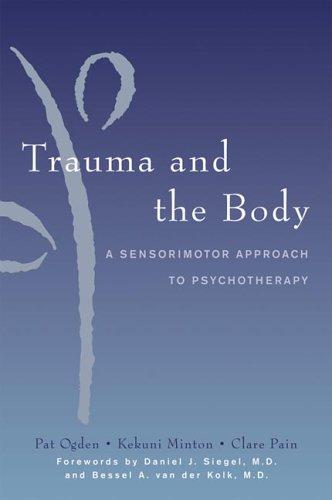
Pat Ogden’s Trauma and the Body addresses a structural failure in the psychotherapeutic traditions that preceded it. Psychoanalysis, including its Jungian variants, privileged symbolic interpretation. Behavioral and cognitive approaches privileged narrative restructuring. Somatic therapies privileged discharge. Each tradition amputated something essential. Ogden’s contribution is to name what was amputated: the sensorimotor processing level, a register of experience that is neither affect nor cognition but the bodily organization of action tendencies, postures, and autonomic states that precede and underwrite both. This is the register where trauma actually lodges. Donald Kalsched, in The Inner World of Trauma, articulates exactly this gap when he warns that “a danger of pure bodywork is that it may release much somatized energy without this raw affect becoming available to the mind in the form of images or words,” and that conversely, psychotherapy that becomes “too mental” loses the psyche entirely. Ogden’s sensorimotor psychotherapy is designed to occupy the intermediate zone Kalsched describes — the place where body meets mind and, as he puts it, “the two fall in love.” What makes Ogden’s framework clinically actionable rather than merely poetic is its insistence that therapists learn to track micro-movements, postural shifts, breathing patterns, and gesture as primary data, not secondary illustrations of psychological content.
The Window of Tolerance Is the Somatic Specification of the Temenos
Ogden borrows Daniel Siegel’s concept of the “window of tolerance” and transforms it into the governing principle of sensorimotor psychotherapy. The window describes the band of autonomic arousal within which a person can process experience without either dissociating (hypoarousal) or flooding (hyperarousal). Trauma collapses this window. The therapeutic task is not primarily to recover memory or interpret symbol but to expand the window itself — to build the somatic capacity to remain present to experience. This concept operationalizes something that depth psychology has long intuited. Jung’s insistence that analysis requires a temenos, a sacred contained space, and Winnicott’s notion of the holding environment both point toward the same functional reality: without containment, the psyche fragments. But neither Jung nor Winnicott specified the physiological mechanism of that containment. Ogden does. The window of tolerance is the body’s version of the temenos. When Kalsched describes the self-care system as a psychic “circuit-breaker” that “throws” when affect exceeds the ego’s capacity, he is describing precisely what happens when arousal exits the window of tolerance. Ogden’s innovation is to make this threshold visible, measurable, and directly addressable through somatic intervention — mindful body awareness, grounding exercises, controlled pendulation between activation and settling. Marion Woodman, working from the Jungian side, recognized this same principle when she insisted that her analysands needed body workshops as much as dream analysis, because “the body is the unconscious in its most immediate and continuous form.” Ogden provides the clinical architecture that Woodman’s intuition demanded.
Trauma Is Not a Story the Mind Has Forgotten but a Procedure the Body Cannot Stop Performing
The book’s most radical claim is that traumatic memory is fundamentally procedural rather than declarative. Trauma survivors do not simply fail to remember what happened; their bodies continue to enact incomplete defensive responses — the fight that was never thrown, the flight that was never completed, the freeze that never resolved into safety. These truncated action sequences persist as chronic muscular tension, collapsed posture, restricted breathing, and hypervigilant orienting. Ogden’s therapeutic method involves bringing these procedural patterns into awareness and then — critically — supporting the body in completing them. This is not abreaction. Ogden explicitly rejects cathartic discharge models. Rather, it is a tracked, titrated, mindful process in which the client observes the body’s impulse, follows it slowly, and discovers the movement or posture that was thwarted. The resonance with Kalsched’s account of Lenore, whose early abandonment could not be “retained as a memory except in a terrible tension in her stomach,” is exact. Kalsched notes that only when Lenore relived the abandonment with a therapeutic witness did the “state-dependent” memory become accessible. Ogden’s method systematizes this insight: the therapist becomes the witness who tracks the body’s procedural memory as it surfaces, ensuring the client stays within the window of tolerance while the incomplete action completes itself.
Why Talk Therapy Fails Trauma and What That Reveals About the Psyche’s Architecture
Ogden’s three-level hierarchy — sensorimotor, emotional, cognitive — explains a clinical phenomenon that frustrates therapists across orientations: the traumatized client who can narrate their history with eloquent precision and remain entirely unchanged. This is not resistance in the classical sense. It is a structural dissociation in which the cognitive level operates independently of the sensorimotor level where the trauma is encoded. The narrative self has been decoupled from the somatic self. Woodman identified this split with characteristic directness: “If a symbol isn’t resonating in your body, your imagination and your head, it is not working for you.” Ogden’s framework gives this observation theoretical scaffolding. Top-down interventions — interpretation, cognitive restructuring, even dream analysis conducted purely verbally — may reorganize the cognitive level without touching the sensorimotor substrate. Conversely, bottom-up interventions that flood the system with somatic activation without cognitive scaffolding retraumatize rather than heal. The therapeutic art lies in working all three levels simultaneously, using the body as the primary point of entry and allowing emotional and cognitive integration to emerge from somatic reorganization rather than imposing it from above.
What This Book Illuminates That Nothing Else Does
Trauma and the Body matters because it solves a specific problem that depth psychology generated but could not resolve on its own terms. Jung knew the psyche was “half bodily, half spiritual.” Woodman insisted the body was the unconscious in its most immediate form. Kalsched mapped the archetypal defense system that splits mind from body after early trauma. But none of them produced a clinical method adequate to the body side of the equation. Ogden does not replace depth psychological understanding; she completes it. For anyone working in the Jungian or post-Jungian tradition, this book is the missing technical manual for the somatic dimension of the individuation process — the dimension where complexes are not merely interpreted but physically reorganized, where the self-care system’s grip on the musculature can be directly observed and gently loosened, and where the “personal spirit” Kalsched describes can literally be felt re-entering the body as posture shifts, breath deepens, and frozen action patterns finally resolve into movement.
Sources Cited
- Ogden, P., Minton, K., & Pain, C. (2006). Trauma and the Body: A Sensorimotor Approach to Psychotherapy. W. W. Norton.
- van der Kolk, B. A. (2014). The Body Keeps the Score. Viking.
- Schore, A. N. (1994). Affect Regulation and the Origin of the Self. Lawrence Erlbaum.