 Seba.Health
Key Takeaways
- Levine's signal achievement is not the discovery that trauma lives in the body—others established that—but the articulation of a precise procedural grammar (felt sense, pendulation, titration) that makes the body's own discharge mechanisms clinically operable without requiring narrative, interpretation, or catharsis.
- *In an Unspoken Voice* provides the missing physiological substrate for what Kalsched describes as the psyche's "intermediate third area": the half-bodily, half-spiritual zone where dissociation locks trauma away from both cognitive mind and felt experience, and where re-integration must occur.
- Levine's concept of the "vortex" of traumatic activation and the "counter-vortex" of somatic resource constitutes a biological analogue to Cody Peterson's Middle Voice: a third position between the Active (fight/flight/master) and the Passive (freeze/collapse/submit) that the traumatized nervous system must find if it is to complete its interrupted response.
The Body’s Unfinished Action Is the Wound That Depth Psychology Cannot Reach Through Words Alone
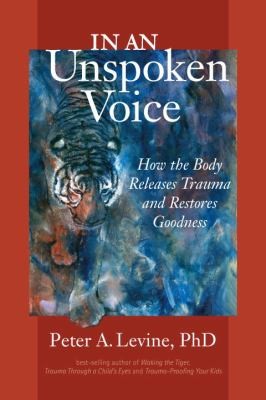
Peter Levine’s central claim is disarmingly simple and radically consequential: trauma is not the event, nor the memory of the event, but the incomplete physiological response to the event still trapped in the body’s sensorimotor loops. The shaking of the impala after a lion attack, the trembling of a child after a near-miss—these are not symptoms but resolutions. When the organism is permitted to discharge the survival energy mobilized during threat, trauma does not form. When that discharge is thwarted—by immobilization, by social inhibition, by the neocortical override that tells us to “hold it together”—the energy becomes a standing wave in the nervous system, generating the downstream phenomena psychiatry catalogs as PTSD, dissociation, chronic pain, and hypervigilance. This reframing moves the locus of trauma from the biographical narrative to the autonomic nervous system, from the talking cure to what Levine calls the “felt sense”—a term borrowed from Eugene Gendlin but retooled here as the primary organ of somatic awareness through which frozen survival responses can be tracked, titrated, and completed.
What makes this more than a clever body-therapy manifesto is its convergence with the deepest insights of depth psychology regarding the psyche’s intermediate reality. Donald Kalsched, drawing on both Jung and Winnicott, locates post-traumatic suffering in the “transitional space” where body meets mind—what he calls “an intermediate third area” that is “not necessarily in the mind or in the body.” Kalsched warns that pure bodywork risks releasing “somatized energy without this raw affect becoming available to the mind in the form of images or words that would enable it to be understood.” Levine is acutely aware of this danger. His method of pendulation—oscillating attention between zones of activation (the “trauma vortex”) and zones of embodied resource (the “counter-vortex”)—is designed precisely to prevent the re-traumatizing flood that occurs when somatic energy is released without a container. The container here is not the therapeutic relationship alone, nor the image, nor the word, but the organism’s own capacity for self-regulation, gradually restored through incremental contact with sensation. Levine does not abandon meaning; he insists that meaning arrives spontaneously when the body’s frozen gesture is allowed to complete itself—a reaching arm finds its reach, a collapsed chest discovers its breath, and the image or memory surfaces not as an imposed interpretation but as a natural emergent of physiological reorganization.
Levine’s “Felt Sense” Occupies the Same Ontological Position as the Abolished Thūmos
Cody Peterson’s analysis of the Middle Voice illuminates something Levine himself does not name but everywhere enacts. Peterson identifies the modern soul’s catastrophic reduction to two options: the Active Voice (“I will master this”) and the Passive Voice (“I am destroyed by this”). Trauma, in Levine’s framework, is precisely the Passive collapse—the freeze response in which the organism has exhausted its Active options (fight, flight) and been overwhelmed into immobility. What Levine calls “renegotiation” is the discovery of a third position that is neither mastery nor annihilation. His clinical injunction to track sensation without trying to change it, to let the body’s involuntary trembling and postural shifts proceed at their own pace, is a somatic enactment of Peterson’s peisomai operation: “allowing reality to persuade the soul into a new shape.” The felt sense, as Levine deploys it, is not an emotion to be expressed or a cognition to be corrected; it is an organ of holding—what Peterson, following Homer, would call the thūmos in its middle-voiced operation. The patient does not do something to the trauma; the patient is not done to by the trauma; the patient undergoes the completion of what was interrupted, remaining present to the body’s own intelligence. This is the grammar of Odysseus lashed to the mast, translated into the consulting room.
Where Marion Woodman Invokes Surrender, Levine Maps the Mechanism
Marion Woodman’s insistence that transformation occurs at the cellular level—that the voice saying “I am unlovable” lives “in the cells” and must be met there—finds in Levine its most rigorous procedural complement. Woodman speaks of surrendering to “archetypal processes, creative processes in the matrix of the unconscious,” and she identifies the body as the site where patriarchal culture has deposited its denigration of the feminine, its shame, its frozen grief. Her workshops use movement, voice, and dream imagery to release what is locked in “muscles, bones, and heart.” Levine provides the neurophysiological map for why these interventions work: the polyvagal system, the relationship between dorsal vagal shutdown and dissociation, the specific role of the ventral vagal complex in restoring social engagement and presence. Where Woodman says “the body pulls back—it doesn’t feel worthy,” Levine would say the organism is stuck in a procedural memory of immobilization, and the task is not to interpret the unworthiness but to help the nervous system discover that the threat has passed. This is not a reduction of Woodman’s insight; it is its grounding. The two approaches need each other: Levine without the imaginal risks becoming a sophisticated technique; Woodman without the somatic map risks the “mental” psychotherapy that Kalsched warns loses the psyche altogether.
Hillman’s provocation that “the wound announces impossibility and impotence” and that therapy “must move from the beautiful wounded condition into the actual present hurt” finds unexpected resonance here. Levine does not aestheticize the wound. He enters it through the specific organ—the constricted diaphragm, the frozen shoulder, the collapsed pelvis—and tracks its sensory signature until the organism’s own righting reflex can complete what was interrupted. Hillman demanded that therapy “drive the nail home” into the specific organ’s archetypal background; Levine drives it home through proprioception and interoception. The two are not identical—Hillman wants consciousness of the wound’s imaginal depths, Levine wants completion of the wound’s physiological arc—but their convergence marks the frontier where depth psychology and somatic psychology must meet if either is to fulfill its promise.
For anyone navigating the depth psychological tradition today, In an Unspoken Voice is indispensable not as a replacement for the imaginal and archetypal work of Jung, Hillman, Woodman, or Kalsched, but as the missing physiological chapter they all point toward without fully writing. It demonstrates that the body is not a metaphor for the unconscious—it is the unconscious, in its most ancient and non-negotiable form, and it will not be talked out of its truth.
Sources Cited
- Levine, P. A. (2010). In an Unspoken Voice: How the Body Releases Trauma and Restores Goodness. North Atlantic Books.
- Levine, P. A. (1997). Waking the Tiger: Healing Trauma. North Atlantic Books.
- Porges, S. W. (2011). The Polyvagal Theory. W. W. Norton.