Seba.Health
Key Takeaways
- Clayton's framework elevates fawning from a behavioral tic catalogued in trauma recovery circles to a full characterological structure—one that reveals how the self is not merely suppressed but actively replaced by a relational prosthesis that anticipates the other's desire before the subject's own desire can register.
- The book's most radical contribution is its insistence that fawning is not the opposite of authenticity but a sophisticated counterfeit of it: the fawner often appears emotionally attuned, generous, and relationally skilled, which means the pathology hides inside what culture rewards as virtue.
- By tracing fawning back to attachment rupture rather than simple social conditioning, Clayton implicitly aligns with depth-psychological accounts of the false self while offering a clinical specificity those traditions often lack—bridging the gap between Woodman's "glass coffin" of compulsive pleasing and contemporary trauma-informed practice.
Fawning Is Not a Behavior but a Replacement Self Installed at the Site of Attachment Failure
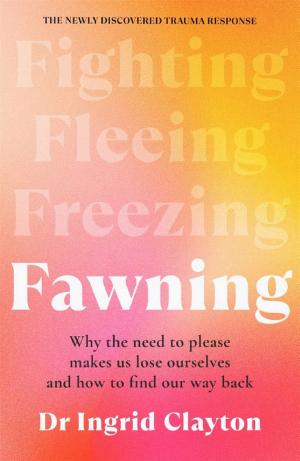
Ingrid Clayton’s Fawning refuses the superficial framing of people-pleasing as a bad habit amenable to boundary-setting exercises. Instead, she treats fawning as a fourth trauma response—alongside fight, flight, and freeze—that restructures the personality around a single imperative: detect what the other wants and become it. This positions the book squarely in dialogue with Marion Woodman’s clinical portraits of women trapped in compulsive compliance. Woodman’s analysand who wrote “the whole structure of my existence has depended on one premise—I have to please others” could serve as the book’s epigraph. But where Woodman situates that dynamic within the archetypal tension between the Loving Mother and the devouring Witch Mother, Clayton grounds it in the neurobiology and relational mechanics of insecure attachment. The fawning child does not learn to please as a strategy; the child becomes a pleasing-apparatus because no other mode of selfhood was safe enough to develop. Clayton’s achievement is to show that what gets lost is not merely spontaneity or assertiveness but the very capacity to register one’s own affective states in real time—the same temporal dissociation Woodman describes when her patient confesses, “Tomorrow or the next day I will know how I felt in the situation.”
The Fawn Response Weaponizes Empathy Against Its Own Host
Clayton’s most unsettling argument is that fawning co-opts genuine relational capacities—attunement, empathy, emotional reading—and turns them outward in exclusive service of the other. The fawner is not numb; she is hyper-perceptive, but her perceptual apparatus is oriented entirely toward threat detection disguised as care. This resonates with Esther Harding’s analysis of the persona that ceases to be a flexible social function and becomes identical with the person wearing it: the “good hostess” who greets everyone with a gracious smile, even those she heartily dislikes, until “we begin to wonder whether there is a real human being inside the mask or not.” Harding saw this persona-identification as the enemy of psychological relationship, because “things that are identical cannot be related.” Clayton extends this insight into trauma territory: the fawner’s persona is not chosen for social convenience but forged in survival terror. It cannot be removed by an act of will precisely because it was never put on voluntarily. This is why Clayton’s therapeutic approach emphasizes somatic and relational work rather than cognitive reframing alone—the body must be convinced, not just the mind, that survival no longer requires self-erasure.
James Hollis’s “Inauthentic Guilt” Is the Fawner’s Operating System
Clayton’s account of what keeps fawning in place maps almost perfectly onto James Hollis’s analysis of guilt as a defense against the deeper angst of parental disapproval. Hollis argues that what we call guilt is often “a child’s protective, reactive feeling state”—a reflexive throttling of any impulse that might displease the omnipotent parent. The fawner lives inside this throttle permanently. Clayton details how the internal monitoring system—Am I safe? Are they pleased? Have I performed correctly?—becomes so automatic that the person mistakes it for conscience, for morality, even for love. Hollis writes that “most of us were conditioned to be nice rather than real, accommodating rather than authentic,” and then proposes, half-jokingly, a Twelve Step program for “recovering nice persons.” Clayton has effectively written the manual for that program. She shows that recovering from fawning requires not just the recognition that one has been living in the “disempowered state of the child” (Hollis’s phrase) but the sustained, embodied practice of tolerating the other’s displeasure—the very thing that once threatened annihilation.
What Culture Calls Virtue, the Psyche Experiences as Captivity
Woodman diagnosed the lethal paradox at the heart of compulsive pleasing: “I want to survive. To survive I must please. To please, I must die.” Clayton’s contribution is to translate this depth-psychological insight into a language accessible to readers who may never encounter Woodman, while losing none of its severity. She also addresses what Woodman called the “power principle”—the family system organized not around love but around compliance, in which “the only reality you understand is pleasing other people, and you have within yourself no individual standpoint. You don’t even know such a thing exists—that’s the tragedy.” Clayton names what Woodman mythologized: the specific developmental mechanisms through which a child’s selfhood is replaced by an apparatus of accommodation. She provides the clinical granularity—attachment styles, nervous system regulation, somatic interventions—that depth psychology has historically gestured toward but rarely specified.
This book matters for a precise reason: it occupies a gap that no other single work fills. Depth psychology has long understood the destruction wrought by compulsive compliance—Woodman’s glass coffin, Hollis’s inauthentic guilt, Harding’s persona-identification—but its insights remain scattered across texts that presuppose familiarity with archetypal language. Trauma-informed psychology, meanwhile, has catalogued the fawn response but often treats it as one item on a checklist rather than a characterological totality. Clayton bridges these traditions. She gives readers who recognize themselves in the fawn response a developmental and somatic framework for understanding how they lost themselves, and—critically—why the losing felt so much like being good.
Sources Cited
- Clayton, I. (2024). Fawning: Why the Need to Please Makes Us Lose Ourselves--and How to Find Our Way Back. G. P. Putnam's Sons.
- Walker, P. (2013). Complex PTSD: From Surviving to Thriving. Azure Coyote.
- Herman, J. (1992). Trauma and Recovery. Basic Books.