
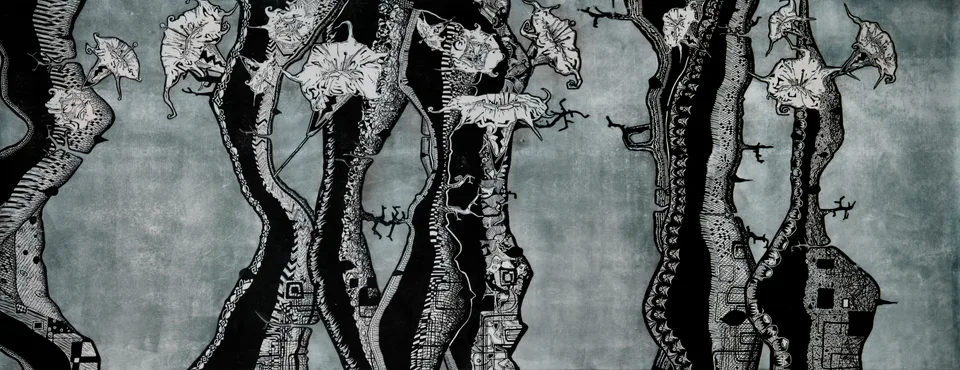
The Self That Won’t Be Quiet
Bradley Peterson and colleagues’ 2009 paper, published in the American Journal of Psychiatry, provides one of the first neuroimaging demonstrations that ADHD involves a specific failure of default-mode network regulation during cognitive task performance. The default-mode network (DMN) — the brain system active during rest, self-referential thought, mind-wandering, and narrative self-construction — is normally suppressed when the individual engages in focused, externally directed cognitive tasks. In youths with ADHD, this suppression fails: the DMN continues to intrude during task performance, producing the characteristic attentional lapses, mind-wandering, and difficulty sustaining focus that define the disorder. Psychostimulant medication, the paper demonstrates, restores the normative pattern of DMN suppression, allowing the brain to shift resources from self-referential processing to task-directed processing.
The Default Mode as the Ego’s Shadow
For depth psychology, the paper’s model of DMN intrusion as the mechanism of ADHD has a suggestive parallel in the concept of the autonomous complex. Jung described complexes as clusters of associated psychic contents — memories, images, affects — that possess their own energy and can intrude upon directed consciousness without the ego’s permission. The experience of mind-wandering during focused task performance — the DMN asserting itself against the ego’s directed attention — is phenomenologically similar to what Jung described as the complex’s disruption of conscious functioning. The difference is that Peterson’s paper identifies the neural substrate: the DMN is the brain system that generates the self-referential, narrative, associative content that complexes draw upon. When the DMN fails to suppress, the ego is flooded with autonomous content that it did not summon and cannot dismiss.
Pharmacology and the Ego-Unconscious Boundary
The finding that psychostimulants restore DMN suppression raises a question that depth psychology cannot avoid: what is the relationship between pharmacological modulation of neural systems and the psychological work of ego-development? If medication can restore the boundary between directed attention and autonomous self-referential processing — can, in effect, strengthen the ego’s capacity to attend without being invaded — then medication is performing a function that the analytic tradition has assigned to ego-development through therapeutic work. This is not an argument against medication; it is an argument for understanding medication within a larger psychological framework. The ego that cannot suppress DMN intrusion is an ego overwhelmed by its own interiority. Whether that capacity is restored through pharmacology, therapy, or developmental maturation, the psychological result is the same: a self capable of directing its attention toward the world without being continuously pulled back into its own associative depths.
Implications for Attention and Consciousness
Peterson’s paper contributes to a growing understanding that attention is not a simple resource to be deployed but a dynamic competition between internally directed and externally directed neural systems. The capacity to focus is not merely the activation of task-relevant circuits but the active suppression of self-relevant circuits — a neural parallel to what the contemplative traditions describe as the quieting of the mind. For depth psychology, this model complicates the romantic equation of interiority with psychological health. A self that cannot suppress its DMN — that is perpetually immersed in self-referential thought, associative wandering, and narrative self-construction — is not necessarily a richer or deeper self. It may be a self that lacks the ego-strength to engage the world on the world’s terms.