Seba.Health
Key Takeaways
- Siegel's central achievement is not merely linking brain to relationship but proposing that "mind" is an emergent process irreducible to either neurology or social interaction alone—a formulation that gives interpersonal neurobiology the same structural ambiguity as Jung's transcendent function, operating precisely at the juncture of opposites.
- The book dismantles the dichotomy between developmental and archetypal approaches to psychotherapy by demonstrating that the neural mechanisms of attachment are themselves the substrate through which archetypal patterns incarnate, making Winnicott's "potential space" and Jung's "counter-crossing transference" neurobiologically legible without reducing either to mechanism.
- Siegel's concept of integration—the linkage of differentiated parts into a coherent whole—functions as a secular, empirically grounded restatement of individuation, offering clinicians a shared vocabulary that bridges Jungian, object-relational, and neuroscientific frameworks without collapsing their distinct epistemologies.
The Mind as Emergent Process Resolves the Oldest Split in Depth Psychology
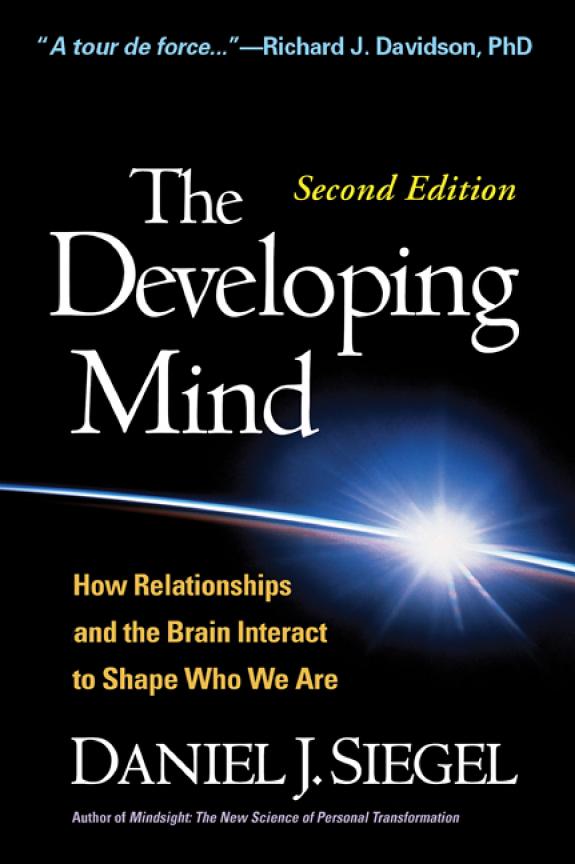
Daniel Siegel’s The Developing Mind accomplishes something no single text before it managed: it provides a rigorous, neurobiologically anchored account of mind as a self-organizing, emergent process that arises from the interface of neural activity and interpersonal relationship—and in doing so, it dissolves the false binary between developmental and archetypal schools that has fractured analytical psychology for decades. Siegel defines the mind not as brain, not as relationship, but as “the process that regulates the flow of energy and information” both within a single organism and between organisms. This formulation carries more philosophical weight than its clinical tone suggests. It places Siegel in direct, if unacknowledged, dialogue with Jung’s insistence that psychic energy flows through biological, psychological, spiritual, and moral channels simultaneously. As Jan Wiener recognizes in The Therapeutic Relationship, Siegel’s framework provides “a biological foundation” for her concept of the transference matrix—the co-constructed womb of analytic relating—because it demonstrates that “interpersonal experience may continue to influence neurobiological processes throughout the lifespan.” The mind is not housed; it is enacted, continuously, in the space between.
This has decisive consequences for how we understand the analytic encounter. Where Kleinian analysts insist that everything in the transference emerges from earliest unconscious fantasy, and classical Jungians privilege the archetypal and symbolic, Siegel’s model shows that the neural pathways mediating emotional regulation, memory, and interpersonal relatedness are literally shaped by early relational experience—and remain plastic enough to be reshaped by subsequent relational encounters, including the therapeutic one. The implication is that working in the transference is always simultaneously a neurobiological event: attunement between analyst and patient generates the resonance patterns that Michael Conforti, drawing on morphogenetic field theory in Field, Form, and Fate, describes as the psyche’s natural mechanism for processing novelty by cross-referencing it with what is already known. Siegel grounds this resonance in measurable neural integration. Conforti grounds it in archetypal field dynamics. The two accounts are not competitors; they describe the same phenomenon at different scales of analysis.
Integration Is Individuation Translated into the Language of Neural Circuitry
The book’s master concept is integration: the linking of differentiated components—left and right hemispheres, cortical and subcortical systems, self and other—into a functional, coherent whole. Siegel argues that mental health is not the absence of conflict but the presence of integration, and that the failure to integrate produces the rigidity or chaos characteristic of psychopathology. This is individuation by another name. Jung defined individuation as the process by which differentiated psychic contents are brought into conscious relationship with the ego and the Self, producing a more complete personality. Siegel’s integration operates on the same structural logic: differentiation without linkage yields fragmentation; linkage without differentiation yields fusion. The healthy mind, like the individuated psyche, holds complexity without collapsing it.
What Siegel adds that the Jungian tradition cannot supply on its own is mechanism. He shows how integration occurs at the synaptic level, how mirror neurons and the prefrontal cortex mediate the capacity for empathy and self-reflection, how implicit and explicit memory systems encode relational experience in distinct ways that produce distinct clinical presentations. This is the empirical scaffolding that Winnicott’s “potential space” and Siegel’s own notion of “mindsight” both require but neither provides independently. Winnicott, in Playing and Reality, describes the infant’s capacity for creative play as contingent on the mother’s reliability, which generates trust, which in turn opens the potential space between self and other. Siegel translates this into neurodevelopmental terms: the “good-enough” attunement of caregiver to infant literally constructs the prefrontal circuits that will later enable the child to regulate emotion, mentalize, and form secure attachments. The potential space is not merely metaphorical; it has a neural address.
Against the Parental Fallacy Without Abandoning the Relational Matrix
James Hillman’s The Soul’s Code mounts a fierce assault on what he calls the “parental fallacy”—the developmental psychology that reduces each person to “a result” of parenting, a mere effect of early causes. Hillman insists on the primacy of the acorn, the innate image, the daimon that precedes and exceeds all environmental influence. Siegel’s work stands as a sophisticated refusal of Hillman’s either/or. The Developing Mind demonstrates unequivocally that early relational experience shapes brain architecture, but it equally insists that the brain’s self-organizing properties and lifelong neuroplasticity mean that no individual is determined by early experience alone. The system is open, not closed. Genes express themselves differently depending on relational context; experience-dependent neuroplasticity means that the story is never only backward-looking. Siegel does not reinstate the parental fallacy; he reveals that the relationship between innate constitution and relational environment is recursive, bidirectional, and ongoing. The acorn and the soil are one system.
This is precisely why The Developing Mind matters now, at a moment when depth psychology risks splitting into camps that privilege either the archetypal-imaginal or the developmental-relational. Siegel’s interpersonal neurobiology provides a common substrate—not a reduction but a shared grammar—that allows the Jungian clinician to understand why Conforti’s morphogenetic fields produce the patterns they do, why Wiener’s transference matrix has the transformative power it has, and why Winnicott’s potential space either opens or closes. No other single text in the library performs this bridging function with such empirical precision. For the practitioner navigating between the claims of neuroscience and the demands of soul, this book is not background reading; it is the operating system.
Sources Cited
- Siegel, D. J. (2020). The Developing Mind: How Relationships and the Brain Interact to Shape Who We Are (3rd ed.). Guilford Press. ISBN 978-1-4625-4269-2.
- Bowlby, J. (1988). A Secure Base: Clinical Applications of Attachment Theory. Basic Books.
- Porges, S. W. (2011). The Polyvagal Theory: Neurophysiological Foundations of Emotions, Attachment, Communication, and Self-Regulation. W. W. Norton.
- van der Kolk, B. (2014). The Body Keeps the Score: Brain, Mind, and Body in the Healing of Trauma. Viking.
- Main, M., Kaplan, N., & Cassidy, J. (1985). Security in Infancy, Childhood, and Adulthood: A Move to the Level of Representation. Monographs of the Society for Research in Child Development, 50(1–2), 66–104.