 Seba.Health
Key Takeaways
- Wang Bi's commentary accomplishes what no other classical reading of the I Ching attempts: it strips the text of Han-dynasty cosmological machinery—yin-yang correlative numerology, five-phase correspondences, image-matching catalogues—and repositions each hexagram as a structural argument about situational coherence, making the Changes legible as philosophy rather than as divination or magic.
- Richard John Lynn's translation is the only major English rendering that foregrounds a single commentarial voice as its organizing principle, thereby revealing that the meaning of the I Ching has never been self-evident but is always a product of the interpretive framework imposed upon it—a hermeneutic lesson more radical than any particular hexagram reading.
- By treating the hexagram as a unified field governed by one "ruling line" whose positional logic determines the meaning of all other lines, Wang Bi introduces a proto-structural method that resonates with Jung's concept of the constellation of an archetype—an organizing center that subordinates peripheral elements to a single dominant pattern of meaning.
Wang Bi’s Erasure of Cosmological Clutter Reveals the I Ching as a Theory of Situational Intelligence
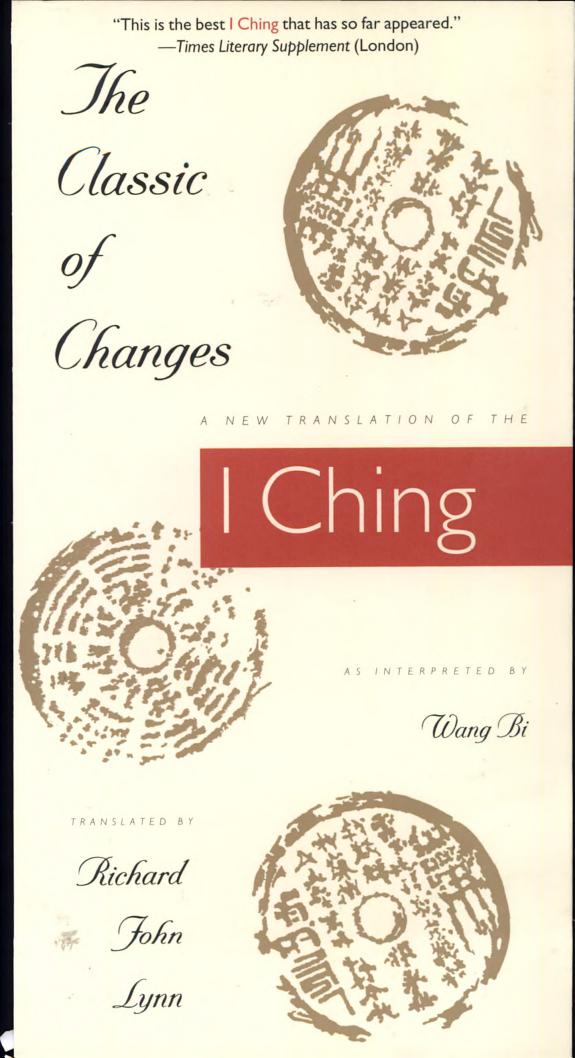
Wang Bi (226–249 CE) died at twenty-three, yet his commentary on the Zhouyi remains the most consequential act of philosophical clearing in the history of Chinese classical interpretation. What Richard John Lynn’s 1994 translation makes available for the first time in English is not merely another version of the sixty-four hexagrams but a demonstration of what happens when someone refuses the accumulated interpretive apparatus and reads the text as a coherent philosophical argument. The Han-dynasty commentators—Jing Fang, Yu Fan, Xun Shuang—had buried the Changes under layers of correlative cosmology: hexagram-line correspondences keyed to calendrical cycles, five-phase associations, trigram-image catalogues that mechanically mapped natural phenomena onto textual meaning. Wang Bi dismantled this entire edifice. As Richard Wilhelm noted in his own introduction, “the task of clearing away all this rubbish was reserved for a great and wise scholar, Wang Pi, who wrote about the meaning of the Book of Changes as a book of wisdom, not as a book of divination.” Lynn’s translation lets the English reader see exactly how that clearing was performed—not through polemic but through meticulous line-by-line commentary that replaces cosmological decoding with positional logic: which line is firm or yielding, where it sits in the hexagram’s internal hierarchy, what relationship it holds to the ruling line. The result is a text that speaks about how situations work—how authority coheres, how timing determines outcome, how a single element can organize or disorganize an entire field of forces.
The Doctrine of the Ruling Line Is a Theory of Psychic Constellation
Wang Bi’s most original contribution is his insistence that each hexagram possesses a “master” or “ruling line” (zhu yao) that determines the meaning of the whole figure. This is not a minor technical point; it transforms the hexagram from a collection of six independent oracular statements into a unified dramatic structure. The ruling line—often but not always the fifth position—functions as the organizing principle to which every other line responds, either in resonance or in tension. For readers versed in depth psychology, this structural move bears striking resemblance to what Jung described as the constellation of an archetype: a single dominant pattern that draws peripheral psychic contents into its gravitational field, giving them their specific significance within a particular moment. Jung’s own foreword to the Wilhelm/Baynes edition emphasized that the I Ching captures “the configuration formed by chance events at the moment of observation”—the qualitative unity of a moment. Wang Bi’s ruling-line doctrine provides the structural mechanics for how that unity holds together. Where Jung described the phenomenon phenomenologically through synchronicity, Wang Bi describes it architectonically through positional relationships. Lynn’s translation makes this parallel visible in a way that neither Wilhelm’s Confucian-flavored synthesis nor Ritsema and Karcher’s oracular-imagistic approach can, because Lynn preserves Wang Bi’s argumentative precision rather than dissolving it into poetic multivalence or moral paraphrase.
Lynn’s Translation Exposes the Hermeneutic Problem That Other Versions Conceal
Every major English translation of the I Ching embeds an interpretive stance that it presents as transparent access to the text itself. Wilhelm, guided by Lao Nai-hsüan, produced a version steeped in late-imperial Confucian synthesis and Song-dynasty Neo-Confucian cosmology—a magnificent achievement, but one that, as Alfred Huang observed, is “Westernized” in ways that “limit possible interpretations of a work that is famously open-ended.” Ritsema and Karcher explicitly sought to recover “the divinatory core, the psychological root of the book as a living practise,” stripping away Confucian moral philosophy to present raw imagistic fields. Lynn does something more epistemologically honest: he presents one historical commentator’s reading, clearly demarcated from the base text, and lets the reader see interpretation happening. Wang Bi’s commentary is not the I Ching; it is a third-century philosophical mind in dialogue with an ancient text, and Lynn frames it as such. This transparency is the book’s deepest gift. It teaches the reader that there is no unmediated I Ching—that every encounter with the text is already an act of interpretation shaped by the philosophical commitments the reader brings. Jung understood this implicitly when he noted that a clever person could “turn the whole thing around and show how I have projected my subjective contents into the symbolism of the hexagrams,” and that the Chinese sage would find this observation not damaging but illuminating. Wang Bi’s commentary, by being so visibly a commentary, makes the projective dimension of all reading inescapable.
The Philosophical I Ching as a Map of Individuation’s Structural Conditions
What makes this volume indispensable for anyone working at the intersection of Eastern thought and depth psychology is its refusal of both mystification and reductionism. Wang Bi does not treat the hexagrams as magical portals to spirit contact, nor does he flatten them into bureaucratic handbooks for statecraft. He reads them as analyses of the formal conditions under which situations cohere, transform, or collapse. Each hexagram becomes a phenomenology of a particular mode of being-in-time: how increase turns to decrease, how obstruction contains the seeds of breakthrough, how the quality of the center determines the fate of the periphery. For clinicians and analysts familiar with Edinger’s work on ego-Self dynamics or with Hillman’s insistence that psychology attend to the specific image rather than the general concept, Wang Bi offers a third position: attend to the structural relationship. The image matters, the archetype matters, but what matters most is where you stand in relation to the governing principle of the moment. Lynn’s translation makes this structural sensibility available with a clarity no other English edition achieves. For anyone who has used the Wilhelm/Baynes edition as a companion to Jungian practice and sensed that something philosophically rigorous was lurking beneath the poetic surface, this is the book that names it.
Sources Cited
- Wang Bi. (1994). The Classic of Changes: A New Translation of the I Ching as Interpreted by Wang Bi. Translated by R.J. Lynn. Columbia University Press.
- Cheng, C.-Y. (1977). Toward Constructing a Dialectics of Harmonization: Harmony and Conflict in Chinese Philosophy. Journal of Chinese Philosophy, 4(3), 209-245.
- Wilhelm, R. (trans.) & Baynes, C.F. (English trans.). (1950). The I Ching or Book of Changes. Princeton University Press.