Seba.Health
Key Takeaways
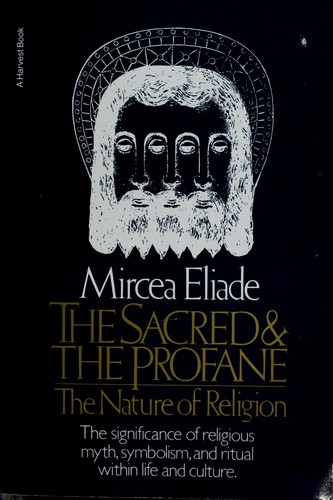
- Eliade does not argue that religion is a belief system; he demonstrates that sacrality is an ontological mode—a way of constituting reality itself—and that the profane world is not a neutral baseline but a privation, a loss of being that modern consciousness mistakes for freedom.
- The book's central engine is the concept of the hierophany, which dissolves the nineteenth-century opposition between "primitive animism" and "advanced monotheism" by showing that every manifestation of the sacred—from a stone to the Incarnation—operates by the same paradox: an ordinary object becomes something wholly other while remaining itself.
- Eliade reveals that modern "secular" experience is not the absence of religious structure but its degradation: birthplaces, first loves, and favorite cities function as crypto-sacred spaces, proving that the profane person has not transcended homo religiosus but merely lost conscious access to the ontological thirst that organizes all human orientation.
The Sacred Is Not a Category of Belief but the Ground of the Real
Eliade opens by distinguishing his project from Rudolf Otto’s. Otto, in Das Heilige, isolated the irrational core of religious experience—the tremendum, the mysterium fascinans—and described it phenomenologically. Eliade honors this but refuses to stop there. His ambition is to show the sacred “in all its complexity,” which means treating it not as a feeling but as an ontological structure. The sacred, for Eliade, is “pre-eminently the real.” This is not a metaphor. When he writes that “the polarity sacred-profane is often expressed as an opposition between real and unreal or pseudoreal,” he is reporting what homo religiosus actually experiences: that only what participates in the paradigmatic acts of the gods possesses genuine existence. Agricultural work performed as a reenactment of divine creation is real; the same work performed for economic profit is “opaque and exhausting,” revealing “no meaning” and making “no opening toward the universal.” The profane is not a neutral condition. It is a diminishment. This reframing has consequences far beyond religious studies. It positions Eliade alongside Jung’s insight in Symbols of Transformation that the psyche does not passively reflect reality but actively constitutes it through symbolic participation. Where Jung sees the symbol as the organ of psychic reality, Eliade sees the hierophany as the organ of cosmic reality. Both thinkers understand that the modern crisis is not a loss of belief but a loss of being.
Hierophany Replaces Evolutionary Models of Religion with a Structural Grammar
The concept of hierophany—“something sacred shows itself to us”—is Eliade’s most consequential contribution. By defining it minimally, he avoids the nineteenth-century trap of arranging religions on an evolutionary ladder from animism to monotheism. A sacred stone is not a “primitive” predecessor of the God of Abraham; both are hierophanies, instances of the same paradox: “any object becomes something else, yet it continues to remain itself.” This structural equivalence allows Eliade to juxtapose Mesopotamian temple symbolism, Australian Achilpa cosmology, Kwakiutl ritual, and Christian liturgy without reducing any to a stage in a developmental sequence. The method parallels what Joseph Campbell attempts in The Hero with a Thousand Faces, but Eliade is more rigorous precisely because he does not seek a single narrative archetype. He seeks a single mode of experience—the irruption of the sacred into the homogeneity of profane space and time—that generates infinite cultural variation. Every hierophany founds a world: it breaks the formless fluidity of undifferentiated space, establishes a center, and opens vertical communication between cosmic planes. Without this founding act, there is “no orientation,” no cosmos, only chaos. Eliade’s insistence that “every spatial hierophany or consecration of a space is equivalent to a cosmogony” makes the temple, the house, even the nomadic tent into repetitions of the original creation. This is the axis mundi doctrine, and it connects directly to Edinger’s reading in Ego and Archetype of the ego-Self axis as a psychological center that orients the personality—without which the psyche, like Eliade’s profane space, becomes an “amorphous mass” of disconnected fragments.
Sacred Time Is Not Nostalgia but Ontological Renewal
Eliade’s treatment of time is where his argument reaches its sharpest edge. Sacred time is “indefinitely recoverable, indefinitely repeatable.” It does not pass; it is “a succession of eternities,” an eternal mythical present that the festival makes accessible. The participant in a religious festival does not merely remember the primordial event; he becomes “the contemporary of the gods,” stepping out of profane duration into the time of origins. This is why the cosmogonic myth serves as “paradigmatic model for every creation or construction” and even as “a ritual means of healing”: “the sick man becomes well because he begins his life again with its sum of energy intact.” The implications for depth psychology are direct. What Eliade describes structurally, Jung describes clinically: the regression to origins that occurs in analysis—the return to the prima materia, the dissolution of rigid ego-structures—is not pathological retreat but an attempt to contact the regenerative source. Van der Kolk’s work in The Body Keeps the Score on trauma’s distortion of temporal experience—the way traumatic time loops, refusing to become “past”—can be read as the profane shadow of Eliade’s sacred time: a compulsive return to origins that has lost its ritual container and therefore its transformative power. Eliade would say that trauma traps the person in a pseudo-sacred time without the myth, without the paradigmatic model, without the festival structure that allows reintegration.
The Profane Modern Is Not Post-Religious but Crypto-Religious
Eliade’s most psychologically penetrating observation is that “even the most desacralized existence still preserves traces of a religious valorization of the world.” The nonreligious person retains “holy places” of a private universe—a birthplace, a scene of first love—where “he had received the revelation of a reality other than that in which he participates through his ordinary daily life.” This is not quaint sentiment. It is evidence that the ontological thirst Eliade identifies as the core of homo religiosus cannot be extinguished, only driven underground. The profane person does not transcend the sacred; he loses the framework that would make his own experience intelligible to himself. He still seeks the center, still craves orientation, still experiences breaks in the homogeneity of space and time, but he has no myth to guide the experience and no ritual to contain it. This diagnosis converges powerfully with James Hillman’s critique in Re-Visioning Psychology of modern psychology’s tendency to literalize the soul’s movements. Hillman argues that when the archetypal imagination is denied, it does not vanish; it reappears as symptom, compulsion, and projection. Eliade makes the identical argument at the cosmological level: when the hierophany is denied, the structures of sacred experience persist as degraded, unconscious, and therefore compulsive patterns.
This is why The Sacred and the Profane matters for anyone encountering depth psychology today. It provides the cosmological grammar that Jung’s psychology presupposes but never fully articulates. Jung describes the archetypes as patterns of psychic experience; Eliade shows that those same patterns once organized the entire experienced world—space, time, nature, labor, sexuality, death. To read Eliade is to understand that the modern therapeutic project of “finding meaning” is not a lifestyle preference but an attempt to solve an ontological emergency: the loss of the sacred as the structuring principle of reality itself.
Sources Cited
- Eliade, M. (1959). The Sacred and the Profane: The Nature of Religion (W. R. Trask, Trans.). Harcourt, Brace & World. ISBN 978-0-15-679201-1.
- Otto, R. (1923). The Idea of the Holy (J. W. Harvey, Trans.). Oxford University Press.
- Jung, C. G. (1968). Psychology and Religion: West and East (CW 11). Princeton University Press.