Seba.Health
Key Takeaways
- Eliade argues that sacred space and sacred time are not metaphors but structuring principles — traditional cultures organized all experience around hierophanies, breakthrough points where the transcendent irrupts into ordinary life.
- The axis mundi — the cosmic center connecting heaven, earth, and underworld — is a universal symbol that reappears across cultures as temple, mountain, tree, and pillar, providing orientation in an otherwise homogeneous world.
- Modern secular consciousness has not eliminated the sacred but driven it underground, where it persists in disguised forms — a claim that aligns directly with Jung's understanding of the repressed numinous returning as symptom.
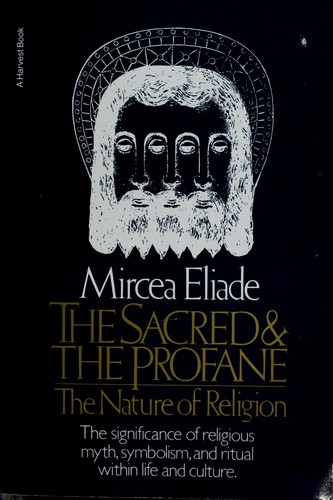
Mircea Eliade’s The Sacred and the Profane builds the morphological framework that Otto’s phenomenology requires. Where Otto identified the numinous as an irreducible category of experience, Eliade maps how traditional cultures organized the whole of life around that experience: how they built their houses, marked their calendars, initiated their young, and buried their dead according to the logic of the sacred. The result is a compact, architecturally precise book that reveals something the modern mind prefers not to recognize: that the desacralization of the world is not a neutral development but a catastrophic loss of orientation.
Hierophany and the Structure of Sacred Space
Eliade’s central concept is the hierophany — literally, a “showing of the sacred.” A hierophany is any event in which the transcendent breaks through the surface of ordinary experience: a burning bush, a sacred spring, a stone that marks the place where a god descended. The hierophany does not make the object magical. It makes it a threshold. The stone remains a stone, but it is also a portal, a point of contact between the human world and the ground of being (Eliade, 1959).
This is the logic that generates sacred space. For traditional cultures, space is not homogeneous. It has a center and a periphery, zones of intense meaning and zones of relative emptiness. The center is marked by the axis mundi, the cosmic pillar, mountain, or tree that connects the three levels of existence: heaven, earth, and underworld. Every temple is built as an axis mundi. Every city is laid out with reference to a center that is, symbolically, the navel of the world. To live in sacred space is to live in a cosmos — an ordered, meaningful whole. To live outside it is to inhabit chaos.
Eliade demonstrates this pattern with extraordinary cross-cultural range: the Hindu temple as the body of Purusha, the Roman mundus as the meeting point of living and dead, the Norse Yggdrasil as the world-tree holding the nine realms in place. The specific images differ. The underlying structure, a vertical axis connecting distinct planes of reality established by a foundational hierophany, repeats with the consistency of a natural law.
Sacred Time and the Eternal Return
The same logic governs time. For traditional cultures, time is not a linear progression from past to future. It moves in two registers simultaneously: profane time, which is irreversible and entropic, and sacred time, which is cyclical and regenerative. Rituals reactualize past events rather than merely commemorating them. The Passover seder does not remember the Exodus — it makes the participants contemporary with it. The initiation rite does not symbolize death and rebirth — it enacts them. Sacred time is the time of origins, the time when the gods created the world, and every ritual return to that time restores the world’s original vitality (Eliade, 1959).
This distinction matters for understanding what modernity has lost. Secular time is purely profane: one thing after another, without qualitative differentiation, without periodic renewal. The modern calendar marks dates but contains no thresholds. There is no moment in the modern year when time opens onto eternity, when the individual participates in the foundational acts that give existence its shape. The result is what Eliade calls the “terror of history” — the experience of being trapped in linear time with no access to regenerative origins.
The Sacred Gone Underground
Eliade’s most provocative claim is that homo religiosus does not disappear in secular modernity. The need for sacred space, sacred time, and contact with the transcendent persists, but without sanctioned forms of expression, it goes underground. The modern person who feels inexplicably moved by a particular landscape, who experiences certain dates as qualitatively different from others, who seeks out peak experiences through drugs, extreme sports, or aesthetic rapture, this person is enacting the same fundamental orientation that built temples and marked solstices. The difference is that the modern person does so without a tradition to contain and interpret the experience.
Jung made precisely the same observation. The gods, banished from their temples, take up residence in the diseases of the body and the neuroses of the mind. The numinous does not disappear when consciousness refuses to acknowledge it. It returns as symptom: compulsion, addiction, as the restless search for an unnamed something that no purchase, achievement, or substance can satisfy (Jung, 1968).
This convergence between Eliade and Jung is the reason this book belongs on the Awe and Beauty shelf. The Seba framework rests on the claim that awe-based stabilization is a therapeutic mechanism — that systematic exposure to the numinous, through nature, beauty, embodied practice, and imaginal encounter, can restore the regulatory capacity that addiction and trauma erode. Eliade provides the structural analysis that explains why this mechanism works: the psyche requires orientation, and orientation requires a center. Without a center, without an axis mundi, however modest or personal, experience remains flat, homogeneous, and vulnerable to the compensatory intensity that substances provide.
The Sacred and the Profane is the map of what was lost. Read alongside Otto’s phenomenology and Keltner’s neuroscience, it reveals the full architecture of the problem: a species built for the encounter with the sacred, living in a world that has forgotten how to provide it. Recovery, in this light, is the re-establishment of a cosmos — the forging of a personal axis mundi that reconnects the individual to the vertical dimension of experience that addiction had colonized and counterfeited.
Sources Cited
- Eliade, M. (1959). The Sacred and the Profane: The Nature of Religion (W. R. Trask, Trans.). Harcourt, Brace & World. ISBN 978-0-15-679201-1.
- Otto, R. (1923). The Idea of the Holy (J. W. Harvey, Trans.). Oxford University Press.
- Jung, C. G. (1968). Psychology and Religion: West and East (CW 11). Princeton University Press.