An old story lies under this image, and the tradition never tired of retelling it: a man swallowed whole by a sea monster, carried through the dark, and given back. From the Book of Jonah to the alchemists, the swallowing was treated as a specific event with a definite shape — a passage, not a panic — and that shape was given a name. The modern dream dictionary keeps none of this. It meets the whale and hands back a mood: something vast and emotional is looming, you feel small, you are overwhelmed. That reading mistakes the animal’s size for its meaning. A whale is not a big feeling; it is the largest living thing, the sea’s own body come up from underneath. The dream in which its mouth opens is not about being impressed by scale. It is about being taken in — swallowed, carried down, held in a dark interior below the waves.
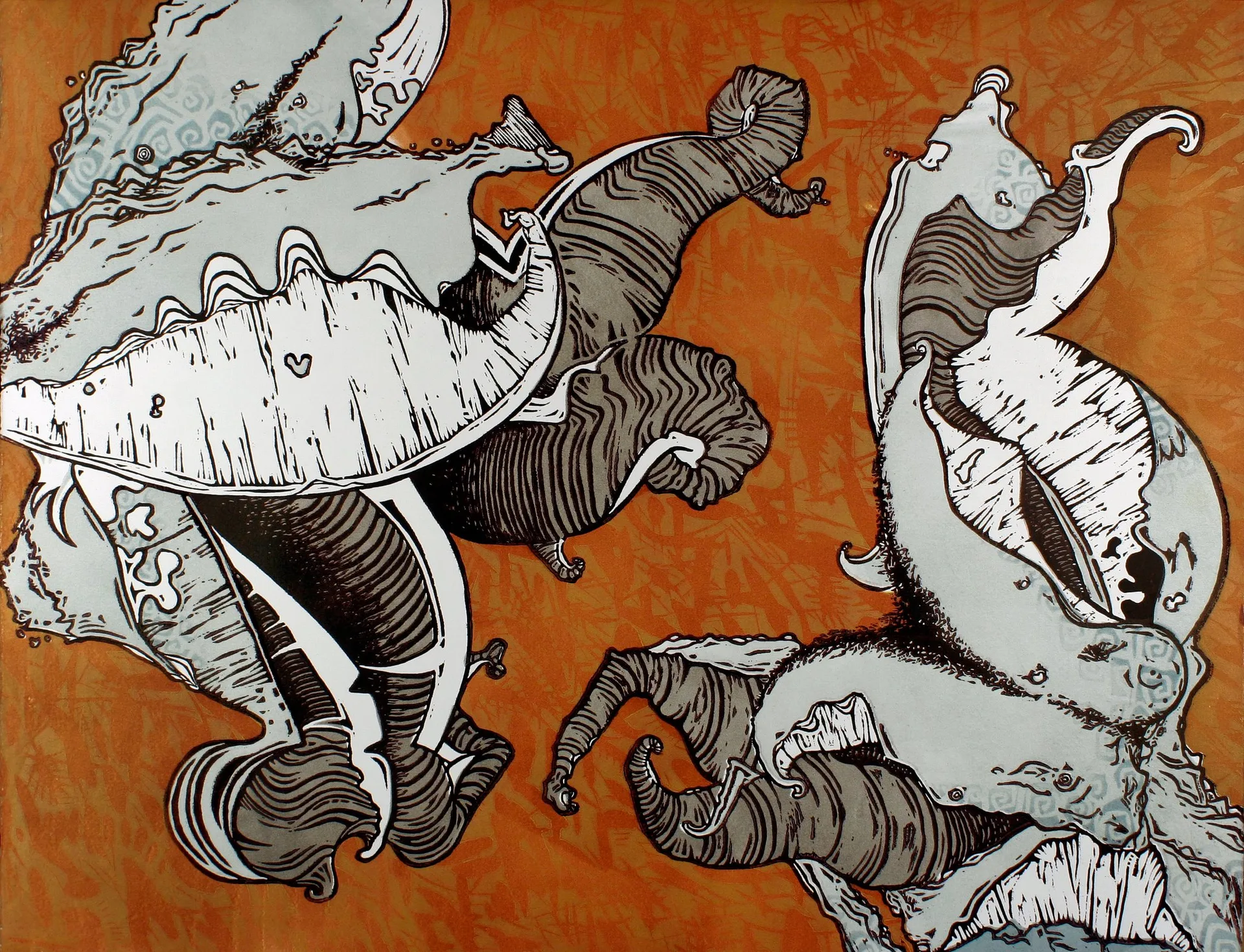
Begin with what the image is actually doing. It is not merely showing you a whale; it is putting you inside one. That interior has a lineage. James Hillman gathers the whole family of it in a single passage: in the Bible, he writes, “Jonah, abandoned by his shipmates, had to remain for a time in the belly of a great whale sunk in the depths of the sea. In that darkness he generated heat, lost his hair. Solitary confinement; utter internality. This is the Nekyia, the night sea journey through the underworld made also by Odysseus, Aeneas, and Hercules, and by Eurydice, Inanna, Persephone, Psyche, by Orpheus, by Christ” (Hillman, Alchemical Psychology, 2010). To be swallowed is to enter that company. The whale is the vessel of the descent, and its belly is the underworld’s antechamber — a solitary confinement whose temperatures, Hillman notes, are “suitable only for demons, ghosts, heroes and heroines, goddesses and shades who are no longer altogether of the upper world.”
Jung read the swallowing as the oldest heroic pattern there is. In Man and His Symbols he sets it beside the dragon-fight and finds it the more passive, more fateful form: “A familiar type is that of Jonah and the whale, in which the hero is swallowed by a sea monster that carries him on a night sea journey from west to east, thus symbolizing the supposed transit of the sun from sunset to dawn. The hero goes into darkness, which represents a kind of death” (Jung, Man and His Symbols, 1964). This is the crucial correction to the dictionary’s flat dread. The going-in is not the disaster it feels like; it is the first half of a passage patterned on the sun’s own disappearance and return. Jung is candid that this is not merely mythology observed from outside: “I have encountered this theme in dreams presented in my own clinical experience.” The whale-belly dream is the individual psyche rehearsing the sun’s nightly death.
But the darkness has two faces, and the tradition insists on both at once. Edward Edinger tells a Jewish legend of which he is “particularly fond”: “after Jonah was swallowed by the whale, the whale gave Jonah a kind of excursion through all the profound mysteries of the universe.” The whale showed him where the earth had opened, where the sea had parted, “the underwater entrance to Gehenna — to Hell,” and finally “the river of youth at the gates of the Garden of Eden.” So, Edinger concludes, “Jonah’s sojourn in the belly of the whale became an initiation into the mysteries of the universe at the same time that it was experienced in its conventional form as a disaster — as being swallowed up and lost to the upper world” (Edinger, The Mysterium Lectures, 1995). The same containment is both catastrophe and revelation. Steven Herrmann, recounting this same legend, draws the psychological law out of it directly: “an encounter with the unconscious brings first darkness, disorientation and distress; but if one persists in scrutinizing the experience, its consequence is to enlarge the personality and bring one closer to wholeness” (Herrmann, Murray Stein: Individuation, Transformation, and the Ways to the Self in Jungian Psychology, 2025). What arrives dressed as being lost is, if one stays with it, the deep things of God.
This double aspect is why the whale in the dream is not simply a threat to be escaped. Marie-Louise von Franz, reading the alchemists who set Jonah emerging from the whale beside the making of the philosopher’s stone, defines the descent’s goal exactly: the “night sea journey” is “a state of conflict and depression in which one is forced to pay attention to the unconscious,” and it “is equivalent to the philosopher’s stone” (von Franz, Alchemy: An Introduction to the Symbolism and the Psychology, 1980). The depression, the being-swallowed, the enforced attention to what lives below — these are not obstacles to the work. They are the work. The whale is the container in which a one-sided daylight self is dissolved and something more complete is made.
There is a harder edge to the image, though, and the tradition keeps it in view. To be inside the whale is also to be at the mercy of what could keep you. Sallie Nichols, reading the Moon card as the Dark Night of the Soul, describes the danger precisely: the hero “like Jonah in the whale’s belly, must overcome the monster which can devour his consciousness and hold it captive,” a victory “over the devouring aspects of the unconscious, which would otherwise engulf his ego consciousness” (Nichols, Jung and Tarot: An Archetypal Journey, 1980). The whale is kin here to the devouring mother, the regressive pull of the deep that would dissolve you and not give you back. The dream holds this tension without resolving it: the same waters that initiate can also drown, and the belly that shelters can also become a grave.
And yet the pattern bends, finally, toward return — and toward a return that is never solitary. Jung, tracing the hero myth through Isaiah’s imagery of a woman in labor, notes that on his exit from the whale the hero “brings with him not only his parents but the whole company of those previously swallowed by the monster—what Frobenius calls the ‘universal slipping out’” (Jung, Psychological Types, 1921). The one who is swallowed and comes back does not come back alone. He brings the dead up with him. Joseph Campbell fills the belly with a whole comparative crowd of the swallowed and the emerging — the Zulu children inside the elephant who found “large forests and great rivers, and many high lands” within it, Finn MacCool inside his peist, the Greek pantheon inside Kronos — and reads Jonah among them as one “of whom it is said in the Midrash that in the belly of the fish he typifies the soul of man swallowed by Sheol” (Campbell, The Hero With a Thousand Faces, 2015). The interior of the monster is, in every telling, a place one is meant eventually to leave, carrying more than one carried in.
So when the whale rises in the dream and its mouth opens, do not ask only how large your fear has grown. Ask what is meant to be carried down, what daylight certainty is being taken under, what “utter internality” is being asked of you before the sun can come around again. The image holds both at once: the belly that is a tomb and the belly that is a womb, the disaster of being lost to the upper world and the excursion through its profound mysteries. It does not tell you which one you are inside of. It only closes the water over your head and waits to see what, three days on, slips out.