The dream dictionaries have a stock answer: bugs mean something is “bugging” you, a small irritation you have not dealt with, anxiety multiplying out of control. They convert the image into a nag and move on. But the dream did not send a nuisance. It sent a particular creature doing a particular thing — a wasp working through a screen, a worm in damp earth, a swarm pouring out of a drawer, a single bee crowned with light. The tradition does not read “insect” as a synonym for worry. It reads the bug as something small that crosses the threshold of the self and changes who is in charge there, and the only useful questions are which creature came, what it was doing, and whether you tried to kill it.
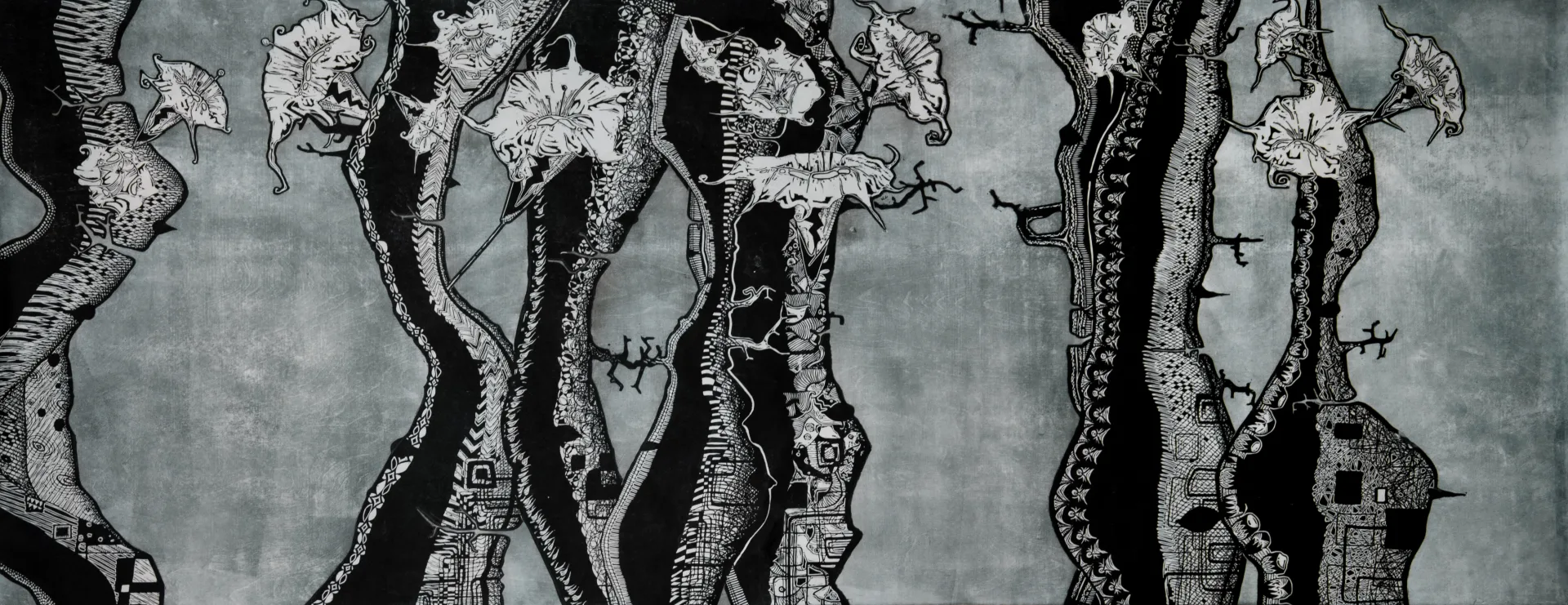
Start with the fear, because it is real and the dream often stages it. James Hillman gives the panic its proper size. The terror in vermin dreams, he writes, is “the fear of being eaten up by one’s complexes… disintegration into myriad parts, infestation with discarded filth (the return of the repressed)” — a “huge human under the influence of a tiny bug” becoming “a rabid personality” (Hillman, Animal Presences, 2008). That is the genuine dread the dictionaries gesture at and never name: not that bugs are gross, but that something microscopic can enter and take over the host. Yet Hillman refuses to stop at the horror. The parasite, he proposes, may be sapping “the overly controlling ego” precisely to “restore a more moderate relation between it and the cosmos.” The infestation shows the dreamer “how it depends in tiny hidden ways upon other psychic organisms” — the complexes we feed on without admitting it.
Notice what the insect does to the shape of the dream. For Hillman the bug is a catalyst of rupture: “An initial pattern is invaded, broken, and something else starts.” The dream “presents catastrophe theory — sudden breakdown of one pattern as another emerges — and the insect were its catalyst” (Hillman, Animal Presences, 2008). The wasp that finally gets through the screen, the fly that “keeps buzzing” while the dreamer “can’t speak or move” — these are not pests but the instant of waking-up-within-the-dream, “consciousness in the unconscious as a light in nature… shaped as a beetle, wasp, or fly.” Sometimes the recognition goes further, into identity: a dreamer finds “the body of a large insect, like a grasshopper… I am amazed that the insect has my face.” To say I am an insect, Hillman notes, need not carry “the Kafkaesque horror”; here it reveals “beauty, gentleness and sadness.”
The Greeks would not have been surprised that the soul shows up winged and small. Karl Kerényi records the astonishing fact at the root of the language: “In Greek, the butterfly has the same name as soul, ψυχή” — the word psyche meaning, by one account, “soul” first and “butterfly” only later, “a double meaning… unparalleled in any other language” (Kerényi, Hermes Guide of Souls, 1944). The fluttering thing and the immortal thing share one name. And the connection ran through death: Jan Bremmer, surveying archaic soul belief, finds creatures “that seem to have come into existence only at the hour of death such as the snake in Greece or the butterfly in Estonia” — animals taken to “represent the body souls” (Bremmer, The Early Greek Concept of the Soul, 1983). The insect is what leaves the body, or what is born the moment the body fails. To dream of one is to dream at that seam.
This is why the alchemists, watching matter rot, kept their eyes on the worm. Edward Edinger ties the crawling creature to the putrefactio, the blackening: “Worms accompany putrefaction, and dreams of worms convey this image with powerful impact.” But the dream-logic is paradoxical — “the despicable worm can turn into the supreme value,” the figure equated even with the Messiah, “a worm and no man” (Edinger, Anatomy of the Psyche, 1985). Lyndy Abraham makes the reversal exact. In the vessel the “mercurial worm devours the old corrupt body… and reduces it to its prima materia”; it is “both the devouring worm of death consuming all corruption and the nourishing worm of life,” carrying the old dictum “that the worm of corruption leads to generation” (Abraham, A Dictionary of Alchemical Imagery, 1998). The thing that eats the dead matter is the same thing that feeds the new life. Nothing regenerates that has not first been broken down by something small and hungry.
So bring the registers together over a single dream-image and the meaning refuses to settle. The bug is the complex that has slipped inside the house of the self; the catalyst that breaks one pattern so another can start; the soul itself in its oldest winged form; the agent of decay that is also the agent of birth. Which it is depends on the verb and on your hand in the dream. Hillman lingers on a woman who watches insects burned alive, “but in the middle is a very big butterfly cocoon, a really tough creature… It keeps coming out of the fire, staying alive” (Hillman, Animal Presences, 2008). The thing you most want to exterminate is often the thing that will not die — and that “tough autonomy of the will to live” may be the dream’s whole point. The bug came through the screen for a reason it will not state plainly. Before you reach for the swatter, the dream is asking a quieter question: what in you is trying to get in, or to get out — and what would be born if you let it finish.