The dream dictionaries reach for one of two cards. Fish means fertility, abundance, something good swimming toward you; or fish means a slippery feeling, a thing you can’t quite grasp. Either way the entry closes the image before it has a chance to move. But a fish in a dream is never just fish. There is the fish glimpsed in clear water and the one hooked and hauled up; the single fish circling and the swarm; the fish you eat and the fish that eats. The tradition does not assign the image a meaning. It asks where the fish is — how deep — and which way it is going: down into the dark, or up into the light.
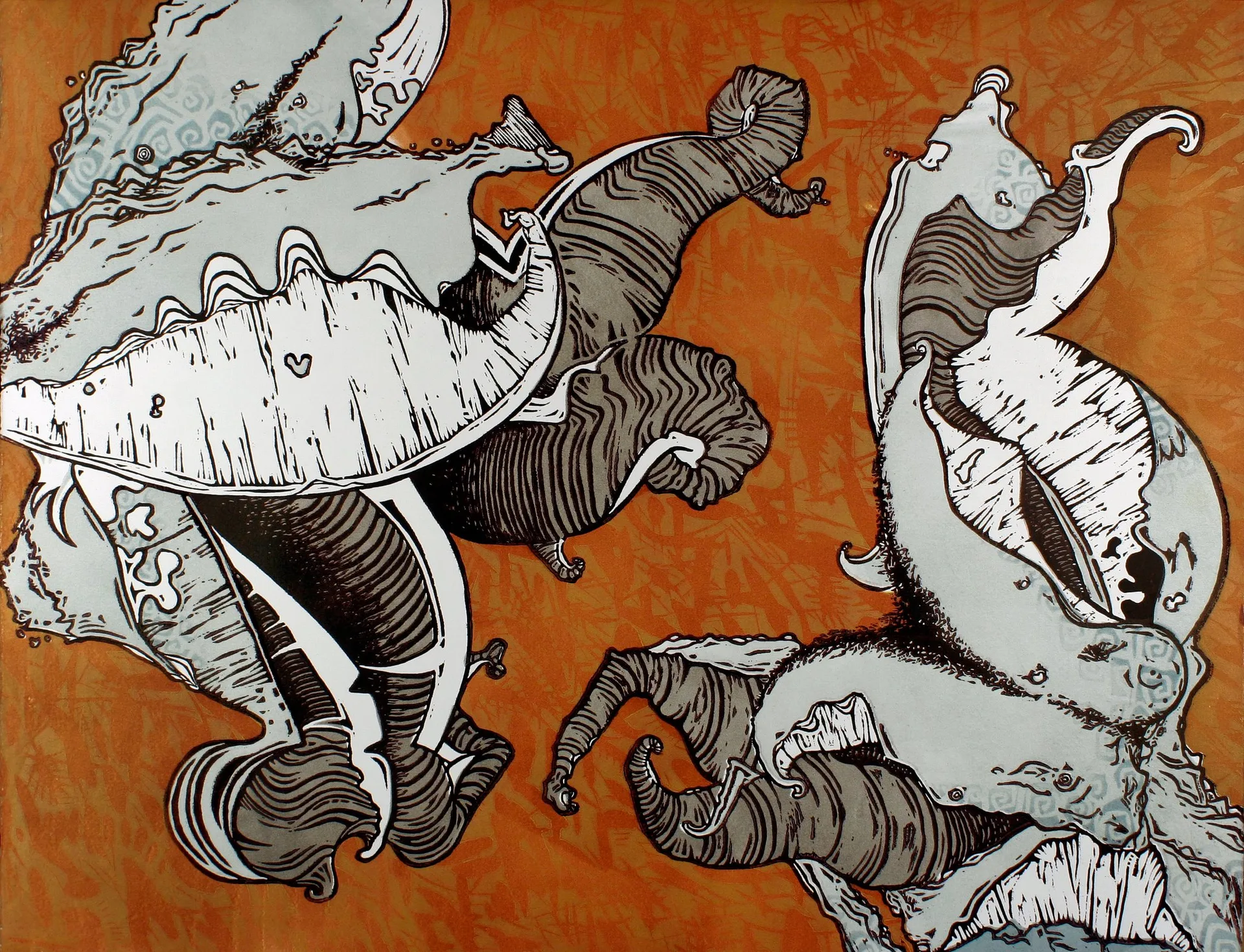
The starting point is the water, not the creature. Jung is blunt about it: “in alchemy ‘our sea’ is a symbol for the unconscious in general, just as it is in dreams” (Jung, Aion, 1951). The fish is what lives there — a content, not the medium. He draws the distinction precisely: where the snake “personifies the unconscious,” the fish “usually represents one of its contents,” and so a fish surfacing marks something more differentiated than mere instinct, something “endowed with higher authority” (Jung, Aion, 1951). The dream fish is a piece of the depths that has taken shape enough to be seen, and possibly caught.
That catching is the whole drama. Edward Edinger reads the fish as fundamentally double: “On the one hand it is a cold-blooded creature of the depths and thus represents unconscious instinctuality akin to the dragon. On the other hand it is a symbol for Christ. Thus it symbolizes both the redeemer and that which is to be redeemed” (Edinger, Ego and Archetype, 1972). He tells of a man’s dream at the start of analysis — a golden fish caught with difficulty, its blood to be boiled to a permanent fluid without clotting. The fish had to be landed before the work could begin. Marie-Louise von Franz hears the same note: the prickly fish laid on the altar is no random catch but the old soteriological emblem, for “both Christ and the fish are symbols of the Self,” and she reaches back past the Gospels to recall that “the Greek philosopher Anaximander suggested that man was descended from a prickly fish” (von Franz, The Interpretation of Fairy Tales, 1970). The fish is older than the cross. It is the deep thing that turns out to carry the saving substance.
Which is why so many traditions placed it at the start of life rather than the end. Anne Baring tracks the fish through the Neolithic shrines of Lepenski Vir, the half-human fish deities shaped like an egg or a womb: “The natural element of the child before birth, like that of the fish, is water, and the sign of imminent birth is the breaking of the waters” (Baring, The Myth of the Goddess, 1991). The fish is “the new life that emerges from the egg in the watery womb of the sea,” the Chaldean fish-god Oannes who climbs from the water to teach civilization, the Ichthys of the early church, Christ seated in the fish-shaped oval “that is both egg and womb” carved over cathedral doors (Baring, The Myth of the Goddess, 1991). A fish in a dream can be the first stirring of something not yet born in you, still gilled, still underwater, still its own element.
But the deep is not benign, and the tradition never lets you forget it. The fish that can be caught can also swallow. Jung names the great pattern: “Jonah and the whale, in which the hero is swallowed by a sea monster that carries him on a night sea journey from west to east.” The hero “goes into darkness, which represents a kind of death” — a descent he says he has met in his own patients’ dreams (Jung, Man and His Symbols, 1964). And in Aion he watches the symbol curdle, the redeeming fish darkening into “the great ‘fish’” that “gradually split into its opposite,” into Leviathan, “the embodiment of his evil side” (Jung, Aion, 1951). The same creature feeds you and devours you, depending on which way the dream is running.
The Greeks knew the unfriendly version most intimately of all. Emily Vermeule recovers a sea utterly without comfort — pontos ichthyoeis, the fish-way, where “under the bridge creatures wait to bite you if you fall off,” a path “more like a tightrope over an open tiger-pit than a safe road home” (Vermeule, Aspects of Death in Early Greek Art and Poetry, 1979). In Homer the worst fate is to be lost to that water: “either the fish have eaten him in the sea or he is dessert for the animals and birds on dry land.” These poetic fish are “silent stealthy hunters, voiceless,” eating their food raw like lions and like Achilles, and to be their food “is worse than for birds and dogs, because it is harder to find the body again, and bury it properly” (Vermeule, Aspects of Death in Early Greek Art and Poetry, 1979). To dream of being in the water with the fish, rather than holding one in your hand, is to dream the older terror: dissolution without a grave.
So the question the dream asks is not whether fish means luck or means evasion. It is a question of position and direction. Are you above the water looking down, or under it among the swarm? Is the fish surfacing toward you, a content of the deep that has finally taken a shape you can land — or are you being carried down into the belly of it, west to east, through the dark that is a kind of death? The image holds both: the thing to be caught and the thing that catches, the redeemer and what must be redeemed. The dream is not telling you the fish is good or bad. It is asking whether you are ready to go down to where it lives, and whether what comes back up will be something newly born.