The dream dictionaries answer in a single word: the basement is the unconscious, the part of you that you keep down out of sight. Sometimes they sharpen it to the negative — repressed fear, buried shame, the dark you would rather not enter. It is not wrong, exactly. But it is the kind of answer that closes a door instead of opening one. James Hall warned against precisely this reflex, refusing to compile “an encyclopedic list of dream motifs and their usual meanings,” which would “move in the direction of a ‘cookbook’ of dream interpretations” that is “misleading as well as inappropriate” because “all dream images are contextual” (Hall, Jungian Dream Interpretation, 1983). The basement is not one image. There is the basement you descend into and the one you discover you did not know you had; the flooded basement and the elegant one; the cellar full of the dead and the cellar where something is still being built. The only useful questions are what kind of basement this is, and what you find when you go down.
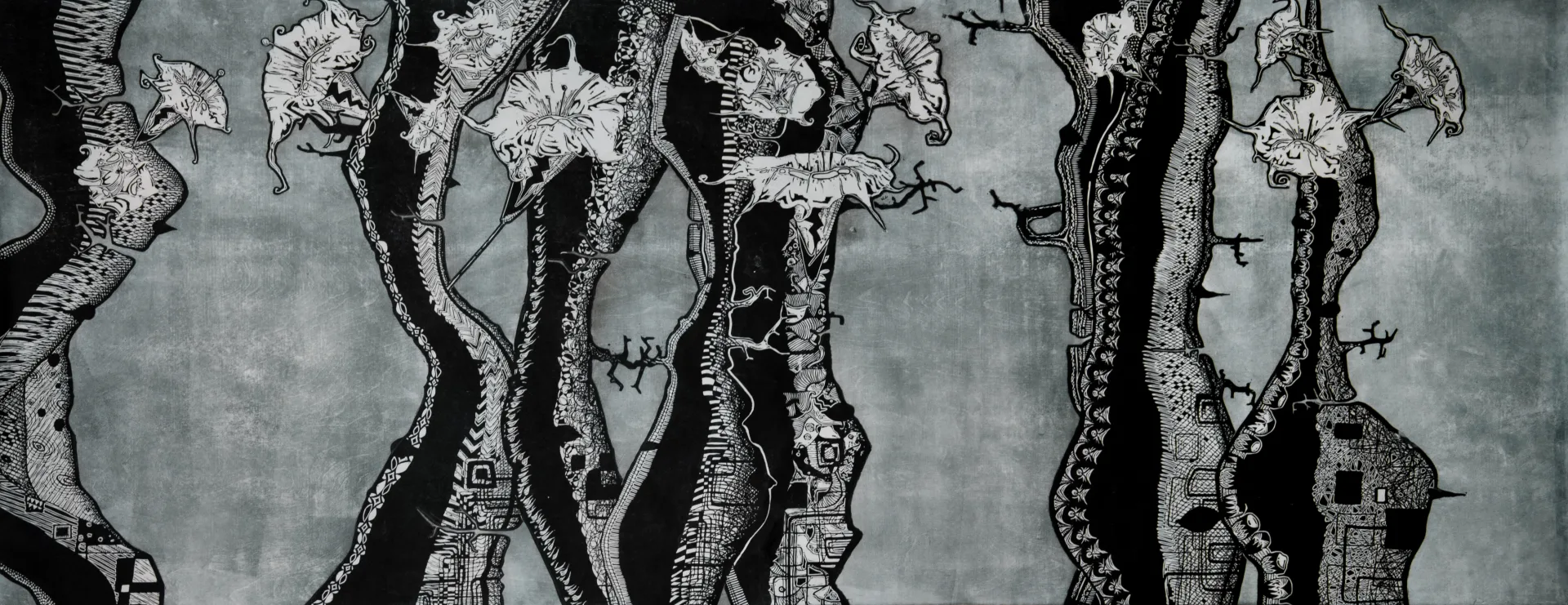
The image begins with the house itself, the oldest map of the psyche we have. Jung dreamed his way into it. He went down “to the cellar, where I found a door opening onto a flight of stone steps that led to a large vaulted room,” its walls “of Roman origin”; then “an iron ring on a stone slab,” and beneath it “a kind of cave, which seemed to be a prehistoric tomb” (Jung, Man and His Symbols, 1964). The descent was a descent in time. He took it as “a guiding image which in the days to come was to be corroborated,” reading the lower storeys as the layers of the collective unconscious sedimented beneath the lit rooms of the day (Papadopoulos, The Handbook of Jungian Psychology, 2006). The basement, in this reading, is not where you hide. It is where you are old — where the house rests on foundations older than you.
Gaston Bachelard, reading houses as the imagination reads them, set the cellar against the attic with great precision. Where the upper rooms hold “dream values which remain after the house is gone,” the lower space is governed by a different law: “space that has been seized upon by the imagination cannot remain indifferent space subject to the measures and estimates of the surveyor” (Bachelard, The Poetics of Space, 1958). A basement is never merely square footage. It is “lived in, not in its positivity, but with all the partiality of the imagination” — which is why the same staircase down can read as refuge or as dread depending entirely on who is descending.
James Hillman pressed harder on what below means, and refused to let it stay metaphor. The work of depth, he wrote, is “to pay special attention to whatever is below,” and he made the inventory concrete: “burials, the dead, ancestors; workers in refuse, sewers, plumbers; criminals and outcasts; the lower body… the underside of the world, the floor of the sea, the downstairs and cellars” (Hillman, The Dream and the Underworld, 1979). The basement belongs to this catalogue of the dishonored and the discarded. To go down is to go among what the day has thrown away — and, in Hillman’s reading, to find that the refuse is not refuse at all but “anything whatsoever that can be turned over… to reveal a deeper significance.”
The Greeks built the descent into architecture. At the oracle of the dead, Walter Burkert records, the seeker passed through “the approach corridor, once completely dark,” through “a labyrinth with many doors into the central chamber, beneath which a vaulted crypt represents the world of the dead” (Burkert, Greek Religion, 1977). This is the basement made sacred: a literal underground room whose purpose was contact with the buried. The dream-basement carries that ancient charge. The stairs down are the stairs to the dead, and the dead, in the old understanding, are precisely what we go below to consult.
And sometimes the basement is a discovery rather than a return. Murray Stein records a dream in which a woman walks through her house to answer the door and leads her guests “to the guest rooms in the basement, which until then she had not realized existed.” The basement “is a discovery. It is much larger than the house itself — six times as big! — and beautifully laid out.” She must warn them of “the water at the entrance,” for “boots are required to pass over the threshold” (Stein, Transformation, 1998). Here the basement is not what was buried but what was unbuilt and unknown — vastness under the floor, with water at the door, asking to be crossed.
When the basement holds something locked rather than spacious, the trauma traditions name the mechanism. Donald Kalsched describes how, under overwhelming affect, “dissociation operates by splitting the child’s attention” so that the unbearable “falls into the background — into ‘implicit memory’”; the fragments are “laid down in implicit memory only,” undifferentiated, accruing “archaic and typical (archetypal) enhancements” in “the deep layer of the psyche” (Kalsched, Trauma and the Soul, 2013). This is the basement that floods, that you do not remember finishing, where something is sealed behind a door. It is not metaphor for what you suppress in the ordinary sense. It is the actual lower room where what could not be felt was put.
So the dream is not telling you that you are hiding something. It is asking what you keep below, and whether you are ready to go down to it. The basement is where the house is oldest and where the dead are kept, where the discarded waits to be turned over, where a room you never knew you owned opens out six times the size of the life above it — and where, sometimes, water stands at the threshold and the door is locked from the inside. The descent is the whole point. The dream has already built the stairs. It is only waiting to see whether you will take them down.