The water is still, and one of the shapes in it is not a log. It lies submerged to the eyes, motionless; another surfaces; a third lunges from the bank in a blur of jaws; a fourth simply lies in the sun and does not move at all. The dictionaries answer before the water has stilled: a hidden enemy, a lurking betrayer, treachery you have not yet seen. The crocodile becomes a warning to watch your back, and the image is closed. But the beast in the dream is never just a threat with teeth. The tradition does not read the crocodile as an enemy. It reads it as the oldest thing in us, surfacing where the conscious mind least expects it — and the only useful questions are what it is doing, and whether you can bear to look at it without flinching.
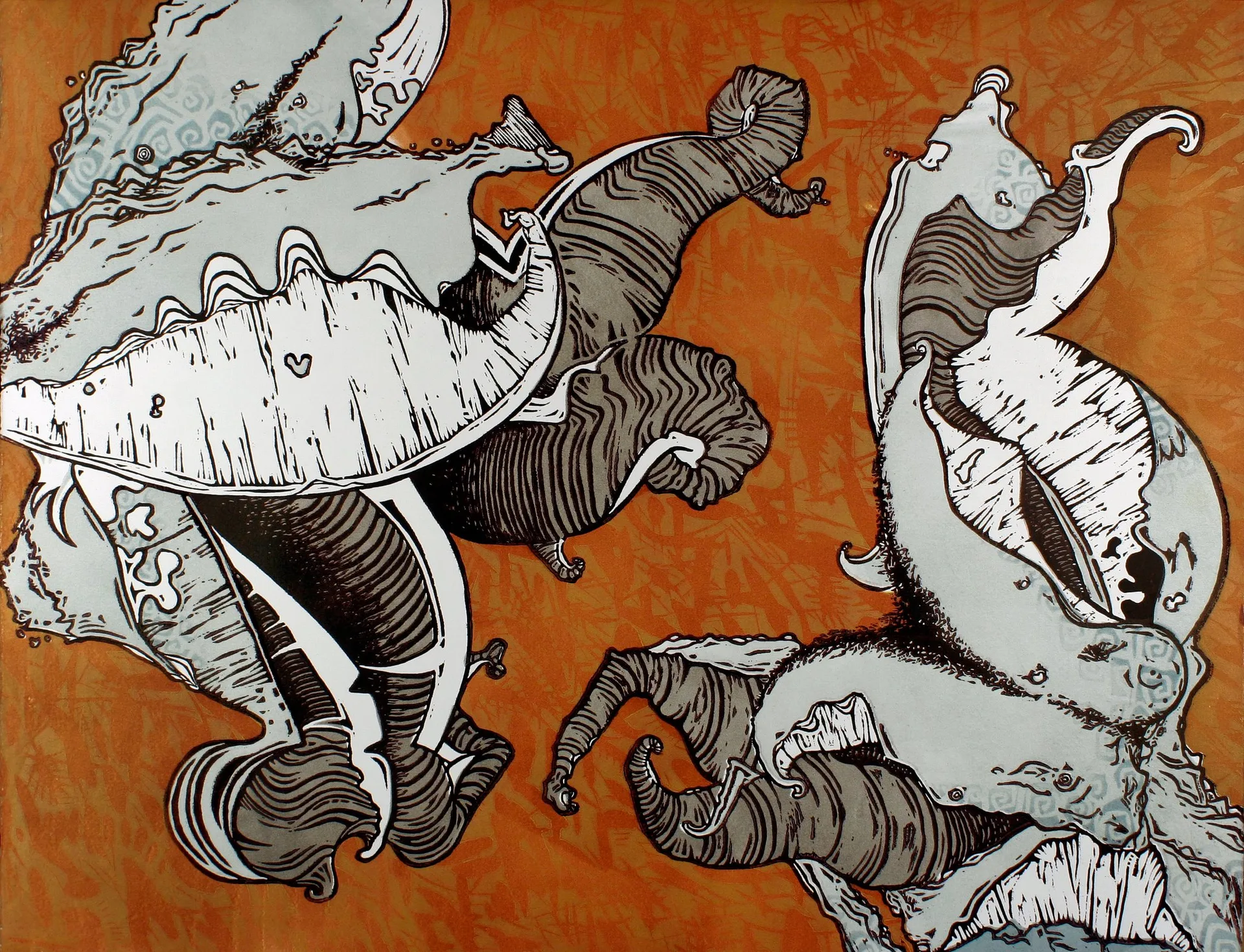
Jung met this animal directly. In his 1928–1930 dream seminar a patient dreams of a crocodile in a hut in Upper Egypt, and Jung will not let it be a danger sign. “The crocodile, as well as the tortoise and any other cold-blooded animal, represents extremely archaic psychology of the cold-blooded thing in us,” he tells the seminar — the part of our nature “dating from paleozoic times,” the partie inférieure of the instinct, “primitively instinctual” (Jung, Dream Analysis: Notes of the Seminar Given in 1928–1930, 1984). What unsettles him is not that the reptile is hostile but that it is unreachable. Citing the animal trainer Hagenbeck, he notes that one can establish a psychic rapport with nearly every warm-blooded creature, “until one comes to snakes, alligators, and such creatures, and there it comes to an end.” The crocodile is “beyond human reach.” That is its meaning: a layer of yourself with which you cannot make compromises.
And so its appearance is not a caution but a summons. “When a crocodile or any saurian turns up,” Jung says, “one may expect something quite unusual to happen.” The saurian rises when “life means business, when things are getting serious,” when “vital contents are to appear from the unconscious” (Jung, Dream Analysis, 1984). The patient who finds the crocodile in the sacred Egyptian hut has wandered into a holy place — Jung reminds the seminar that the crocodile was a cult animal in Upper Egypt — and there, precisely where the spirit is, “the most primitive instincts come up.” Where there is a church, he adds, the devil is not far away.
The myth keeps the beast at the water’s edge, exactly where the dream tends to set it. Emily Vermeule, reading the monster of early Greek imagination, finds the sea itself “ever double-faced and changeable, sometimes the way to paradise and sometimes the jaws of death, but never predictable” (Vermeule, Aspects of Death in Early Greek Art and Poetry, 1979). The devouring beast she calls the ketos — the thing that swallows the hero whole, from whose belly the armed man climbs back out alive. That is the older fantasy beneath the reptile in the shallows: not an attacker to be evaded, but a maw one might be taken into and, just possibly, returned from.
Erich Neumann gives the swamp its psychology. The “unconscious life of nature,” he writes, is “like the swamp,” which “begets, gives birth, and slays again in an endless cycle” — the realm of the uroboric Great Mother who is at once “terrible and devouring, beneficent and creative” (Neumann, The Origins and History of Consciousness, 2019). To the emerging self, this devouring depth “appears as a dragon to be overcome,” “the devouring maw of the earth, into which, weary and submissive, the ordinary mortal sinks.” Yet Neumann insists the swallowing is not the end of the story but its hinge: even in the victor’s myth “there is a phase of captivity and defeat,” and “this phase is the necessary prelude to rebirth.” The crocodile in the murky water is the threshold of that swamp — the place where one is either dissolved or born.
The body knows this animal too, and reacts before thought. Peter Levine locates the freeze beneath everything else in “the reptilian brain,” the instinctual core older than feeling or reason; when the predator strikes and escape is impossible, the prey enters “the immobility or freezing response,” a state “very similar to death” (Levine, Waking the Tiger, 1997). It is the crocodile’s own logic turned inward: the beast that waits motionless at the bank, and the body that goes motionless before it, are the same archaic nervous system meeting itself. Pat Ogden notes that such a defense, once frozen in, can be thawed — the abandoned impulse “to run away,” the power waiting in the legs, recovered when the body is finally allowed to finish the act it could not complete (Ogden, Trauma and the Body, 2006). The dream of the lunging reptile may be that interrupted motion asking, at last, to move.
So the crocodile is not one idea, and James Hillman warns against trying to meet it with one. The serpent and dragon, he writes, are “a primordial form of life, or life in its primordiality,” whose “meanings renew with its skin and peel off as we try to grasp hold”; the many-headed beast tells us “we cannot meet it with one idea alone” (Hillman, Senex & Puer, 2015). To pin the crocodile to “an enemy” is to do exactly what the cold-blooded thing forbids — to grasp what slips, to compromise with what makes no compromises.
The image holds its hand open between being devoured and being reborn. What surfaces in the dark water is the oldest layer of you, the one the daylight mind cannot reach and cannot befriend. The dream is not telling you to watch your back. It is telling you that something paleozoic in you has stirred, that life has begun to mean business — and asking whether you can stand at the water’s edge and let it rise.