Seba.Health
Key Takeaways
- Kalsched's central achievement is not a theory of trauma but a theory of defense: he demonstrates that the psyche's self-protective response to annihilation becomes the primary source of ongoing suffering, making the cure itself the disease that must be cured.
- By treating dream imagery as the psyche's self-portrait of its own dissociative operations, Kalsched collapses the Freud-Jung split into a single clinical optics — neither wish-fulfillment nor compensation, but a third category: archetypal defense rendered visible in the moment of therapeutic crisis.
- The book redefines Jung's Self under conditions of trauma as fundamentally ambivalent — both savior and torturer of the personal spirit — thereby challenging any monistic or perfectionist theology of the Self and aligning Jungian metapsychology with the darkest findings of object relations theory.
The Psyche’s Protector Becomes Its Jailer: Kalsched Locates Pathology Not in the Wound but in the Defense
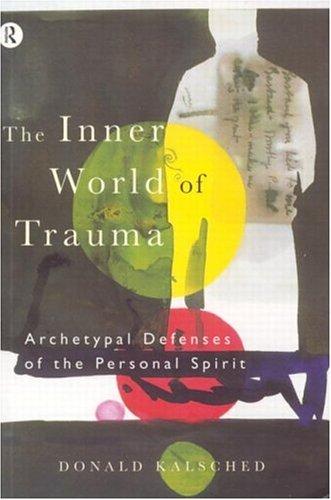
Donald Kalsched opens The Inner World of Trauma with a deceptively simple clinical observation that reorganizes the entire field of trauma psychology: the most devastating thing about early trauma is not the original event but the archaic defense system that crystallizes in response to it. Splitting, projective identification, trance-states, depersonalization — these are not symptoms to be eliminated but the residue of a “miraculous” self-preservative operation that once saved the child’s life. The axeman in one patient’s dream, the shotgunner in another’s, the seductive food daimon in a third — these are not mere internalized perpetrators. They are archetypal figures, far more sadistic than any outer abuser, because they represent the psyche’s own defensive intelligence turned autonomous and persecutory. Kalsched insists that clinicians who see these inner tormentors only as introjected versions of real abusers are “only half correct.” The diabolical figure is a “psychological factor set loose in the inner world by trauma — an archetypal traumatogenic agency within the psyche itself.” This reframing has immediate clinical consequences: holding patients responsible for their resistance to treatment becomes not just a technical error but a structural misunderstanding. The patient’s ego is not the agent of resistance; it is the battlefield on which “titanic forces of dissociation and integration are at war over the traumatized personal spirit.”
Dream as Self-Portrait: A Third Way Between Freud’s Wish-Fulfillment and Jung’s Compensation
The book’s most original interpretive move is its treatment of trauma-linked dreams. Kalsched does not read these dreams as Freud would — as disguised wish-fulfillments — nor as classical Jungians typically would — as compensatory messages from a wise unconscious. Instead, he proposes that dreams occurring at critical moments in therapy are the psyche’s self-portrait of its own dissociative operations. When a patient dreams of a murderer attacking a vulnerable child at the precise moment hope enters the therapeutic relationship, the dream is neither fulfilling a wish nor compensating an attitude. It is showing the therapist exactly how the self-care system operates: hope triggers the defense, the defense attacks the hopeful part, and the patient wakes re-traumatized from within. This interpretive lens recovers the experimental openness that characterized the early Freud-Jung dialogue before their theoretical reification. Kalsched traces their collaboration to its breaking point — the question of how to understand “daimonic” and “uncanny” images — and argues that each man grasped half the truth. Freud saw the defensive function but reduced the numinous to illusion; Jung honored the numinous but sometimes failed to see its defensive conscription. Kalsched’s synthesis insists that archetypal imagery in trauma is simultaneously real (as a stratum of psychic experience) and conscripted (as a defense against annihilation). This is the theoretical core of the book, and it has no precise equivalent in either tradition taken alone.
The Self as Ambivalent: Why Monistic Theology Fails the Traumatized Patient
Kalsched mounts a sustained argument against any view of Jung’s Self as exclusively synthetic, integrative, or healing. He takes direct aim at analysts who reserve the concept of the Self for the psyche’s wholeness-making processes, arguing that this theoretical move “mistrusts darkness” and ironically installs a Freudian metapsychology — the ego as harmonizer above the chaotic id — inside Jungian language. For Kalsched, Jung meant “something radically other”: the Self contains both good and evil, and both structure the deep psyche. Under conditions of severe trauma, the Self’s dark side manifests as the Protector/Persecutor — the very figure that Leopold Stein first theorized as an archetypal defense and that Michael Fordham elaborated through the analogy of autoimmune disease. Stein’s formulation is pivotal: the Self, like the body’s immune system, attacks parts of the ego it mistakes for foreign invaders. The self-care system thus operates as a psychological autoimmune disorder — the organism destroying itself in the name of self-preservation. This resonates powerfully with Edinger’s account of the ego-Self axis in Ego and Archetype, but Kalsched pushes further: when trauma shatters the axis before it can form, the Self does not simply withdraw. It fragments into a dyadic structure — one part regressed and innocent, the other progressed, omnipotent, and daimonic — that forecloses the very developmental process Edinger describes. Winnicott’s “True Self” maps onto the hidden, imperishable core; Fairbairn’s “Internal Saboteur” maps onto the persecutory caretaker. Kalsched weaves these together not eclectically but architectonically, showing that the dyad is archetypal precisely because clinicians of radically different orientations — Ferenczi, Klein, Fairbairn, Guntrip, Fordham, Redfearn — independently discovered it.
Fairy Tale as Clinical Map: The Two-Stage Incarnation of Spirit
The second half of the book deploys fairy tales — Rapunzel, Eros and Psyche, Fitcher’s Bird, Prince Lindworm — not as illustrative metaphors but as structural maps of the self-care system and its transformation. Rapunzel’s tower is the numinous enclosure that protects the personal spirit but becomes a prison; the enchantress is the Protector/Persecutor who maintains dissociation; the Prince’s blinding is the catastrophic loss that accompanies any attempt to breach the defense. Kalsched reads the Prince’s eventual healing — Rapunzel’s tears restoring his sight — as an image of how grief, not insight alone, dissolves the self-care system’s hold. The therapeutic implication is precise: “bewitchment” must be converted to “enchantment,” meaning the numinous energies conscripted for defense must be released into lived symbolic experience. This is where Kalsched parts company with purely cognitive or behavioral approaches to trauma and aligns with Winnicott’s concept of “indwelling” — the gradual introduction of mind and psyche to each other through a transitional relationship. The fairy tales make visible what clinical language alone cannot: the two-stage process by which spirit first withdraws from embodiment (dis-incarnation) and then, through sacrifice and relational risk, returns.
For anyone working clinically with dissociation, addiction, or psychosomatic illness — or simply trying to understand why certain patients destroy every good thing that enters their lives — this book provides the only framework that simultaneously honors the archetypal depth of the defense and its concrete clinical mechanics. No other text in the Jungian or psychoanalytic canon explains with such precision why the psyche’s own healing intelligence can become the agent of ongoing destruction, or why the path back requires not the defeat of the inner daimon but its transformation through embodied, relational grief.
Sources Cited
- Kalsched, D. (1996). The Inner World of Trauma: Archetypal Defences of the Personal Spirit. Routledge. ISBN 978-0-415-12329-7.
- Jung, C.G. (1951). Aion: Researches into the Phenomenology of the Self (CW 9ii). Princeton University Press.
- Winnicott, D.W. (1960). Ego Distortion in Terms of True and False Self. In The Maturational Processes and the Facilitating Environment.