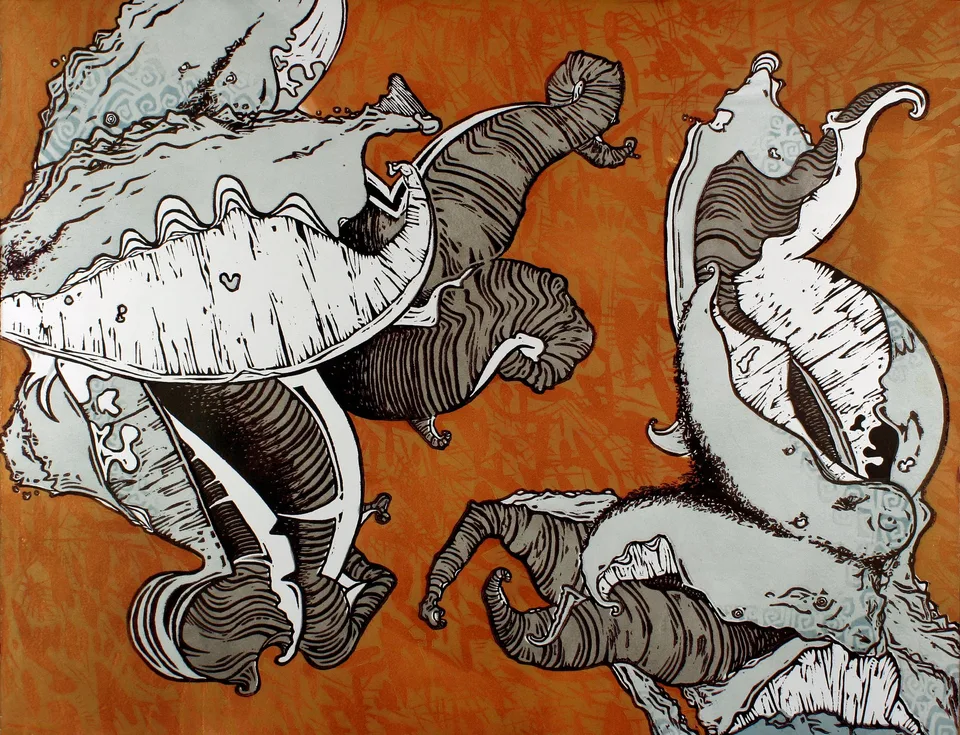

Where Beauty Meets the Vast
Williams and colleagues’ 2022 paper explores the relationship between two psychological capacities that have been studied largely in isolation: aesthetic engagement — the habitual tendency to seek out, appreciate, and be moved by beauty — and dispositional awe — the tendency to experience awe frequently in daily life. Their central finding is that these are distinct but deeply connected. Individuals high in aesthetic engagement are substantially more likely to report dispositional awe, and this relationship holds even after controlling for the personality trait most closely associated with both: openness to experience. Aesthetic engagement, the paper demonstrates, is not simply openness by another name. It is a specific capacity — a particular orientation of attention and affect toward the qualitative dimensions of experience — that predisposes the individual toward the encounter with vastness that awe requires.
The Interoceptive Foundation
The paper’s most significant contribution is its identification of interoceptive awareness as a mediating factor. Interoception — the body’s capacity to sense its own internal states, including heartbeat, breath, visceral tension, and temperature — has emerged in recent neuroscience as foundational to both emotional experience and self-awareness. Williams and colleagues demonstrate that individuals with greater interoceptive sensitivity report both higher aesthetic engagement and more frequent awe. The implication is architecturally important: the capacity to be moved by beauty and the capacity to be overwhelmed by vastness both depend on the organism’s access to its own somatic signals. One cannot be aesthetically receptive — cannot shiver before a Bach cantata or weep before a landscape — if one cannot feel one’s own body. And one cannot experience awe — the dissolution of self-boundaries before the vast — if the self has no embodied boundaries to dissolve.
The Body as Gateway to the Numinous
For depth psychology, this finding confirms a thesis that Marion Woodman, Bessel van der Kolk, and the entire somatic therapy tradition have advanced: that access to the psyche’s deepest resources — including its capacity for numinous experience — runs through the body. The traumatized individual who is dissociated from visceral sensation is not merely physically numb but spiritually impoverished: cut off from the somatic substrate that enables aesthetic experience, awe, and self-transcendence. Williams’s data suggest that restoring interoceptive awareness — through yoga, somatic experiencing, body-based mindfulness, or any practice that reconnects the individual with their visceral life — may simultaneously restore the capacity for beauty and wonder. The clinical implication is that aesthetic impoverishment is not a secondary symptom of psychological distress but a primary indicator of disconnection from the body’s intelligence.
Beyond Personality Traits
The finding that aesthetic engagement predicts awe beyond openness to experience is theoretically consequential because it challenges the sufficiency of trait-based personality models. The Big Five framework treats openness as a broad disposition toward novelty, imagination, and unconventional thinking. Williams’s data suggest that within the territory openness maps, there exists a more specific capacity — a trained or innate sensitivity to beauty’s qualitative dimensions — that does independent psychological work. Jung would recognize this immediately as the feeling function operating in its most differentiated form: not general receptivity but precise evaluation, the soul’s capacity to register the specific quality of what it encounters and to respond with proportionate depth. This capacity, the paper suggests, is not merely aesthetic. It is the foundation of the psyche’s encounter with the sacred.