Seba.Health
Key Takeaways
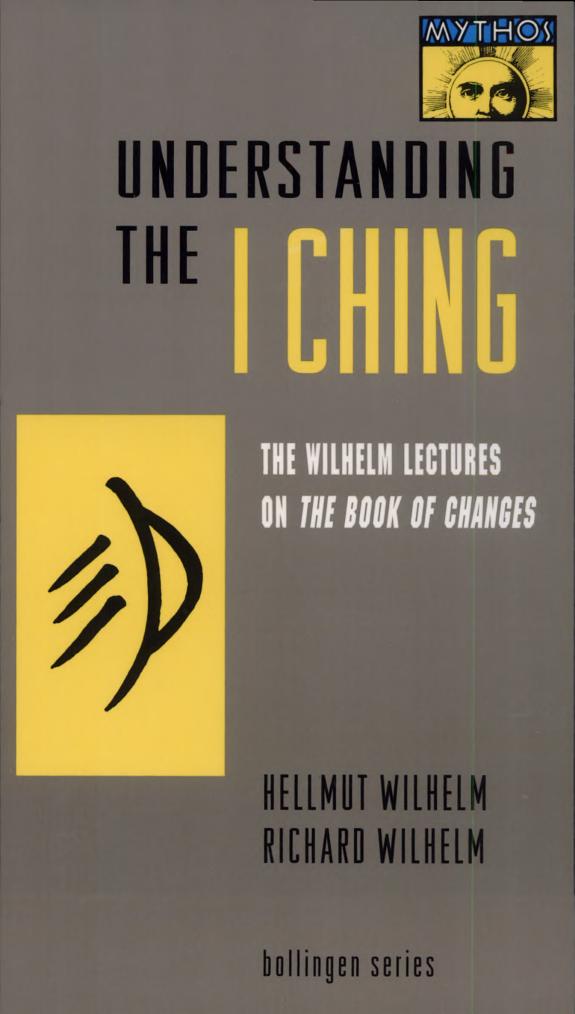
- Hellmut Wilhelm demonstrates that the I Ching's concept of change is not cyclical recurrence but self-contained wholeness — a distinction that collapses Western assumptions about progress, entropy, and the linear arrow of time.
- The book reveals that the early Chou dynasty's appropriation of the I Ching was an act of psychological differentiation: the relegation of totemistic, fear-based religion in favor of reason as "the instinct of the heart," making the I Ching a document of consciousness development rather than divination alone.
- Wilhelm's lectures constitute a quiet argument that the I Ching's systematic completeness — its capacity to assign every psychic urge its place — functions as what depth psychology would later call a map of the archetypal field, predating Jung's typological and structural models by millennia.
The Opposite of Change Is Not Stillness but Perversion: Wilhelm’s Recovery of a Lost Ontology
Hellmut Wilhelm’s most penetrating contribution in these eight lectures is his explication of what the Chinese concept of I actually means — and, more critically, what it excludes. Western metaphysics has consistently opposed change to rest, becoming to being, flux to stasis. Wilhelm dismantles this framework in a single, devastating move: “The opposite of change is neither rest nor standstill, for these are aspects of change. The idea that the opposite of change is regression, and not cessation of movement, brings out clearly the contrast with our category of time.” Change, in the I Ching’s architecture, is natural development; its negation is not immobility but the growth of what ought to decrease, the downfall of what ought to rule. This is not a philosophical nicety. It reconfigures the entire moral and psychological landscape. In Jungian terms, what Wilhelm describes is remarkably close to the concept of enantiodromia — the principle that any psychic extreme constellates its opposite — but with a crucial difference. For the I Ching, the pathological state is not the swing itself but the refusal of swing, the artificial arrest that produces monstrous reversals. Jung articulated this in his discussions of the unconscious compensating a one-sided conscious attitude, but Wilhelm’s lectures reveal that the Chinese had systematized this insight into a comprehensive cosmology centuries before depth psychology gave it clinical form. Richard Wilhelm’s own translation of the Ta Chuan supports this reading: “Changes are the imperceptible tendencies to divergence that, when they have reached a certain point, become visible and bring about transformations.” Hellmut Wilhelm takes this further, insisting that the I Ching’s concept “is not an external, normative principle that imprints itself upon phenomena; it is an inner tendency according to which development takes place naturally and spontaneously.”
The Chou Revolution Was a Psychological Differentiation, Not Merely a Political One
Wilhelm’s second lecture performs an act of intellectual archaeology that has rarely been appreciated. He argues that the early Chou rulers’ reformulation of the I Ching was nothing less than a reorganization of the psyche’s relationship to the numinous. The Shang dynasty’s totemistic religion “controlled its believers through fear” and operated through “that indefinable twilight which permits the sway of the dark forces of the human psyche.” The Chou stripped this away. Their prohibition of alcohol was not a temperance measure but a psycho-spiritual discipline: the refusal to permit altered states that would reinstate archaic participation mystique. Wilhelm’s language here — “the dark force is relegated to the place where it belongs, and it can no longer lay false claim to supremacy” — is strikingly parallel to Erich Neumann’s account in The Origins and History of Consciousness of the ego’s emergence from the uroboric matrix. The Chou transformation, as Wilhelm reads it, is the collective version of the hero myth: consciousness differentiating itself from the unconscious without annihilating it. The I Ching becomes the instrument of this differentiation precisely because it preserves the irrational within a rational structure. The hexagrams do not banish the dark; they locate it. This is why Wilhelm insists that “the situations depicted in the Book of Changes are the primary data of life — what happens to everybody every day, and what is simple and easy to understand.” The system’s power lies not in mystification but in radical clarity.
The I Ching as a Complete Map of Psychic Positions
Wilhelm’s later lectures on the trigrams, hexagrams, and the Ten Wings reveal an ambition in the I Ching that goes beyond oracle or philosophy: it aims at totality. “The universality and completeness of this I Ching system, in which every urge born of human will and thought is assigned its place, naturally has made possible a manifold use.” This is not hyperbole. The sixty-four hexagrams, generated from the interplay of the two fundamental principles through the eight trigrams, constitute a closed system of situational possibilities. Every configuration of firmness and yielding, every balance and imbalance, every phase of advance and retreat has its designated form. Wilhelm is explicit that this system “leaves open what it ordinarily blocks off — indeed, it leads directly to the bedrock which supports not only it, but human existence in its entirety.” The resonance with Jung’s archetypal theory is unmistakable, and it is no accident that Jung wrote the foreword to his father Richard Wilhelm’s translation of the I Ching. But Hellmut Wilhelm goes further than Jung’s foreword does. He argues that the I Ching’s systematic architecture — its “clean-cut edifice of the mind” — is not a wall sealing off consciousness from the depths but a conduit to them. The intellectual structure serves an ancillary function; it is “one link only in the chain of knowledge.” This is precisely the opposite of what Ritsema and Karcher later attempted in their I Ching: The Classic Chinese Oracle of Change, where the emphasis falls on recovering the divinatory imagination beneath the Confucian moralism. Wilhelm’s position is more dialectical: the rational structure and the irrational depth require each other. Destroy the structure, and you get the eruptions he warns against — “the depths were sounded, and then they erupted, often in disconcerting ways.”
Why These Lectures Remain Irreplaceable
What makes Change singular is its origin and its restraint. These lectures were delivered in occupied Peking in 1943, to a group of German-speaking exiles who refused collaboration with the Axis powers. Wilhelm was not writing for scholars; he was offering an existential framework to people living under tyranny. His reading of the I Ching as a tool for “remain[ing] masters of their fates” within a system of overwhelming institutional power is not antiquarian commentary — it is survival literature. No other introduction to the I Ching achieves this combination of philological precision, philosophical depth, and existential urgency. For anyone working within depth psychology, these lectures reveal the I Ching not as an exotic curiosity but as the oldest surviving map of what Jung called the psyche’s self-regulating function — and they do so with a clarity that neither Richard Wilhelm’s magisterial translation nor later scholarly apparatus has matched.
Sources Cited
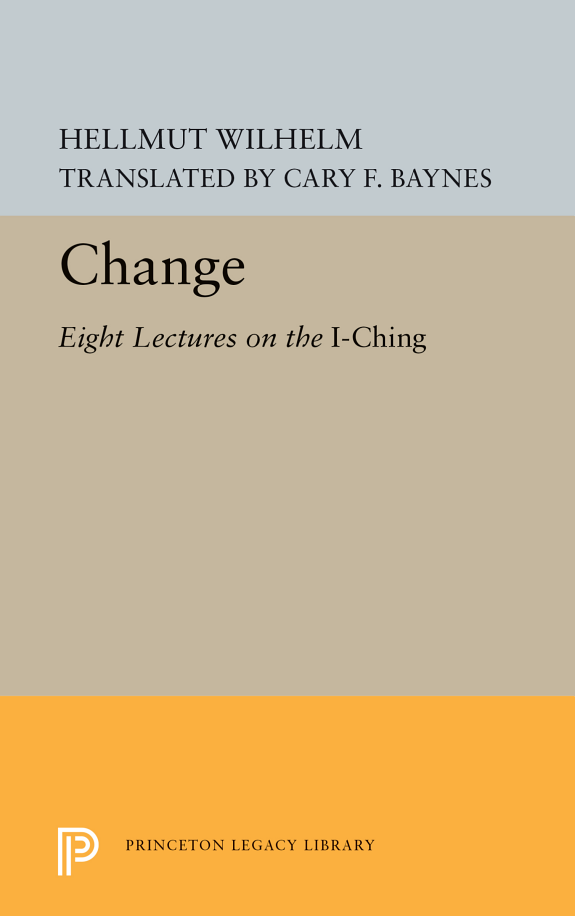
- Wilhelm, H. (1960). Change: Eight Lectures on the I Ching. Princeton University Press / Bollingen Foundation.
- Wilhelm, R. (trans.) & Baynes, C.F. (English trans.). (1950). The I Ching or Book of Changes. Princeton University Press.
- Jung, C.G. (1952). Synchronicity: An Acausal Connecting Principle. Collected Works, Vol. 8. Princeton University Press.