Seba.Health
Key Takeaways
- Thielman's "canonical and synthetic" method is not a compromise between historical criticism and confessional theology but a principled refusal to let either subsume the other, producing a framework where theological diversity becomes evidence of divine proximity rather than textual failure.
- The book's most original move is its argument that apparent contradictions between New Testament documents—Paul on law versus James on works, Mark on parables preventing repentance versus 2 Peter on God's universal patience—are themselves theologically significant, functioning as markers of the contingent, pastoral character of revelation rather than as problems requiring harmonization or surgical excision.
- By treating "early catholicism" not as a degenerative phase of primitive Christianity (as Baur, Käsemann, and Bultmann maintained) but as one voice in a unified canonical witness, Thielman dismantles the Tübingen School's developmental schema at its root and reopens the Pastoral Epistles, 2 Peter, and Jude as full theological participants rather than embarrassments to be explained away.
The Canon Is Not a Prison but a Diagnostic Instrument for Hearing the Text’s Own Voice
Thielman opens his Theology of the New Testament with a remarkably compressed history of the discipline stretching from Melanchthon’s Loci communes through Gabler, Wrede, and Räisänen, and what emerges is not a simple literature review but a genealogy of the anxiety that has haunted New Testament theology since the Enlightenment: the fear that confessional commitment contaminates historical judgment. Rather than sidestepping this anxiety, Thielman walks directly into it. He concedes Wrede’s and Räisänen’s point—that the decision to study these twenty-seven texts as a theological unit “arises from within the Christian community, not from outside it”—and then turns the concession into an argument. Every historian, he insists, operates from presuppositions; the secular critic who dismisses canonical boundaries is no less engaged in “proclamation” than the theologian who observes them. The French Confession of Faith’s appeal to the “inward illumination of the Holy Spirit” as the ground for recognizing canonical authority is, for Thielman, neither evasion nor special pleading. It names the epistemic starting point that makes the entire enterprise coherent. This positions Thielman against Räisänen’s call for a “global perspective” liberated from ecclesiastical narrowness, but it also distinguishes him from scholars like Brevard Childs, who approached canonical criticism more from a literary-structural angle. Thielman’s claim is simultaneously more modest and more radical: the canon is not primarily a literary structure to be analyzed but a living tradition to be heard, and the interpreter’s job is to stop the text from becoming an echo of the interpreter’s own prejudices.
Theological Diversity Is Not a Defect to Be Repaired but a Revelation of God’s Pastoral Character
The book’s most penetrating theological argument appears in its treatment of diversity and apparent contradiction within the canon. Thielman identifies the standard solutions—Luther’s relegation of James and Revelation to an appendix, Bultmann’s Sachkritik that strips mythological husk from existential kernel, Käsemann’s identification of “irreconcilable theological contradictions,” and the liberation-theological proposal to let the experience of the oppressed sit in judgment on patriarchal texts—and finds them all subjective and self-defeating. “One person’s husk will always be another person’s kernel,” he observes, and a canon that can be trimmed at will loses the capacity to address any time and place. His alternative is striking: when historical-critical labor cannot resolve an apparent divergence, the interpreter should treat the divergence itself as theologically meaningful. The contingent, pastoral, evangelistic character of the New Testament writings means that we are “missing the wider body of knowledge that provides the key to this coherence.” This is not an apologetic dodge. It is a theological claim about how God reveals: not through systematic treatises but through letters to struggling communities, narratives shaped by particular audiences, and apocalyptic visions forged under political oppression. The diversity, in other words, is evidence that “God is a gracious God who comes to his people of his own initiative and in the midst of their day-to-day existence.” This resonates deeply with the kind of attention to the particular and the contingent that Rudolf Bultmann himself championed in his Theology of the New Testament, though Thielman reverses Bultmann’s conclusions: the contingency does not authorize the modern interpreter to discard the form in favor of the content, because the form—letter, gospel, apocalypse—is itself the mode of divine speech.
The Dismantling of “Early Catholicism” Restores the Theological Voice of the Canon’s Most Neglected Books
Thielman devotes sustained attention to demolishing the “early catholicism” paradigm that has dominated the study of the non-Pauline letters since Ferdinand Christian Baur. Baur’s Hegelian schema—Pauline thesis, Petrine antithesis, catholic synthesis—assigned most of the later New Testament writings to a postapostolic compromise that diluted Paul’s radical gospel into institutional structure. Holtzmann, Harnack, and especially Käsemann perpetuated this framework, treating the Pastoral Epistles, 2 Peter, Jude, and James as symptoms of decline. Thielman does not simply disagree; he historicizes the paradigm itself, showing that it depends on Hegel’s philosophy of history rather than on the texts. By giving each of the twenty-seven documents its own chapter—including the often-ignored Philemon, Titus, and 3 John—he forces the reader to confront the theological substance of writings that the “early catholic” framework had reduced to historical curiosities. His treatment of James as “the wisdom of the undivided life,” for example, refuses to read James merely as an anti-Pauline polemic. Instead, James uses Genesis 15:6 not to contradict Paul’s argument in Romans 4 but to address a different pastoral problem—the gap between intellectual assent and lived commitment. This approach shares ground with N. T. Wright’s insistence on reading Paul within Second Temple Judaism rather than through Reformation-era lenses, and with Richard Bauckham’s work on the theology of Revelation as a coherent literary-theological achievement rather than a primitive eschatological outburst. Thielman’s contribution is to extend this restorative reading across the entire non-Pauline corpus simultaneously, so that the theological integrity of the canon’s “margins” becomes visible as a unified phenomenon rather than a series of isolated defenses.
Christ as the Gravitational Center That Makes Canonical Unity Intelligible Without Flattening Diversity
The concluding chapter identifies five convergences across the New Testament—the significance of Jesus, faith as response, the outpouring of the Spirit, the church as God’s people, and eschatological consummation—but the first dominates. Thielman argues that the New Testament’s Christology consistently exceeds traditional messianic categories: Jesus is not merely the anointed king of Psalm 2 or the lord of Psalm 110 but the one in whom “the God who created the universe lived among human beings.” This claim functions as the gravitational center that holds the canon’s diverse witnesses in orbit. Mark’s theology of the cross, Luke’s theology of salvation history, John’s theology of eternal life, Paul’s theology of justification, Hebrews’ theology of priestly perfection, and Revelation’s theology of cosmic sovereignty all articulate different aspects of this single, overwhelming claim. Thielman’s synthesis here is closer to Adolf Schlatter’s insistence on reading the texts “as they want to be read” than to G. B. Caird’s more dialogical-synthetic approach, though Thielman explicitly draws on Caird’s New Testament Theology as a methodological precedent. The difference is that Thielman anchors the unity not in a shared conceptual vocabulary but in a shared narrative: creation, rebellion, incarnation, atonement, resurrection, Spirit, return. This narrative structure gives the book’s final chapter a cumulative force that purely thematic New Testament theologies lack.
For the reader today—whether a pastor preparing to preach from an “embarrassing” text like Jude, a scholar navigating the politicized debates over Pauline authorship of the Pastorals, or a theologian seeking to understand how twenty-seven ancient documents can speak with a unified voice without saying the same thing—Thielman’s work provides something no other single-volume New Testament theology does with comparable clarity: a principled method for honoring both the irreducible historical particularity of each text and the theological coherence of the whole, without sacrificing either to the other.
Sources Cited
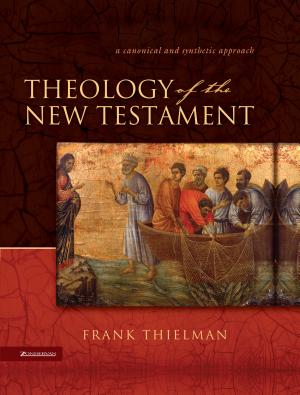
- Thielman, Frank S. (2005). Theology of the New Testament: A Canonical and Synthetic Approach. Zondervan.
- Bultmann, Rudolf (1951-55). Theology of the New Testament. 2 vols. Scribner.