Seba.Health
Key Takeaways
- Greene and Sasportas achieve what Neumann and Fordham attempted from opposite directions — a working developmental psychology of individuation — by using the horoscope as a structural map that holds both fate and freedom simultaneously, bypassing the Developmental versus Classical School impasse entirely.
- The book's treatment of subpersonalities and inner conflicts constitutes one of the earliest practical bridges between Hillman's polytheistic psychology of imaginal figures and a clinical framework ordinary people can use without abandoning ego-coherence.
- By reading the parental marriage as an intrapsychic archetypal configuration rather than a biographical fact, Greene delivers a theory of inherited psychic patterning that rivals Kalsched's trauma model in explanatory power but locates the wound in the structure of consciousness itself, not in the event.
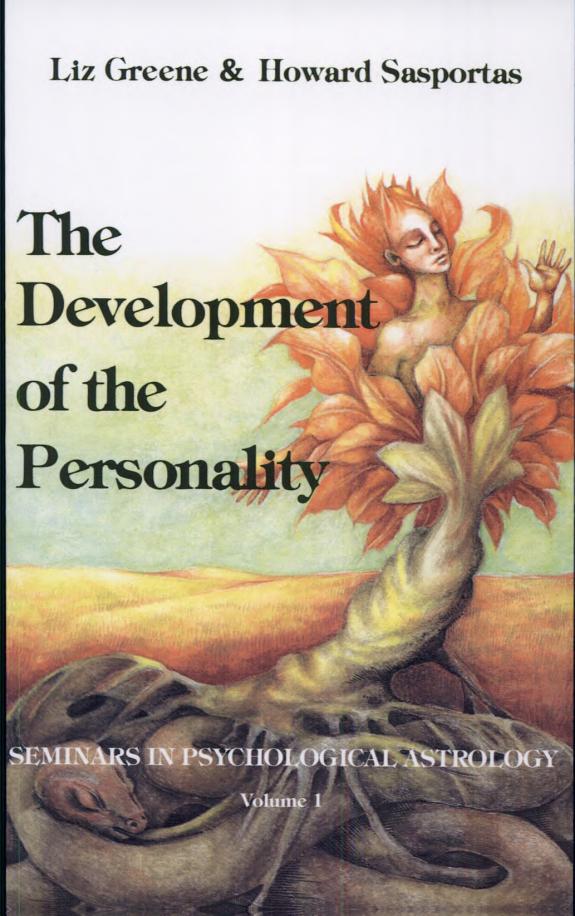
The Horoscope as Developmental Scaffolding: How Greene and Sasportas Solve the Problem That Split Post-Jungian Psychology
The central argument of The Development of the Personality is not that astrology explains psychology or that psychology validates astrology. It is that the birth chart functions as an image of the Self in Jung’s precise sense — a totality that is always already present, whose progressive unfolding constitutes individuation. This places the book directly inside the fault line that Andrew Samuels identified between Fordham’s Developmental School and Neumann’s Classical School. Fordham insisted on empirical infant observation; Neumann constructed a mythological stadial sequence. Both claimed to complete what Jung left unfinished regarding early development. Greene and Sasportas sidestep this debate by proposing a third instrument: the natal chart as a synchronistic snapshot of psychic structure at the moment of incarnation, which contains the developmental stages as potentials rather than as causes. The chart does not explain why a person develops as they do — it images the pattern that was always there, waiting to be lived. Greene states this with characteristic directness in her broader work: people become more like their horoscopes as consciousness increases, not less. They do not transcend the chart; they inhabit it. This is a direct inversion of the spiritual-bypass model that plagued astrological practice, and it aligns precisely with Hillman’s circular model of development — the idea that development is something becoming itself, becoming the nature that was always there — while giving that model a concrete, readable structure that Hillman’s own archetypal psychology deliberately refused to provide.
The Parental Marriage Is Not a Memory but an Archetypal Inheritance
Greene’s seminar on the parental marriage in the horoscope is the book’s most psychologically radical contribution. She reads the Sun-Moon relationship in the chart not as a record of how the parents actually behaved but as the individual’s archetypal image of the masculine and feminine principles in union or conflict. The real parents are carriers of this image, not its authors. This is a significant departure from object-relations models that trace psychic structure to actual caregiving failures. It is closer to Jung’s own view of the child as repository of parental psychopathology — what Samuels notes as one of Jung’s divided positions on child psychology — but Greene presses it further. The parental marriage depicted in the horoscope is a fate, a moira: it is the particular configuration of opposites the individual is born into and must eventually reconcile within. This reframing has profound clinical implications. It means that a person’s distorted expectations of relationship are not merely wounds to be healed through corrective emotional experience; they are structural features of the psyche that demand conscious engagement. Greene’s position here resonates with Neumann’s insistence that ego consciousness evolves by passing through archetypal images and being transformed in the passage, but it grounds this abstract evolutionary model in the specificity of an individual life. No two charts depict the same parental marriage, and therefore no two individuals face the same developmental task. This is individuation made concrete.
Subpersonalities as Polytheism with a Center
Sasportas’s seminars on childhood stages and subpersonalities represent the book’s structural counterweight to Greene’s mythological depth. His mapping of planetary energies onto developmental phases — Mars as the assertion drive, Venus as the relational capacity, Saturn as the encounter with limitation — is openly indebted to both Freudian stage theory and Jungian archetype theory, but his real innovation is the concept of subpersonalities as semi-autonomous complexes organized around planetary symbols. This directly parallels Hillman’s vision of personality as “a living and peopled drama in which the subject ‘I’ takes part but is neither the sole author, nor director, nor always the main character.” But where Hillman dissolves the ego into the democracy of imaginal figures and refuses any centering principle, Sasportas retains the Self — imaged as the total horoscope — as an organizing center that holds the multiplicity together. This is not a retreat into ego psychology; it is a practical necessity for anyone working with clients who are fragmented, not theorists who are deconstructing. Beebe’s later eight-function, eight-archetype model of typological consciousness performs a similar operation — using archetypal positions to organize the plurality of cognitive functions — but Sasportas’s subpersonality model is more psychodynamically alive, more attuned to the feeling-texture of inner conflict. When Mars in the fourth house clashes with Saturn on the Midheaven, the client does not experience a typological tension; they experience a war between the child who needed to fight and the adult who learned that fighting brings punishment. Sasportas gives that war a name, a location, and a trajectory.
Vocation as the Irreducible Mystery That No System Can Capture
Greene’s treatment of vocation — drawn from Jung’s essay in the Collected Works volume also titled The Development of Personality — is the book’s philosophical spine. She quotes Jung’s assertion that what tips the scales toward the extraordinary is not necessity or moral decision but vocation, “an irrational factor that destines a man to emancipate himself from the herd.” She then makes a startling confession for an astrologer: whatever it is that induces a person to actually live their chart is not visible in the chart. The horoscope shows the pattern; it does not show whether anyone will be home to inhabit it. This admission places Greene in direct conversation with Hillman’s The Soul’s Code and its acorn theory, published a decade later. Hillman insists that each person bears a uniqueness already present before it can be lived, and that reading life backward reveals form rather than causation. Greene arrives at the same insight from within the astrological tradition: the chart is the acorn, but the daimon that cracks it open is something else, something that cannot be symbolized because it is the very capacity for symbolization.
This is what makes The Development of the Personality irreplaceable for anyone working at the intersection of depth psychology and symbolic systems. It does not merely apply Jungian concepts to astrological practice. It demonstrates that the horoscope, read with psychological sophistication, becomes a phenomenology of the Self — a map of the archetypal stages Neumann theorized, the imaginal plurality Hillman championed, and the developmental specificity Fordham demanded, unified in a single, readable image. No other book in the depth psychology tradition accomplishes this integration with such practical clarity, and no subsequent work in psychological astrology has matched its theoretical rigor.
Sources Cited
- Greene, L. & Sasportas, H. (1987). The Development of the Personality. Seminars in Psychological Astrology, Vol. 1. Weiser Books.
- Winnicott, D.W. (1965). The Maturational Processes and the Facilitating Environment. International Universities Press.
- Jung, C.G. (1954). The Development of Personality. Collected Works, Vol. 17. Princeton University Press.
- Mahler, M., Pine, F., & Bergman, A. (1975). The Psychological Birth of the Human Infant. Basic Books.