Seba.Health
Key Takeaways
- Dvornik demonstrates that the so-called "Photian Schism" is not primarily a theological rupture but a political conflict between Moderate and Extremist factions within Byzantium, a structural antagonism that predates Photius and survives him by centuries — making the patriarch less an agent of schism than its most visible casualty.
- The book's most devastating finding is that the Western Church did not count the anti-Photian Council of 869-70 among the ecumenical councils until eleventh-century Gregorian canonists retroactively elevated it — meaning the discrepancy between Eastern and Western council numbering is a medieval fabrication, not an ancient doctrinal division.
- Dvornik proves that the "second schism of Photius" — his alleged re-excommunication by John VIII — never happened, and that both Eastern and Western traditions unknowingly converged on this same legendary falsehood by the sixteenth century, making the Photian Legend one of the most consequential historiographical errors in Christian history.
The Photian Schism Is Not a Story of One Man’s Ambition but of a Structural Antagonism Byzantium Could Never Resolve
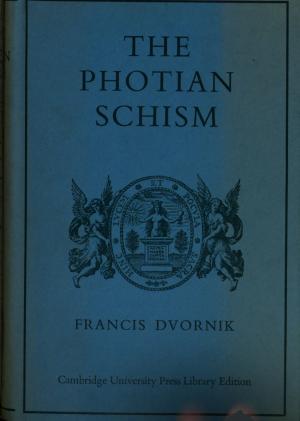
Francis Dvornik’s The Photian Schism: History and Legend executes a surgical historiographical operation: it separates a millennium of accumulated legend from the documentary evidence and shows that nearly everything the Western tradition believed about Patriarch Photius was wrong. The book’s architecture — Part I (“History”) reconstructing events from primary sources, Part II (“Legend”) tracing the distortion of those events through Western and Eastern canonical, theological, and polemical literature — is itself the argument. Dvornik does not simply rehabilitate Photius; he demonstrates that the entire framework within which Photius was condemned was built on partisan documents, canonical oversights, and anti-Greek prejudice that compounded across centuries. The key to Dvornik’s reinterpretation is his insistence that ninth-century Byzantine church politics operated through two permanent factions — Extremists (rigorists, often monastic, heirs to the Studite tradition) and Moderates (pragmatists, often linked to the imperial court and the intellectual establishment). Photius was a Moderate; Ignatius was the Extremists’ man. Every patriarchal transition was a factional realignment, not a moral drama. Dvornik traces this pattern backward through the Studite Schism under Methodius and forward through the tetragamy conflict, showing that “the die-hards carried the day” even in the final struggle over union with the West. The Photian affair was, in this reading, one episode in a recurring Byzantine structural crisis, and Photius’s worst error — the synod of 867, where he attacked Pope Nicholas I — was not a calculated assault on Roman primacy but a loss of self-control that “precipitated Basil’s change of policy towards the Extremists and the Pope.” This reframing recalls the dynamics Elaine Pagels identifies in The Gnostic Gospels, where theological “heresy” consistently masks political contests for institutional control. The difference is that Dvornik has the documentary apparatus to prove it.
The Legend Was Built Not by Theologians but by Canonists Who Never Read the Photian Council’s Acts
The book’s most original contribution lies in Part II, where Dvornik tracks the Photian Legend through unpublished canonical collections, papal professions of faith, and the writings of Gregorian reformers. His finding is precise and damning: the Council of 869-70, which condemned Photius, was not recognized as the Eighth Ecumenical Council by the Roman Church itself until the late eleventh century. The Frankish Church under Hincmar explicitly refused its ecumenicity. Gerbert (later Pope Sylvester II) professed faith in only six councils in 991. The Popes’ own Professio fidei in the Liber Diurnus listed seven councils. It was only when Gregorian canonists — Cardinal Deusdedit, Ivo of Chartres — mined the Lateran Archives for ammunition in the Investiture Contest that they “discovered” the anti-Photian council’s canons forbidding lay interference in episcopal elections, and elevated the council to ecumenical status as a polemical weapon. The irony Dvornik savors is exquisite: these same canonists also found and used the Acts of the Photian Council of 879-80, which had annulled the 869-70 council with papal approval, but failed to register the contradiction. “By a curious irony of fate, the same Acts which in the eleventh century were regarded as favourable to the Papacy were discarded by historians and canonists of later periods as damaging to the same Gregorian claims.” The entire edifice of the Eighth Council’s authority rests on an eleventh-century oversight that subsequent generations canonized as tradition. This is historiographical criticism operating at the level of what Michel Foucault would later call genealogy — showing that what presents itself as immemorial tradition has a datable, contingent, politically motivated origin.
Photius’s “Second Excommunication” Is a Pure Invention, and Both East and West Fell for It
Dvornik devotes Chapter VII of Part I to demolishing the legend of Photius’s “second schism” — the claim that John VIII, having initially rehabilitated Photius at the Council of 879-80, subsequently discovered he had been deceived by forged documents and excommunicated the patriarch again. Dvornik traces this fabrication to the anti-Photian Collection, a partisan dossier compiled by Extremist opponents, which attributed to successive popes (Marinus I, Hadrian III, Stephen V) letters condemning Photius that Dvornik shows are either forged, misattributed, or misread. The most remarkable dimension of this finding is that by the sixteenth century, when Western and Eastern scholars finally compared notes, they discovered they agreed on this one fictitious point: both traditions accepted the second schism as historical fact. Baronius built his Annals on it; Hergenröther’s massive nineteenth-century study reinforced it; and even Orthodox scholars like A. P. Lebedev, despite their instinct to defend Photius, “succumbed to the superficial cogency of the Cardinal’s logic.” Only the obscure Syrian hieromonachus Gerazim Yared and the Russian scholar Ivantsov-Platonov mounted serious challenges, and both went unread in the West. The convergence of two hostile traditions on the same error is itself a lesson in how legends function — not through the triumph of one side’s propaganda but through the gradual naturalization of partisan claims into shared assumptions.
The Book’s Real Subject Is How Institutions Forget What They Once Knew
What makes Dvornik’s work irreplaceable is not its rehabilitation of Photius — though that alone would justify it — but its demonstration of institutional amnesia as a historical force. The Roman Church knew in 880 that John VIII had ratified the Photian Council. It knew that the 869-70 council had been annulled. It possessed the documents. And then, through the severance of contact with Byzantium, the polemical needs of the Gregorian reform, and the sheer accident of which manuscripts canonists happened to consult, it forgot. The East underwent a parallel process: unionists after the thirteenth century, needing to blame someone for the schism, retroactively cast Photius as its architect, even though the Byzantine liturgical tradition continued to venerate him as a saint and the Synodicon of Orthodoxy proclaimed “Eternal memory to Ignatius and Photius, the Orthodox and renowned Patriarchs.” Dvornik’s concluding reflection — that “it was not in this broad-minded spirit that East and West fought each other throughout the Middle Ages” — carries the weight of four hundred pages of evidence. For anyone working in depth psychology’s tradition of examining how collective narratives distort memory and perpetuate injury, this book provides one of the most rigorously documented case studies in existence. It shows that the schism between Eastern and Western Christianity was not caused by Photius, nor by doctrinal irreconcilability, but by the legendary apparatus that grew around a ninth-century political conflict and was never adequately dismantled. The wound that separates Christendom is, in Dvornik’s account, substantially a wound of misremembering.
Sources Cited
- Dvornik, Francis (1948). The Photian Schism: History and Legend. Cambridge University Press.
- Dvornik, Francis (1966). Early Christian and Byzantine Political Philosophy. Dumbarton Oaks.