Seba.Health
Key Takeaways
- Corbin's central achievement is not the recovery of Ibn 'Arabi for Western readers but the demolition of the binary between "real" and "imaginary" that undergirds both modern secularism and orthodox theology — the mundus imaginalis is not a metaphor but an ontological claim that dismantles every psychology built on the Cartesian split.
- The book establishes that prayer is not petition but cosmogony: the worshiper does not address a pre-existing God but participates in the theophanic event through which God becomes manifest, making Creative Imagination the organ of divine self-disclosure rather than a subjective faculty.
- Ibn 'Arabi's distinction between Allah as universal God and Rabb as personal Lord — the God individualized in syzygic relation with each soul — constitutes a radical challenge to both Jungian archetypalism and monotheistic literalism, because neither collective symbols nor doctrinal universals can substitute for the irreducible "alone with the Alone."
The Mundus Imaginalis Is Not a Therapeutic Concept but an Ontological Insurgency Against the Modern West
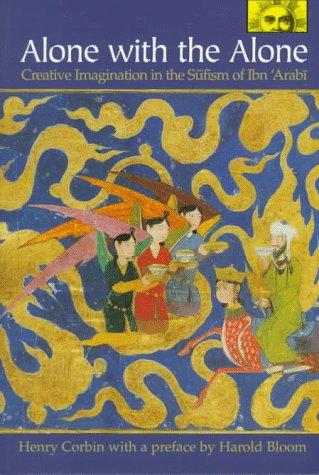
Corbin’s Alone with the Alone has been domesticated by depth psychology readers as a source text for James Hillman’s “imaginal” — but this domestication betrays the book’s actual radicalism. Corbin does not argue that imagination is psychologically valuable or therapeutically useful. He argues that the intermediate world — the ‘alam al-mithal, the world of Idea-Images where “spirits are materialized and bodies spiritualized” — possesses ontological density equal to or greater than sensory reality. The entire Prologue to Part Two constitutes a philosophical assault: “there has ceased to be an intermediate level between empirically verifiable reality and unreality pure and simple,” Corbin writes, and this collapse is not a neutral epistemological development but the specific catastrophe of modernity. When the Imagination degenerates into “fantasy, the madman’s cornerstone” (borrowing Paracelsus’s formulation), the result is not merely aesthetic impoverishment but the annihilation of the very plane on which theophany occurs. This is why Corbin insists on distinguishing Imaginatio from phantasia with the severity of a diagnostician. Hillman would later take up this distinction in Re-Visioning Psychology, but Hillman psychologized what Corbin understood cosmologically. For Corbin, the mundus imaginalis is not a mode of soul-making — it is a mode of being, and to lose access to it is to lose the world in which God becomes real. Jung’s project, despite its sympathy for the imaginal, remains epistemologically modest by comparison; in Aion, the Self is an archetype knowable through its effects on consciousness. For Ibn ‘Arabi as Corbin reads him, the “Self” is neither the Jungian Self nor the yogic Self nor the psychologist’s self — it is the syzygic unity of knower and Lord, and “He who knows himself knows his Lord” is not a developmental achievement but a reciprocal ontological event.
Ibn ‘Arabi’s God Is Not Hidden but Sad — and Creation Is the Exhaled Consequence of That Sadness
The cosmogony Corbin unfolds in Chapter III is one of the most extraordinary in any mystical literature. The leitmotiv is “not the bursting into being of an autarchic Omnipotence, but a fundamental sadness: ‘I was a hidden Treasure, I yearned to be known.’” The divine Names suffer in nonknowledge because no one names them; this suffering descends as the divine Breath (tanaffus), which is simultaneously Compassion (Rahma) and existentiation (ijad). Creation is not ex nihilo — a doctrine Corbin explicitly identifies as the theological origin of the modern degradation of imagination — but the self-differentiation of a Being whose “primordial Cloud” (‘ama’) is itself the absolute theophanic Imagination. This Cloud is “Creator-Creature” (khaliq-makhliq): the Hidden and the Revealed, the First and the Last. What this means for psychology is devastating. The sadness Corbin locates at the root of creation is not neurotic suffering, not the Freudian repetition compulsion, not even the Jungian longing for wholeness. It is a theological pathos — a God who aches to be known and who, in breathing out the world, breathes out the very organs by which He can be perceived. Stanislav Grof’s perinatal matrices, Edward Edinger’s Ego and Archetype with its account of inflation and alienation as a drama of God-image loss — these are secular echoes of what Corbin treats as the foundational structure of reality itself. The “pathetic God” of Ibn ‘Arabi does not await human worship passively; He prays for self-disclosure through the worshiper’s creative act.
Prayer as Theophany Renders Every Psychology of “Projection” Incoherent
The culminating insight of the book — and the one most resistant to assimilation by Western psychology — is its account of Creative Prayer. “Prayer is not a request for something: it is the expression of a mode of being, a means of existing and of causing to exist.” The God to whom prayer is addressed is “created” by the Active Imagination, but this does not make Him unreal; it makes Him theophanic. The worshiper’s himma — the creative energy of the heart — projects a “Form of God” (surat al-Haqq) that is simultaneously the image the worshiper makes and the image through which the divine discloses itself. This is why Corbin insists that the language of “projection” — the default explanatory framework of psychoanalysis and even of much Jungian thought — fails catastrophically here. To say the God-image is “projected” implies a subject who fabricates an illusion. But in Ibn ‘Arabi’s framework, the theophanic Imagination is itself the substance of creation; human imagination is “Imagination in His Imagination.” The heart (qalb) that perceives and creates the Form of God is not a subjective organ but a cosmological instrument — the site where the coincidentia oppositorum of Creator and creature is enacted instant by instant. Harold Bloom’s preface grasps this when he compares the Sufic “sharing” with God to the rare moments of identification with Shakespeare’s greatest characters: “The imaginal realm is a concept generous enough to embrace both the spiritual and the aesthetic.”
The Rabb-Vassal Relationship Is the Corrective Depth Psychology Has Not Yet Absorbed
What makes this book irreplaceable for anyone working with depth psychological material is its insistence on the individualized divine-human relationship. Ibn ‘Arabi distinguishes between Allah as God-in-general and Rabb as the particular Lord “personalized in an individualized and undivided relation with his vassal of love.” This is not the collective unconscious speaking through universal archetypes; it is a singular syzygy in which “only the knowledge which the fedele has of his Lord is the knowledge which this personal Lord has of him.” To lose contact with one’s specific Lord-archetype is to fall into the “spiritual imperialism” of imposing “the same Lord upon all” — a diagnosis that applies equally to dogmatic religion and to any psychology that substitutes generalized archetypal schemas for the unrepeatable encounter between a particular soul and its particular God. Neither Jung’s individuation model nor Hillman’s polytheistic psychology captures this bilateral intimacy with full precision, because both still operate within frameworks that universalize the imaginal. Corbin’s Ibn ‘Arabi insists that the theophanic event is as unique as a fingerprint: the God I know is the God who knows me, and no collective symbol or doctrinal proposition can mediate that mutual recognition. For the contemporary reader navigating between materialist reductionism and spiritual inflation, Alone with the Alone offers something no other book in the depth psychology library provides: a rigorous metaphysics of the imaginal that refuses to collapse into either subjectivism or dogma, grounded in a tradition that has practiced this refusal for eight centuries.
Sources Cited
- Corbin, H. (1969). Creative Imagination in the Sufism of Ibn Arabi. Princeton University Press (Bollingen Series XCI).
- Corbin, H. (1971). The Man of Light in Iranian Sufism. Shambhala Publications.
- Ibn Arabi. (n.d.). Al-Futuhat al-Makkiyya (The Meccan Revelations). Multiple editions.