 Seba.Health
Key Takeaways
- Seaford argues that the invention of coinage restructured Greek consciousness itself — the abstraction of value from substance produced new capacities for abstract thought while severing the felt connection between worth and embodied experience.
- The pre-monetary economy of Homeric exchange operated through substances that carried qualitative, embodied value (cattle, tripods, metals), and the transition to coined money marks the moment when value became disembodied.
- Seaford provides the economic genealogy of the mind-body split: the same abstraction that produced coined money produced the philosophical soul, and both represent the extraction of value from the body's felt registration of significance.
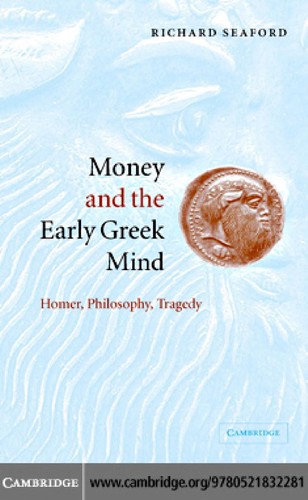
Richard Seaford’s Money and the Early Greek Mind proposes a thesis so large that it is easy to mistake for overreach: the invention of coinage in the seventh century BCE did not merely change how the Greeks conducted commerce. It changed how they thought, what they could conceive, and, most consequentially, how they understood the relationship between value and substance, soul and body, abstract principle and embodied experience. Seaford reads the emergence of Greek philosophy, the transformation of tragic narrative, and the restructuring of religious practice as downstream effects of a single material innovation: the stamping of metal with a guaranteed value that no longer depended on the metal’s weight, purity, or physical properties. The coin is the first object in Western history whose value is entirely conventional — detached from substance, guaranteed by collective agreement, infinitely exchangeable. Seaford argues that this object rewired Greek consciousness from the inside out.
The Pre-Monetary Economy of Embodied Value
Seaford begins where any argument about Greek consciousness must begin: with Homer. In the Iliad and Odyssey, exchange operates through objects whose value is inseparable from their material properties and the social relationships they embody. Cattle, tripods, cauldrons, textiles, and wrought metal circulate not as fungible units of abstract value but as bearers of qualitative significance. A tripod given as a prize at funeral games carries the weight of the occasion, the status of the giver, the competitive context of its bestowal. A ransom offered for a captive’s body is measured in specific objects, gold, worked bronze, horses, whose materiality is the point. The object does not represent value. The object is value, in a mode inseparable from its sensory and social properties.
This economy is an economy of thumos. The Homeric hero evaluates worth through the same organ that evaluates threat, honor, grief, and desire — the thumos, the somatic register in the chest that responds to significance before rational calculation intervenes. When Achilles weighs Agamemnon’s offered compensation in Book IX of the Iliad, his rejection is not a cognitive judgment about the inadequacy of the sum. It is a thumos-response: the offered goods fail to register as sufficient because no quantity of material objects can metabolize the dishonor that Achilles has absorbed into his body. The evaluation is visceral, pre-rational, grounded in the felt quality of substances and relationships. This is the economy that existed before coined money, and its psychological architecture is organized around the body’s direct registration of value.
Coinage and the Abstraction of Value
Seaford’s central argument concerns what happened when this economy was disrupted. The introduction of coinage, first in Lydia, then rapidly across the Greek world, created a new kind of object: one whose value was guaranteed not by its material substance but by the stamp of the issuing authority. A coin of base metal bearing the city’s seal was worth what the city said it was worth, regardless of its weight or purity. Value, for the first time, was abstracted from substance and located in convention, agreement, and collective trust.
The psychological consequences, Seaford argues, were revolutionary. The capacity to conceive of value as detachable from material substance — to hold in mind a principle of equivalence that is not grounded in any sensory property — constitutes a new cognitive operation. It is, in fact, the same operation that Greek philosophy would formalize as abstraction. When Anaximander posits the apeiron (the unlimited, the indefinite) as the origin of all things, he is performing in cosmological terms what the coin performs in economic terms: extracting a principle from the flux of material experience and granting it autonomous existence. When Heraclitus writes that all things are exchanged for fire and fire for all things “as goods for gold and gold for goods,” he is drawing the analogy explicitly. The philosophical soul — the psyche of Pythagoras and Plato, detachable from the body, self-identical across transformations, capable of surviving the dissolution of its material substrate — is, in Seaford’s reading, a conceptual product of the same abstraction that produced coined money.
The Mind-Body Split as Economic Event
This is where Seaford’s argument intersects most powerfully with the genealogy of thumos and the feeling function. Snell demonstrated that the Homeric self lacked a unified concept of interiority — that inner life was distributed across somatic organs (thumos, phrenes, noos) whose operations were inseparable from bodily sensation. The philosophical tradition from Pythagoras through Plato progressively unified that distributed self into a single entity — the psyche or soul — and simultaneously extracted it from the body, declaring it immortal, rational, and fundamentally different in kind from the flesh it temporarily inhabited.
Seaford provides the material mechanism for that extraction. The abstraction of value from substance in the economic domain produced the cognitive template for the abstraction of soul from body in the philosophical domain. The same culture that learned to treat a stamped disc of metal as equivalent to a hundred cattle learned to treat an invisible, intangible soul as the true self, with the body demoted to temporary housing. The mind-body split that Descartes is usually credited with formalizing was, in Seaford’s account, already structurally complete in Plato — and its origin is not philosophical but economic.
The cost to the feeling function is direct. In the pre-monetary Homeric economy, value is registered somatically — through the thumos, through the body’s felt response to the qualitative properties of substances and social relationships. In the monetary economy, value is registered abstractly — through calculation, through the cognitive operation of comparing quantities stripped of their qualitative properties. The coin teaches the mind to ignore the felt difference between objects and attend only to their numerical equivalence. This is, in psychological terms, the subordination of the feeling function (which evaluates through qualitative, embodied discrimination) to the thinking function (which evaluates through quantitative, abstract comparison). Seaford does not use Jungian terminology, but the structure he describes is the same structure Jung identified in his typology: the historical privileging of thinking over feeling, of abstraction over embodiment, of the concept over the sensation.
Tragedy as the Site of Resistance
Seaford’s analysis of Attic tragedy reveals the cultural space where this transformation was contested. Tragedy, he argues, is the art form that registers the cost of monetization — the destruction of the qualitative bonds (kinship, reciprocity, embodied obligation) that the pre-monetary economy maintained and that the abstract equivalence of money dissolves. When Medea calculates the value of her betrayal, when Antigone insists on obligations that no civic accounting can quantify, when Oedipus discovers that the identity he has constructed through social exchange conceals a reality that no transaction can resolve, tragedy is staging the collision between two economies of value: one rooted in embodied, relational significance and one organized by abstract equivalence.
The thumos is the organ of the older economy. It evaluates through felt response, through the body’s registration of qualitative difference, through the pre-reflective discrimination that knows this gift is adequate and that insult is intolerable — not because it has counted the sum but because it has felt the weight. The philosophical soul is the organ of the newer economy: abstract, self-identical, detachable from the body, capable of calculation but increasingly deaf to the body’s own evaluative intelligence. Tragedy holds both in the same frame and lets the audience feel the friction between them.
Seaford and the Recovery of Embodied Value
For any project that traces the genealogy of the feeling function from Homer to the contemporary clinic, Seaford provides the missing economic chapter. The disembodiment of value is a material transformation with psychological consequences that persist into the present: the modern subject’s difficulty accessing embodied feeling, the clinical prevalence of alexithymia and interoceptive deficit, the therapeutic project of recovering the body’s evaluative intelligence — all of these operate within the long shadow of the abstraction that Seaford identifies. The recovery of thumos is, in this light, an economic task as much as a psychological one: a refusal to accept that all value is fungible, that the body’s felt discrimination of significance is less real than the mind’s calculation of equivalence.
Sources Cited
- Seaford, R. (2004). Money and the Early Greek Mind: Homer, Philosophy, Tragedy. Cambridge University Press. ISBN 978-0-521-53992-0.
- Onians, R. B. (1951). The Origins of European Thought: About the Body, the Mind, the Soul, the World, Time and Fate. Cambridge University Press.
- Kurke, L. (1999). Coins, Bodies, Games, and Gold: The Politics of Meaning in Archaic Greece. Princeton University Press.
- Snell, B. (1953). The Discovery of the Mind: The Greek Origins of European Thought. Harvard University Press.