Seba.Health
Key Takeaways
- Harris reframes psychopathology not as the presence of "negative" internal content but as the dominance of cognitive fusion and experiential avoidance — a move that quietly dissolves the medical model's symptom-fixation and replaces it with a functional analysis of suffering rooted in language itself.
- ACT Made Simple demonstrates that the six core processes of psychological flexibility are not a clinical toolkit bolted onto behaviorism but a coherent model of the self as process, making it one of the few CBT-lineage texts that converges — without acknowledgment — on depth psychology's insistence that ego-identification is the root of neurosis.
- The book's most radical clinical claim is that the therapeutic relationship itself must model defusion and acceptance rather than simply prescribe them, positioning the therapist not as expert-healer but as fellow sufferer navigating the same "normality of suffering" — a stance closer to the wounded healer archetype than to any manualized protocol.
Fusion Is the Modern Name for Identification, and Harris Knows It
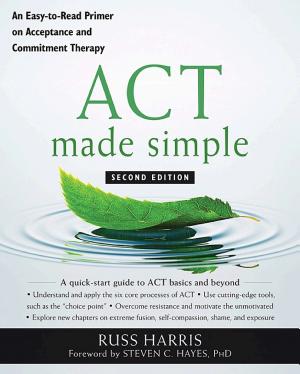
Russ Harris builds ACT Made Simple around a deceptively simple diagnostic insight: human suffering is not caused by the content of thoughts and feelings but by the process of fusing with them. Cognitive fusion — the condition in which a person treats thoughts as literal truths, obeys them automatically, and experiences them as identical with reality — functions in Harris’s framework the way identification functions in depth psychology. When Jung describes the ego inflated by an archetype, or when Edinger maps the ego-Self axis in its undifferentiated state, they are describing a structural condition in which the experiencing subject cannot distinguish itself from what it experiences. Harris arrives at the same territory through Relational Frame Theory (RFT), the behavioral science of language that undergirds ACT. Because human language creates derived relations — “I am worthless” becomes functionally equivalent to the experience of worthlessness — the mind generates suffering not through faulty logic (the cognitive distortion model of Beck) but through the very competence of symbolic thought. This is a profound departure from standard CBT. Where Beck and Ellis treat distorted cognitions as bugs to be debugged, Harris and the ACT tradition treat fusion as a feature of normal human cognition. Suffering is not a malfunction; it is what language does when left unobserved. The parallel to the Buddhist concept of avidya (ignorance as root cause of dukkha) is not accidental — Harris references mindfulness traditions explicitly — but the convergence with Jungian thought on identification is unacknowledged and, for that reason, more interesting.
The Hexaflex as a Map of Psychological Wholeness
The six core processes of ACT — defusion, acceptance, contact with the present moment, self-as-context, values, and committed action — are arranged in Harris’s famous “hexaflex” diagram. Clinicians often treat these as six separate interventions. Harris, to his credit, insists they are facets of a single process: psychological flexibility. This is the book’s structural argument, and it carries more weight than most readers register. Self-as-context — the “observing self” that notices thoughts and feelings without being them — occupies the center of this model for a reason. It is the pivot on which every other process depends. Without a vantage point distinct from mental content, defusion is impossible, acceptance is performative, and values clarification collapses into intellectualization. Harris describes self-as-context through metaphors (the sky that contains weather, the chessboard beneath the pieces) rather than through theoretical abstraction, which makes it accessible but also obscures its depth. What he is pointing toward is what Roberto Assagioli, in Psychosynthesis, called “disidentification” — the capacity to have thoughts, feelings, and sensations without being reduced to them. It is also structurally equivalent to what Wilber calls the “Witness” position and what the Upanishadic tradition calls the ātman distinguished from the empirical self. Harris does not make these connections. He does not need to for clinical purposes. But for the reader interested in where ACT sits within the broader cartography of consciousness, self-as-context is the gateway that links a behavioral therapy to the perennial philosophy.
Creative Hopelessness Is the Therapeutic Equivalent of Descent
One of the most clinically potent — and psychologically dangerous — moves Harris teaches is “creative hopelessness”: the deliberate guided exploration of how every control strategy the client has used to eliminate unwanted internal experience has ultimately failed or made things worse. This is not motivational interviewing. It is not rapport-building. It is a structured confrontation with the futility of avoidance. Harris is explicit that this must be done with compassion and precision; done poorly, it becomes invalidation. Done well, it catalyzes a fundamental shift in the client’s relationship to their own suffering. The structure mirrors what depth psychology calls the nekyia — the night sea journey, the descent. James Hollis, in The Middle Passage, identifies the midlife crisis as the collapse of the “first adulthood’s” provisional personality, a collapse that is not pathology but prerequisite for authentic selfhood. Creative hopelessness performs the same function in compressed therapeutic time: it dismantles the client’s “change agenda” (the desperate attempt to control inner experience) so that a different relationship to suffering becomes possible. Stanislav Grof’s cartography of non-ordinary states similarly identifies ego-death experiences as transformative precisely because they shatter the illusion of control. Harris, operating within a behavioral science framework, would never use the word “ego-death.” But creative hopelessness aims at the same structural target: the relinquishing of the control agenda that keeps the client trapped in the very suffering they seek to escape.
Why the Therapist’s Own Defusion Is the Book’s Hidden Curriculum
Harris devotes surprising space to the therapist’s own psychological flexibility — their willingness to sit with discomfort in session, to notice their own fusion with the thought “I need to fix this client,” to model acceptance rather than merely prescribe it. This is not a throwaway ethical addendum. It is the book’s most radical proposition, and it distinguishes ACT from the vast majority of manualized treatments. The therapist who cannot defuse from their own rescue fantasies will inevitably reinforce the client’s control agenda. Harris positions the clinician not as the possessor of techniques but as someone practicing the same processes they invite clients into — a stance that echoes Irvin Yalom’s insistence in The Gift of Therapy that the therapeutic relationship is the mechanism of change, not a vehicle for delivering mechanisms of change. It also resonates with Jung’s insistence that the analyst must undergo their own analysis, not as credentialing but as ontological prerequisite. The wounded healer archetype — the therapist whose authority derives from their own encounter with suffering — lives inside ACT Made Simple without ever being named.
For the reader approaching depth psychology through clinical practice, Harris’s book illuminates something no purely Jungian or psychodynamic text does with equal clarity: it operationalizes the movement from identification to awareness in session-by-session, exercise-by-exercise terms, making visible the micro-mechanics of a transformation that depth traditions describe in mythic or structural language. It is a Rosetta Stone — not a replacement for the deeper cartographies but a practical grammar that reveals how ancient insights about consciousness and suffering translate into the lived encounter between two people in a room.
Sources Cited
- Harris, R. (2019). ACT Made Simple: An Easy-To-Read Primer on Acceptance and Commitment Therapy (2nd ed.). New Harbinger. ISBN 978-1-68403-271-8.
- Hayes, S. C., Strosahl, K. D., & Wilson, K. G. (2012). Acceptance and Commitment Therapy: The Process and Practice of Mindful Change (2nd ed.). Guilford Press.
- Törneke, N. (2010). Learning RFT: An Introduction to Relational Frame Theory and Its Clinical Application. New Harbinger.