Seba.Health
Key Takeaways
- Grof identifies addiction as misdirected spiritual yearning — the addict seeks transcendence through substances because the culture offers no legitimate container for the numinous experience.
- The concept of spiritual emergency reframes the crisis of addiction as a potential initiatory threshold rather than mere pathology, placing the alcoholic's suffering within a transpersonal developmental framework.
- Recovery requires not just the removal of the substance but the provision of an authentic path toward the wholeness the substance falsely promised.
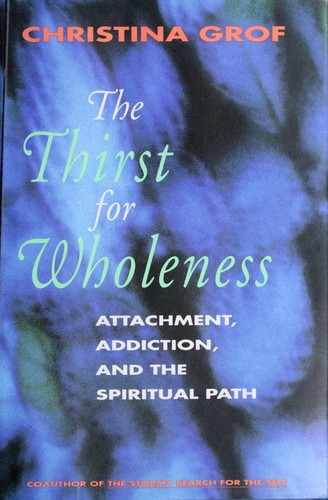
Christina Grof knew addiction from the inside. A recovering alcoholic and co-developer (with Stanislav Grof) of Holotropic Breathwork, she wrote The Thirst for Wholeness at the intersection of personal recovery, transpersonal psychology, and contemplative tradition. The result is one of the few books in the addiction literature that takes seriously a proposition most clinical frameworks avoid: that the addict is not seeking oblivion but seeking God, and that the tragedy of addiction lies not in the seeking but in the vehicle chosen for the search.
The Misdirected Mystic
Grof’s foundational claim is that human beings carry an innate drive toward transcendence — a hunger for experiences that dissolve the boundaries of the isolated ego and restore a felt sense of connection to something larger. In cultures that provide ritual containers for this drive, vision quests, initiatory ordeals, contemplative practices, the hunger finds legitimate expression. In cultures that do not, the hunger persists but the channels narrow. Alcohol and drugs offer a chemical shortcut to states that resemble mystical experience: boundary dissolution, oceanic feeling, the temporary cessation of psychic pain. The first drink, for the person who becomes alcoholic, often produces precisely this effect — a flooding warmth, a sudden belonging, a sense that the unbearable gap between self and world has closed (Grof, 1993).
The problem is pharmacological and existential at once. The substance delivers the experience but degrades the vessel that receives it. Each repetition erodes the nervous system’s capacity to generate the states organically. What began as a glimpse of wholeness becomes a machinery of fragmentation. The addict is trapped in a loop: the very thing that once opened the door now seals it shut, and the memory of what was glimpsed drives the compulsion to try again.
Spiritual Emergency and the Initiatory Frame
Grof’s second major contribution is the concept of spiritual emergency applied to addiction. Developed originally to describe crises triggered by meditation, breathwork, or spontaneous kundalini awakening, the spiritual emergency framework distinguishes between breakdown and breakthrough. The same symptoms — disorientation, ego dissolution, overwhelming affect, encounter with transpersonal content — can indicate either psychotic decompensation or genuine developmental transformation. The difference lies not in the symptoms but in the container available to hold them.
Applied to addiction, this framework produces a radical reorientation. The alcoholic’s descent — the loss of control, the confrontation with powerlessness, the annihilation of the ego’s pretensions — mirrors the structure of initiatory death found across world mythology. The initiate enters the underworld, is stripped of identity, and returns transformed. The alcoholic enters the same territory but without a guide, without a ritual frame, without a community of elders who have made the journey and can name what is happening. Alcoholics Anonymous, in Grof’s reading, succeeds precisely because it provides this missing container. The sponsor is the guide. The meeting is the ritual space. The steps are the initiatory sequence. The Higher Power is the transpersonal reference point that reorients the seeker away from the bottle and toward the genuine source of what was always being sought (Grof, 1993).
The Body as Threshold
Grof does not neglect the somatic dimension. The thirst she describes is not abstract — it registers in the body as restlessness, agitation, a nameless ache that the addict learns to interpret as the need for a drink. This is an interoceptive phenomenon. The body signals that something is missing, and the addict, having lost (or never developed) the capacity to read those signals accurately, reaches for the substance that provides immediate but false relief. Recovery, in Grof’s model, involves relearning how to inhabit the body without fleeing from what it communicates. Meditation, breathwork, movement, and somatic therapy all function as practices that restore the connection between the organism and its own inner states — the feeling function reawakened through disciplined attention.
The convergence with depth psychology is direct. Jung’s letter to Bill Wilson in 1961 identified the alcoholic’s craving as a spiritual thirst expressed in “low-level” terms — spiritus contra spiritum. Grof builds on this insight by providing a developmental and experiential account of how the thirst operates, how it becomes pathological, and how it can be redirected. The addict does not need to stop wanting. The addict needs to learn what is actually wanted.
Why This Book Endures
Three decades after publication, The Thirst for Wholeness remains one of the few texts that holds the clinical and the sacred in a single frame without reducing either to the other. Grof does not sentimentalize addiction, nor does she pathologize the spiritual impulse that fuels it. The book stands as a corrective to any recovery model that treats sobriety as an endpoint rather than a threshold — the beginning of the real work, which is the recovery of the capacity for genuine encounter with the numinous. For the alcoholic who always sensed that the drinking was about something larger than the drink, Grof’s work offers not validation but orientation: the thirst was real, the direction was wrong, and the path remains open (Grof, 1993).
Sources Cited
- Grof, C. (1993). The Thirst for Wholeness: Attachment, Addiction, and the Spiritual Path. HarperOne. ISBN 978-0-06-250314-5.
- James, W. (1902). The Varieties of Religious Experience. Longmans, Green. ISBN 978-0-14-039034-6.
- Peterson, C. (2024). The Shadow of a Figure of Light: The Archetype of the Alcoholic and the Journey to Enlightenment. Chiron Publications. ISBN 978-1-68503-517-4.