Seba.Health
Key Takeaways
- Huxley's mescaline experiment is not a report on drug effects but a sustained philosophical argument that ordinary consciousness is a reduction valve — and that the "Mind at Large" it filters out is the very reality depth psychology calls the unconscious, making *The Doors of Perception* an epistemological treatise disguised as autobiography.
- The book's most radical move is its insistence that chemically mediated experience carries the same ontological weight as contemplative or spontaneous mystical states, directly challenging the Cartesian partition between spirit and matter that both institutional religion and institutional science depend upon.
- Huxley frames perceptual intensification not as hallucination but as the removal of habitual ego-filtering, anticipating by two decades Hillman's archetypal psychology claim that the soul's food is direct experience and that every system we construct is a "crust that shields sensitivity from immediate exposure."
The Reducing Valve Is the Ego: Huxley’s Convergence with Depth Psychology’s Central Problem
Huxley’s governing metaphor — that the brain and nervous system function as a “reducing valve” filtering Mind at Large into the trickle necessary for biological survival — is not pharmacology. It is a theory of consciousness that maps directly onto the structural insight at the heart of Jungian and post-Jungian psychology: that ego-consciousness is a contraction, not a totality. When Huxley gazes at a vase of flowers and perceives “what Adam had seen on the morning of his creation — the miracle, moment by moment, of naked existence,” he is describing what James Hillman later calls the removal of “the crusts that shield sensitivity from immediate exposure.” Hillman, discussing mystical consciousness and even “the chemical ‘instant visions’ of Huxley,” identifies the same aim: to get through to “a direct experience of reality, things just as they are,” such that “the division between subjective awareness here and objective nature there disappears.” The reducing valve is not a biological curiosity. It is the ego’s defense system recast in neurological language. Huxley’s genius is to have made visible, in a single afternoon’s experiment, the psychic operation that analysis takes years to erode — the systematic exclusion of the numinous for the sake of functional coherence. Where Jung argued that the unconscious is vast and the ego a small island, Huxley provided the phenomenological proof: suspend the valve, and the ocean rushes in.
Chemically Conditioned Experience Is Still Experience: Huxley Against the Spirit-Matter Split
The most combative passage in the book addresses institutional religion’s objection that a drug-induced experience cannot be an encounter with the divine. Huxley’s rebuttal is precise and devastating: “all our experiences are chemically conditioned, and if we imagine that some of them are purely ‘spiritual,’ purely ‘intellectual,’ purely ‘aesthetic,’ it is merely because we have never troubled to investigate the internal chemical environment at the moment of their occurrence.” This argument dismantles a pillar of Western dualism. It refuses the clean separation between soma and psyche on which both materialist science and orthodox theology depend. Richard Tarnas, tracing the Uranus-Neptune archetypal cycle through modern cultural history, places Huxley’s Doors of Perception at the center of a “wave of cultural and spiritual impulses” during the 1950s — alongside D.T. Suzuki’s Zen lectures, the Beat movement, and the early psychedelic research of Stanislav Grof. For Tarnas, the book exemplifies the “special connection between the chemical and the spiritual — two seemingly distinct categories within the Neptunian archetypal complex.” Huxley is not merely defending mescaline. He is arguing that the body is itself a spiritual instrument, that the contemplatives who fasted, flagellated, and breathed in specific patterns were already chemists of consciousness. The implication for depth psychology is profound: if the boundary between chemical and spiritual is illusory, then the therapeutic encounter — with its somatic resonances, its hormonal surges of transference and countertransference — is always already a sacred operation, not a simulation of one.
Perception as Soul-Making: What Huxley Shares with Hillman’s Imaginal Turn
The heart of the book is not the exotic visions but the transfiguration of the ordinary. A chair, a fold of cloth, a garden seen through a glass door — these become saturated with significance not because the drug adds something but because it removes the conceptual screen that normally stands between perceiver and perceived. Huxley calls this screen “the world of selves, of time, of moral judgments and utilitarian considerations.” Hillman’s archetypal psychology arrives at the same diagnosis from a different direction. In Re-Visioning Psychology, Hillman argues that “fantasy-images are both the raw materials and finished products of psyche” and that every perception must pass through psychic organization to happen at all. Huxley’s mescaline simply short-circuits the habitual organization, revealing the imaginal richness that Hillman insists is always present beneath the ego’s flattening gaze. Both thinkers converge on a single point: the poverty of modern consciousness is not a deficit of information but a surplus of filtering. Where Hillman calls for “soul-making” through the deepening of events into experiences, Huxley demonstrates that the perceptual apparatus itself can be the site of that deepening — that seeing is already, under the right conditions, a form of contemplation. The resonance extends to Hillman’s critique in The Soul’s Code of cultures that have lost the capacity to discriminate among invisibles: “a certain blinding of one eye and an opening of the other to elsewhere.” Huxley’s experiment is precisely this — a deliberate blinding of the utilitarian eye so that the contemplative eye can open.
The Gnostic Undercurrent: Huxley and the Pansophic Tradition
Stephan Hoeller’s account of Jung as a link in the Pansophic chain — the transmission line running from Valentinus through alchemy to modern depth psychology — illuminates an aspect of Huxley that criticism often neglects. Huxley was not a casual experimenter but a deeply read student of mystical traditions. His references to Meister Eckhart’s Istigkeit (is-ness), to the Dharma-Body of the Buddha, to Platonic participation are not literary decoration. They position the mescaline experience within the perennial Gnostic project: direct knowing (gnosis) as opposed to mediated belief (pistis). Hoeller writes that “depth psychology thus became the logical conclusion of an age-long process” bringing the Pansophic tradition into modernity. Huxley’s contribution is to insist that this process need not be confined to the analytic hour or the meditation cushion — that the doors can be opened chemically, and that what enters is the same reality the alchemists sought to distill. This is the claim that makes the book permanently controversial and permanently indispensable.
Why This Book Still Matters
For anyone encountering depth psychology today, The Doors of Perception performs a function no other text does: it makes the phenomenology of the unconscious empirically immediate. Jung theorized the numinous; Hillman re-imagined it; Grof mapped its cartography in non-ordinary states. But Huxley, in seventy spare pages, rendered the moment of ego-dissolution in prose so lucid that the reader can almost undergo it vicariously. The book is a bridge between the consulting room and the temple, between neuroscience and mysticism, between the chemical substrate of experience and its irreducible meaning. It does not replace the long work of analysis — Huxley himself acknowledged that the mescaline vision grants no ethical transformation — but it demolishes the false walls that keep disciplines of consciousness sealed off from one another. In an era when psychedelic-assisted therapy is re-entering clinical practice, Huxley’s 1954 testimony remains the clearest articulation of what is at stake: not the drug, but the door, and the courage to walk through it.
Sources Cited
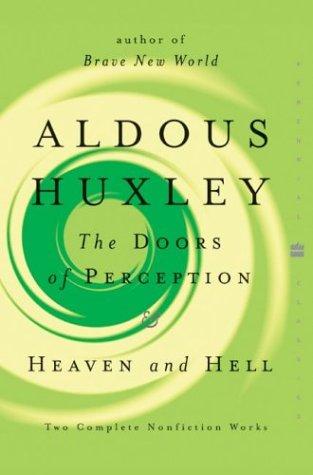
- Huxley, A. (1954). The Doors of Perception. Chatto & Windus. ISBN 978-0-06-059518-2.
- Carhart-Harris, R. L., Erritzoe, D., Williams, T., Stone, J. M., Reed, L. J., Colasanti, A., ... & Nutt, D. J. (2012). Neural correlates of the psychedelic state as determined by fMRI studies with psilocybin. Proceedings of the National Academy of Sciences, 109(6), 2138–2143.
- James, W. (1902). The Varieties of Religious Experience: A Study in Human Nature. Longmans, Green.