 Seba.Health
Key Takeaways
- Campbell's diffusionist argument in *Oriental Mythology* is not primarily historical but depth-psychological: the transmission of mythological motifs from Sumer outward reveals the universality of the psychic substrate that receives and transforms them, not merely the fact of cultural contact.
- By framing Upanishadic, Taoist, and Buddhist thought as mythology operating at its highest register of conscious self-awareness, Campbell inverts Eliade's developmental model and positions philosophical vocabulary as a technically mastered form of archaic mythological instrument.
- *Oriental Mythology* occupies a structurally paradoxical position in the tetralogy: it is simultaneously the most admiring and the most diagnostically critical of the four volumes, because the Oriental ideal of dissolving the individual into the cosmic order directly contradicts Campbell's own deepest valuation of individuation.
The Orient as a Single Mythological Province: Campbell’s Most Architecturally Ambitious Claim
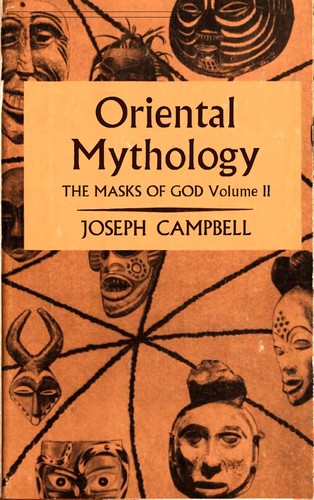
When Campbell declared in the Foreword to The Masks of God that Oriental mythology comprises “that broad and various, yet essentially unified, major province represented by the philosophical myths and mythological philosophies of India, Southeast Asia, China, and Japan — to which can be joined the earlier yet closely related mythological cosmologies of archaic Mesopotamia and Egypt,” he was not offering a table of contents. He was asserting a structural thesis that most scholars of any single tradition would reject on sight: that these civilizations share not merely overlapping motifs but a common mythological grammar whose generative logic can be traced to the hieratic city-states of the fourth millennium B.C. Oriental Mythology exists to substantiate that claim. The book tracks the diffusion of cosmological mathematics — the planetary associations, the number symbolism, the zodiacal imagery — from Sumer outward, arguing that the great philosophical traditions of India and China are elaborations upon, not replacements for, the archaic mythological order first crystallized in Mesopotamia. This is Campbell’s version of what Adolf Bastian called the Völkergedanken in dynamic relationship with the Elementargedanken: the local ethnic inflections are real, but they are inflections of a single score. The “single symphony” metaphor from his Foreword — “with its themes announced, developed, amplified and turned about, distorted, reasserted” — is not decorative language. It is the operational model of the entire volume.
Mythology as Conscious Philosophical Control, Not Primitive Projection
The decisive intellectual move of Oriental Mythology depends upon a distinction Campbell established in The Hero with a Thousand Faces and deepened in Primitive Mythology: the difference between myth as spontaneous dream-product and myth as deliberate pedagogical instrument. In Hero, he insisted that the mythological traditions “are not the spontaneous products of sleep” but rather “consciously controlled” picture-languages, and that “the trance susceptible shaman and the initiated antelope priest are not unsophisticated in the wisdom of the world.” Oriental Mythology radicalizes this point. The Upanishadic identification of Ātman and Brahman, the Taoist dissolution of contraries, the Buddhist emptying of all conceptual categories — these are presented not as philosophical advances beyond mythology but as mythology operating at its highest register of conscious self-awareness. Where Mircea Eliade, in The Sacred and the Profane, tended to frame archaic ontology as a mode of being superseded by historical consciousness, Campbell argues the reverse: the great Oriental systems represent mythological thinking that has become fully transparent to itself. The philosophical vocabularies of Śaṅkara or Lao-tzu are, in Campbell’s reading, the equivalent of what he elsewhere calls upadhis — the “attributes” or “deceptive limitations” assigned to the unlimited so that the mind can approach it — wielded now with complete technical mastery. This is why the volume treats the Bṛhadāraṇyaka Upaniṣad and the cosmogonic myth of Tiamat within the same analytical framework: they are expressions of identical structural imperatives at different levels of self-reflexive articulation.
The Individual Swallowed by the Cosmic Order: The Oriental Dilemma Campbell Cannot Resolve
The tension that gives Oriental Mythology its dramatic force — and that links it directly to the argument of Creative Mythology — is Campbell’s ambivalence about the very traditions he so meticulously documents. The Oriental mode, as he presents it, is one in which the individual is dissolved into the cosmic rhythm: the goal is identification with the transpersonal ground, whether called Brahman, Tao, or Śūnyatā. The mythological apparatus — the temple architectures, the ritual calendars, the mandalic cosmographies — exists to achieve precisely this dissolution. Campbell admires the grandeur of the achievement, yet his entire intellectual trajectory, from the monomyth’s emphasis on the hero’s return to the secular world to his later celebration of creative individuation in the Western literary tradition, pulls him toward a fundamentally different valuation. In Primitive Mythology, he had already established that the “mythogenetic zone” is ultimately the individual human body and psyche — “the creator and destroyer, the slave and yet the master, of all the gods.” Oriental Mythology thus occupies a paradoxical position within the tetralogy: it is simultaneously the most admiring and the most diagnostically critical of the four volumes, because it presents traditions that achieve the highest mythological integration at the cost of what Campbell, following his reading of Jung’s individuation process, regards as the essential modern task — the differentiation of the individual from the collective mythological field. This is precisely the ground that Erich Neumann explored in The Origins and History of Consciousness, where the hero’s separation from the uroboric matrix is the precondition for psychological development. Campbell and Neumann are tracking the same problem from opposite ends: Neumann from the developmental psychology of ego-formation, Campbell from the comparative morphology of mythological systems.
Diffusionism as Depth-Psychological Method
One of the most frequently misunderstood aspects of Oriental Mythology is its diffusionist argument — the claim that specific mythological complexes (the dying-and-rising god, the world-tree, the cosmic sacrifice) traveled historically from Sumer and Egypt into India, China, and beyond. Critics from the Eliadean school and from cultural anthropology have accused Campbell of flattening cultural specificity. But the diffusionist argument in this volume is not primarily historical; it is depth-psychological. Campbell uses the archaeological and philological evidence of diffusion to demonstrate that when a mythological motif is transplanted into a new cultural matrix, it does not merely survive — it activates latent psychic potentials specific to the receiving culture. The motif of the sacrificed cosmic giant, for instance, appears in the Babylonian Tiamat, the Vedic Purusha, the Icelandic Ymir, and the Australian Karora, each time reconfigured according to what Campbell, drawing on Bastian, calls the local “ethnic idea.” The diffusion is real, but what it reveals is the universality of the psychic substrate that receives and transforms the transmitted image. This is why Oriental Mythology must be read in tandem with Primitive Mythology: the first volume establishes the innate releasing mechanisms and imprinting structures that make mythological reception possible; the second shows those structures in their most elaborate cultural operation.
Why This Book Matters Now
For anyone navigating depth psychology today — particularly the Jungian tradition’s engagement with Eastern thought — Oriental Mythology provides an indispensable corrective to two opposite errors. It prevents the naïve equation of Eastern philosophical traditions with “pure spirituality” by showing their roots in the same archaic mythological complexes that produced blood sacrifice and ritual regicide. And it prevents the dismissal of those traditions as culturally alien by demonstrating their structural continuity with the Western mythological inheritance. No other single work maps the full circuit from Sumerian temple astronomy through Vedāntic metaphysics to Ch’an Buddhist paradox with this combination of philological precision and psychological depth. It remains the essential bridge text between Campbell’s archetypal morphology and the tradition-specific scholarship of Heinrich Zimmer, Ananda Coomaraswamy, and the Eranos circle.
Sources Cited
- Campbell, J. (1962). *Oriental Mythology: The Masks of God, Volume II*. Viking Press.
- Campbell, J. (1949). *The Hero with a Thousand Faces*. Pantheon Books.
- Campbell, J. (1959). *Primitive Mythology: The Masks of God, Volume I*. Viking Press.
- Campbell, J. (1968). *Creative Mythology: The Masks of God, Volume IV*. Viking Press.
- Eliade, M. (1957). *The Sacred and the Profane*. Harcourt, Brace & World.
- Neumann, E. (1954). *The Origins and History of Consciousness*. Pantheon Books.