 Seba.Health
Key Takeaways
- Campbell's subtitle is not decorative but diagnostic: "metaphor as myth" names the anagogical reading that opens inner space, while "metaphor as religion" names the literalist collapse that forecloses it — making the book a sustained argument that the entire Judeo-Christian-Islamic tradition has been systematically misreading its own symbolic language.
- The book recasts the Space Age not as a technological event but as a mythopoetic threshold: the Apollo missions did not merely expand the physical horizon but annihilated the very concept of horizon, thereby rendering every locally bounded mythology obsolete and demanding a planetary consciousness that is simultaneously cosmological and intrapsychic.
- By grounding archetypes in the psychophysiological constancy of Homo sapiens sapiens across forty millennia, Campbell collapses the distance between Bastian's Elementargedanken and Jung's collective unconscious into a single bioenergetic claim — making mythology not a cultural product but a species-level organ of perception.
The Space Age Destroyed Not a Boundary but the Concept of Boundary Itself
Campbell’s opening gambit — the astronaut’s reply “Newton!” to Houston’s query about navigation — is not anecdotal color. It is the book’s epistemological thesis compressed into a single word. Kant’s doctrine that the laws of space are a priori, native to the mind before experience, becomes Campbell’s foundation for asserting that mythology, too, is a priori: not a cultural acquisition but a species-level readiness awaiting activation through metaphor. The Apollo missions, for Campbell, did not simply push the frontier outward; they abolished the frontier as a category. “No More Horizons,” the theme he had first articulated in Myths to Live By (1972), here receives its fullest elaboration. When the earth is seen from the moon, no national boundaries appear, but more radically, no center appears either. The Jerusalem-centered cosmos of II Kings, the Ptolemaic crystalline spheres, even the heliocentric model — all were organized around a privileged vantage point from which a horizon could be drawn. The planetary image from space offers no such privilege. Campbell presses this observation beyond geopolitics into ontology: if there is no spatial center, there can be no ethnically owned deity, no locally authorized cosmogony, no scripture that speaks for the whole by speaking from one place. The “inconceivable immensity of galaxies, clusters of galaxies, and clusters of clusters” that he catalogs is not mere cosmic awe; it is the demolition equipment for every territorial theology.
Denotation Is the Pathology; Connotation Is the Cure
The distinction between denotation and connotation is the central diagnostic instrument of this book, more precise than anything Campbell had previously deployed. When a metaphor is read denotatively — the Virgin Birth as a gynecological event, the Ascension as a literal journey upward through atmosphere — its spiritual charge collapses into historical debris. When read connotatively, it opens what Campbell calls “inner space”: the psyche’s own depth, which the metaphor was always addressing. This is not a soft hermeneutic preference; Campbell frames it as the fundamental error of Western religious exegesis. “For some reason which I have not yet found anywhere explained,” he writes, “the popular, unenlightened practice of prosaic reification of metaphoric imagery has been the fundamental method of the most influential exegetes of the whole Judeo-Christian-Islamic mythic complex.” The charge is devastating in its scope. It indicts not marginal fundamentalism but mainline tradition. His companion text Thou Art That, assembled posthumously from lectures overlapping this period, drives the point with brutal specificity: the Promised Land “refers not to a geographical location but to the territory of the human heart.” Here Campbell aligns with Meister Eckhart’s apophatic tradition and with Jung’s insistence in Aion that Christ is a symbol of the Self, not a historical personality to be imitated but an archetypal image to be realized. Where Jung remained cautious about declaring religion’s interpretive apparatus broken, Campbell announces the diagnosis without diplomatic reserve.
Mythology as Biology: The Forty-Thousand-Year Constant
Campbell’s most radical move in this book — easily missed beneath the cosmological spectacle — is his insistence that archetypes are not merely psychological but psychophysiological. “The bioenergetic system of the one species, Homo sapiens sapiens, is and has been for some 40 millennia a constant.” This is not Jungian orthodoxy; it is a harder claim. Bastian’s Elementargedanken become not cultural universals floating in a shared ideational space but biological invariants rooted in the organs, the nervous system, the body itself. The prologue, “Myth and the Body,” stakes this ground explicitly: “myths and dreams are motivated from a single psychophysiological source — namely, the human imagination moved by the conflicting urgencies of the organs (including the brain) of the human body.” This biologization of archetype theory anticipates the later neuroscience of Jaak Panksepp’s affective systems and moves Campbell closer to Stanislav Grof’s perinatal matrices than to Hillman’s imaginal psychology, which deliberately de-literalizes the body. It also explains Campbell’s confidence that a planetary mythology is not merely desirable but inevitable: if the elementary ideas are species-wide biological facts, then the dissolution of local ethnic inflections does not destroy myth but liberates it. The artist — whom Campbell identifies as the modern shaman — becomes the agent of this liberation, casting new metaphors from contemporary experience that touch the same forty-thousand-year-old substrate.
Art as the Organ of Mythological Renewal
Chapter 3, “The Way of Art,” completes the argument by identifying the esthetic mode of perception as the precondition for mythological experience. Drawing on Coomaraswamy’s distinction between desi (provincial) and marga (spiritual path) art, and on Blake’s dictum about cleansed doors of perception, Campbell argues that the nonjudgmental seeing proper to art is identical to the mode of consciousness that allows things to become “transparent to transcendence.” This is not art criticism; it is a theory of consciousness. The artist does not illustrate myths — the artist generates the metaphorical field within which myth can operate. Jean Erdman’s dance, James Joyce’s verbal cosmos in Finnegans Wake, the astronaut’s photograph of Earth: these are equivalent operations. Each produces an image that pitches consciousness past its own categories. Novalis’s aphorism — “The seat of the soul is there, where the outer and the inner worlds meet” — becomes the book’s operative definition of mythological space itself.
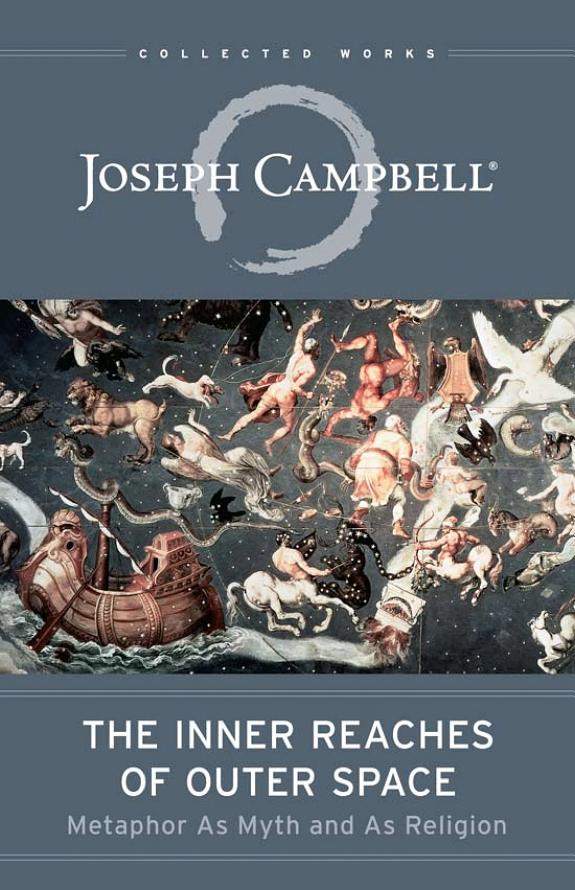
For a reader encountering depth psychology today, The Inner Reaches of Outer Space does something no other book in the tradition accomplishes: it provides a rigorous semiotic theory of why religious symbols fail and what conditions are required for their renewal. It is not a survey of myths, not a retelling of hero journeys, but a diagnosis of symbolic pathology and a prescription — grounded simultaneously in Kantian epistemology, Jungian archetype theory, and comparative cosmology — for re-opening the connotative dimension that institutional religion has sealed shut. No other text in Campbell’s corpus, and no text in the broader Jungian library, makes this argument with such compressed force.
Sources Cited
- Campbell, Joseph (1986). The Inner Reaches of Outer Space: Metaphor as Myth and as Religion.