Seba.Health
Key Takeaways
- Vernant demonstrates that Greek rational thought did not emerge as a rupture from myth but as a structural transposition of mythic categories into a new register—the political space of the *polis*—making the birth of reason inseparable from the birth of democratic publicity.
- The book dismantles the "Greek miracle" narrative by showing that the Mycenaean palace system, with its divine king and scribal secrecy, had to collapse entirely before *logos* could replace *mythos* as the organizing principle of collective life.
- Vernant reveals that the concept of *physis* (nature) and the first philosophical *arche* are not proto-scientific discoveries but secularizations of sovereignty—the cosmic order mirrors the political order of equals deliberating in the open, not the hierarchical decree of a hidden king.
The Birth of Reason Is a Political Event, Not an Intellectual One
Jean-Pierre Vernant’s The Origins of Greek Thought makes a single, devastating argument: philosophy did not arise because certain gifted individuals began thinking more clearly. It arose because a specific social structure—the polis—created a form of human relationship in which public, egalitarian speech replaced the secret, hierarchical word of the Mycenaean palace. The Milesian philosophers did not discover nature; they relocated sovereignty from the divine king to the cosmic center, from the hidden chamber to the open agora. Vernant traces how the collapse of Mycenaean palatial civilization—with its wanax (divine sovereign), its redistributive economy, its Linear B scribal apparatus serving royal monopoly on knowledge—created a power vacuum that was filled not by a new king but by a new form of social space. The circle of warrior-equals who replaced the king’s court became the template for the circle of citizens, and the cosmos imagined by Thales, Anaximander, and Anaximenes is structurally identical to this political arrangement: no privileged center, no hidden sovereign, but elements in balanced, reciprocal relation. Where Edward Edinger reads the Milesian concept of physis as the psyche’s first projection of the separation between subject and object—“the discovery of physis, nature, means that one has perceived the separation between subject and object”—Vernant insists the prior condition is sociological. The ego does not separate from nature in a vacuum; it separates within a community that has already deposed the sacred king and made knowledge a public possession.
Myth Does Not Die—It Is Geometrized
Vernant’s most subtle contribution is his refusal of the standard Enlightenment narrative in which mythos is superseded by logos. He shows instead that the categories of early Greek philosophy—the elements, the opposites, the cycle of generation and destruction—are direct transpositions of Hesiodic theogonic structures into a new, depersonalized idiom. The cosmic genealogies of the Theogony, where deities beget and overthrow one another, become in Anaximander’s cosmology a system of impersonal powers that “pay penalty and retribution to each other for their injustice according to the assessment of time.” The language is juridical, not mythological, yet the deep structure—powers in dynamic tension, regulated by a principle of cosmic justice (dikē)—is identical. This insight has profound implications for depth psychology. Edinger, following F. M. Cornford, notes that Empedocles’ four rhizomata still carry the names of deities—“Zeus, Hera, Hades, and Nestis”—calling this “a transition stage in which philosophical concepts are still mixed with their personified, mythological origins.” Vernant would sharpen this: it is not a transitional embarrassment but the permanent structure of Greek thought. The philosophical concept never fully escapes its mythic matrix; it geometrizes it. James Hillman grasps this from the other side when he writes that “we return to Greece in order to rediscover the archetypes of our mind and of our culture.” But where Hillman treats Greece as an imaginal landscape—“a differentiated archipelago of locations, where the Gods are and not when they were or will be”—Vernant insists on the historical specificity of the transformation. The gods did not simply move to an archetypal elsewhere; they were reconstituted as abstract principles within a concrete political revolution.
Secularization of the Word Is the True “Greek Miracle”
The deepest layer of Vernant’s argument concerns language itself. In the Mycenaean system, the royal word was performative, secret, and sacred: the king’s decree created reality because the king participated in divine sovereignty. With the polis, speech became public, contested, and rhetorical. Knowledge was no longer something revealed to a privileged functionary but something argued before equals. This secularization of the word—its transfer from ritual efficacy to dialectical persuasion—is what makes philosophy possible. Vernant shows that writing, which in the palace served the closed circuit of royal administration, became in the polis an instrument of publicity: laws were inscribed on stone and placed in the center of the city for all to read. Erich Neumann’s The Origins and History of Consciousness describes an analogous process at the intrapsychic level: consciousness evolves by wresting content from the unconscious, making visible what was hidden, differentiating what was fused. Vernant provides the sociohistorical correlate. The ego does not simply “emerge from participation mystique,” as Edinger puts it; it emerges into a specific kind of community that rewards articulation, contestation, and the submission of private vision to public scrutiny. The philosophical logos is born not in solitary contemplation but in the agonistic space between speakers.
Why Vernant Remains Indispensable for Depth Psychology
Stephan Hoeller traces the “Pansophic tradition” from classical antiquity through Gnosticism to Jung, treating the history of Western interiority as a continuous esoteric transmission. Vernant offers a necessary corrective: the Greek contribution to the Western psyche is not only an interior, mystical one but a structural and political one. The capacity for self-reflection that depth psychology presupposes—the ability to stand outside one’s own experience, to treat inner contents as objects of inquiry—has its historical origin in the Greek invention of public reason. Without the polis, there is no Socratic maieusis, no Platonic anamnesis, no Aristotelian entelecheia. Vernant does not reduce thought to politics; he shows that a particular form of collective life generated the conceptual space within which the psyche could become an object of investigation for the first time. For anyone practicing or studying depth psychology today, this book provides something no intrapsychic account can: the material, institutional, and political conditions under which the soul first became thinkable as soul. It is the missing ground beneath every Jungian amplification of Greek philosophy—the reason the Greeks could articulate archetypes at all.
Sources Cited
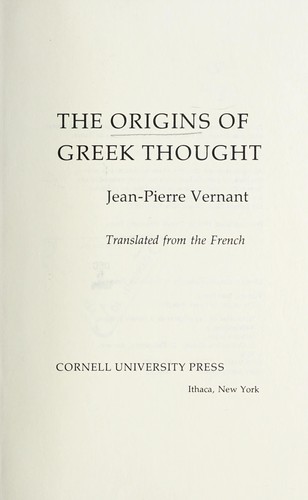
- Vernant, J.-P. (1982). The Origins of Greek Thought. Trans. from the French. Cornell University Press.
- Vernant, J.-P. (1983). Myth and Thought Among the Greeks. Routledge.
- Detienne, M. (1996). The Masters of Truth in Archaic Greece. Zone Books.