Seba.Health
Key Takeaways
- Nagy demonstrates that Achilles and Odysseus are not literary characters invented by a single poet but cultural institutions forged through centuries of oral tradition — the hero is a communal product, not an individual creation.
- The concept of kleos aphthiton (unwithering glory) reveals that Homeric heroism is inseparable from the poetic tradition that preserves it, binding the hero's inner life to the collective memory of the community.
- Nagy's oral-traditional framework reframes thumos not as private interiority but as a psychic organ shaped by — and expressed through — the formulas, themes, and performance contexts of communal epic.
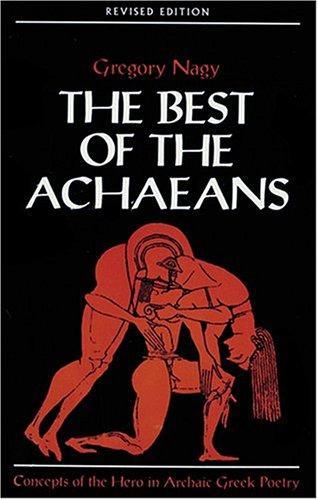
Gregory Nagy’s The Best of the Achaeans arrived in 1979 and permanently altered the terms on which Homeric scholarship operates. The book’s central provocation is that Achilles and Odysseus are not characters in the modern literary sense — not products of a single authorial imagination. They are institutions. Each hero represents a crystallization of communal values, forged not in a writer’s study but across generations of oral performance, refined by the selective pressures of audience response, ritual context, and the formulaic demands of the hexameter line. The Homeric hero is not invented. The Homeric hero is grown, like a metal worked through repeated heating and hammering until it holds an edge that no single smith designed. For depth psychology, this reframing carries implications that have gone largely unexamined.
The Hero as Cultural Institution
Nagy builds on the oral-formulaic theory of Milman Parry and Albert Lord, which demonstrated that Homeric poetry was composed in performance using a system of traditional formulas — metrically shaped phrases carrying semantic weight accumulated across centuries of use. A phrase like podas ōkus Achilleus (“swift-footed Achilles”) is not a decorative epithet chosen for a particular scene. It is a traditional marker that activates the entire complex of associations the audience has built around Achilles through a lifetime of hearing the tradition performed. The formula carries more meaning than any single instantiation can exhaust, and that surplus meaning is the product of communal transmission, not individual composition.
Nagy extends this insight from the level of the phrase to the level of the hero. Achilles is not a character who happens to appear in traditional poetry. Achilles is the tradition’s way of crystallizing a particular configuration of values — the hero who chooses a short life with glory over a long life without it, whose mēnis (wrath) structures the Iliad’s entire narrative, and whose death, though it occurs outside the poem’s frame, governs every episode within it. Odysseus represents the complementary configuration: the hero of mētis (cunning intelligence), of survival, of the long return. Together, they do not exhaust the possibilities of Homeric heroism so much as they define its poles: the incandescent intensity of Achilles against the enduring adaptability of Odysseus. The tradition maintains both because the community needs both.
The depth-psychological resonance is immediate. Jung’s concept of the archetype describes a pattern of psychic organization that is not the product of individual experience but of collective, transgenerational transmission. The archetype does not exist in any single instantiation; it exists in the pattern that persists across instantiations, shaping individual experience while exceeding any individual’s capacity to contain it. Nagy’s hero functions identically: Achilles as performed in any single epic event is one instantiation of a traditional pattern that no single performance exhausts. The hero is an archetype in the strict Jungian sense — a structuring pattern maintained by the collective and activated through participatory engagement.
Kleos Aphthiton and the Metabolism of Grief
Nagy’s analysis of kleos aphthiton, “unwithering glory”, traces the mechanism through which the hero’s inner life becomes a communal possession. Kleos is not fame in the modern sense of celebrity or reputation. It is the glory that lives in the song, the verbal monument that the epic tradition builds around the hero’s defining acts. Achilles’ choice of a short life with kleos is not a decision about personal preference. It is a covenant with the tradition itself: Achilles exchanges biological survival for survival in the collective memory, and the Iliad is the instrument through which that exchange is ratified.
The psychological dimension of this exchange centers on penthos — grief. Nagy demonstrates that the hero’s grief and the community’s grief are structurally inseparable. When Achilles mourns Patroclus, the narrative stages an eruption of sorrow so total that it threatens to dissolve the hero’s capacity to function. The thumos is overwhelmed, not with anger alone but with a grief that registers in the body as physical agony, as the refusal of food, as the embrace of a corpse that has become the only remaining object of attachment. This is not literary embellishment. It is the tradition’s way of encoding the phenomenology of traumatic loss in formulaic language precise enough to be re-experienced in performance.
The audience’s participation in that grief, through the structured emotional engagement that performance demands, constitutes what depth psychology would call a collective metabolization of affect. The community does not merely hear about Achilles’ loss. The community, through the medium of the performed epic, undergoes a version of that loss, processes it through the body’s own affective systems, and emerges on the other side of the narrative with the grief partially integrated. The thumos of the audience mirrors the thumos of the hero, and the mirroring is the therapeutic mechanism. Nagy does not use clinical language, but the structure he describes — communal affect regulation through narrative participation, maps directly onto the dynamics of group process and the shared affective field that depth-oriented clinicians recognize as the container.
Oral Tradition and the Shaping of Thumos
The most far-reaching consequence of Nagy’s framework for the study of thumos is methodological. If Homeric poetry is not the product of a single author’s imagination but the sedimented output of centuries of oral performance, then the psychological vocabulary preserved in that poetry, thumos, phrenes, noos, menos, cannot be read as one poet’s idiosyncratic terminology. These terms carry the weight of communal usage. They have been tested, refined, and maintained because they name something the community recognizes as real. When Homer says that Achilles’ thumos is divided, or that Odysseus speaks to his own thumos in deliberation, the formula survives because it accurately maps an experience that audiences across generations verify through their own embodied recognition.
This transforms thumos from a literary curiosity into a piece of psychological evidence. The oral tradition functions as a natural experiment in collective validation: formulas that fail to resonate with audience experience drop out of the tradition; formulas that name something true persist. The persistence of thumos across the entire range of Homeric poetry — in contexts of rage, grief, desire, deliberation, and moral conflict — demonstrates that the tradition recognized a single psychic organ operating across the full spectrum of embodied evaluation. Thumos is not an abstraction imposed by a poet. It is a communal discovery, verified through generations of participatory performance, describing the body’s own evaluative intelligence.
Nagy and the Genealogy of the Feeling Function
Nagy’s work provides the missing link between Harrison’s ritual hypothesis and the individualized thumos psychology of the Iliad. Harrison showed that Greek religious consciousness originates in collective bodily enactment. Snell showed that the Homeric self distributes interiority across somatic organs. Nagy demonstrates the mechanism that connects the two: oral tradition, operating through formulaic language and performed narrative, translates communal somatic experience into the individualized psychological vocabulary that Homer’s heroes employ. The hero’s thumos is not a private possession. It is the tradition’s deposit in the individual — the communal body’s intelligence precipitated into a single chest.
For the project of tracing the feeling function from Homer through Jung to contemporary interoceptive science, Nagy’s contribution is indispensable. The feeling function does not originate in the individual. It originates in the collective, is shaped by participatory practice, and is deposited in the individual body as an organ of evaluative response that carries more than any single life can account for. That is what thumos is. That is what Nagy’s Achilles, the best of the Achaeans, embodies and — through the unwithering glory of the tradition — transmits.
Sources Cited
- Nagy, G. (1979). The Best of the Achaeans: Concepts of the Hero in Archaic Greek Poetry. Johns Hopkins University Press. ISBN 978-0-8018-6015-7.
- Parry, M. (1971). The Making of Homeric Verse: The Collected Papers of Milman Parry. Oxford University Press.
- Lord, A. B. (1960). The Singer of Tales. Harvard University Press.
- Caswell, C. P. (1990). A Study of Thumos in Early Greek Epic. Brill.