 Seba.Health
Key Takeaways
- Armstrong presents the Buddha not as a deity or abstraction but as a historical figure whose primary insight was psychological: suffering has a structure, and that structure can be known.
- Buddhist psychology and depth psychology converge on the principle that transformation begins with unflinching attention to suffering rather than its avoidance.
- The doctrine of anatta (no-self) anticipates the Jungian recognition that the ego is not the center of the psyche — it is a construct that must be relativized for individuation to proceed.
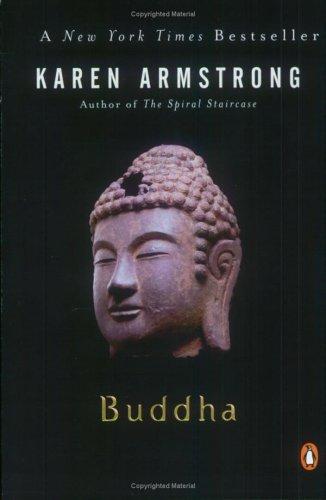
Karen Armstrong’s Buddha belongs to the Penguin Lives series, which constrains its authors to brevity, and that constraint turns out to be an advantage. What Armstrong delivers in fewer than two hundred pages is not a hagiography but a psychological portrait: the Buddha as a man who looked at suffering with the kind of sustained, unflinching attention that the depth psychological tradition would later recognize as the precondition for all genuine transformation.
Suffering as Structure
The biographical arc Armstrong traces is well known: the sheltered prince, the encounter with sickness, old age, and death, the renunciation, the years of extreme asceticism, the eventual turn toward a middle way. But Armstrong’s contribution is to read this arc psychologically rather than devotionally. The Buddha’s insight, as Armstrong presents it, was not metaphysical but diagnostic. Suffering (dukkha) is not a punishment or an accident. It has a structure, the Four Noble Truths, and that structure can be mapped, understood, and worked with. Armstrong frames the Buddha as a clinician of the human condition, someone whose genius lay not in revelation but in phenomenological precision (Armstrong, 2001).
This is precisely where Buddhist psychology and depth psychology converge. Both traditions insist that the path through suffering runs directly through its center, not around it. The addicted patient who numbs unbearable affect, the analysand who intellectualizes to avoid the body’s knowledge, the spiritual seeker who bypasses grief with premature transcendence: all are engaged in the same evasion that the Buddha identified as the root of continued suffering.
Anatta and the Relativization of the Ego
Armstrong gives careful attention to the doctrine of anatta — the teaching that there is no fixed, permanent self. This is the point where Western readers tend to recoil, because the entire architecture of modern selfhood assumes a stable ego at the center of experience. But the Buddhist teaching is not that there is no experience; it is that the experience does not belong to a permanent owner. The ego is a process, not an entity.
Jung arrived at a structurally similar insight through an entirely different route. The goal of individuation is not the strengthening of the ego but its relativization, its recognition that it is not the center of the psyche but a satellite orbiting a deeper organizing principle Jung called the Self (Jung, 1958). The language differs. The direction is the same.
Armstrong does not draw these parallels explicitly, but she does not need to. The psychological reader will recognize them on every page. Mark Epstein’s Thoughts Without a Thinker makes the connection explicit for those who want the bridge built out in clinical terms.
Sources Cited
- Armstrong, K. (2001). Buddha. Penguin Lives. ISBN 978-0-14-303436-5.
- Epstein, M. (1995). Thoughts Without a Thinker: Psychotherapy from a Buddhist Perspective. Basic Books.
- Jung, C. G. (1958). Psychology and Religion: West and East (CW 11). Princeton University Press.